KI-Beratung Beta

Gutscheinbedingungen

**Gültig vom 23.11. bis 30.11.2026 | Gültig für nicht preisgebundene fremdsprachige Bücher | Einzelne Artikel können ausgeschlossen sein | Online auf www.bücher.de einlösbar | Click & Collect nur mit Online-Zahlung (Paypal/Kreditkarte) vorab | Nicht kombinierbar mit anderen Gutscheinen oder Preisaktionen | Nur einmal pro Einkauf einlösbar | Gutschein wird auf max. 500€ Bestellwert angerechnet | Keine Barauszahlung | Nicht gültig für Versandkosten und Services

  • Produktbild: Emotions, Metacognition, and the Intuition of Language Normativity
  • Produktbild: Emotions, Metacognition, and the Intuition of Language Normativity
- 12%

Emotions, Metacognition, and the Intuition of Language Normativity Theoretical, Epistemological, and Historical Perspectives on Linguistic Feeling

12% sparen

148,99 € UVP 171,19 €

inkl. gesetzl. MwSt., Versandkostenfrei


Beschreibung

This book proposes a comprehensive discussion of the issue of linguistic feeling , the subject’s metalinguistic capacity to intuitively apprehend the normative – lexical, syntactic, morphological, phonological… – dimensions of a definite language he or she is acquainted with. The volume’s twelve contributions...

Beschreibung

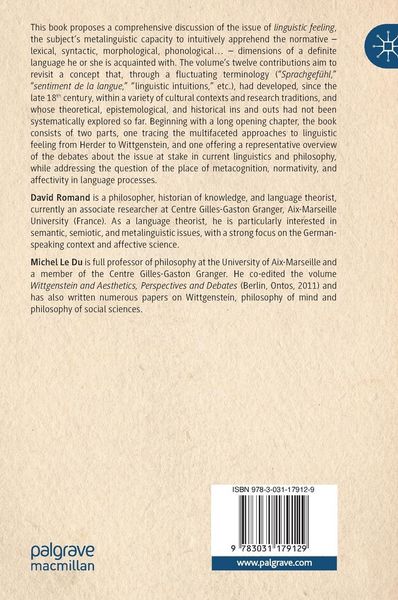
This book proposes a comprehensive discussion of the issue of
linguistic feeling
, the subject’s metalinguistic capacity to intuitively apprehend the normative – lexical, syntactic, morphological, phonological… – dimensions of a definite language he or she is acquainted with. The volume’s twelve contributions aim to revisit a concept that, through a fluctuating terminology (“
Sprachgefühl,”
“
sentiment de la langue
,” “linguistic intuitions,” etc.), had developed, since the late 18
th
century, within a variety of cultural contexts and research traditions, and whose theoretical, epistemological, and historical ins and outs had not been systematically explored so far. Beginning with a long opening chapter, the book consists of two parts, one tracing the multifaceted approaches to linguistic feeling from Herder to Wittgenstein, and one offering a representative overview of the debates about the issue at stake in current linguistics and philosophy, while addressing the question of the place of metacognition, normativity, and affectivity in language processes.

Portrait


David Romand
is a philosopher, historian of knowledge, and language theorist, currently an associate researcher at Centre Gilles-Gaston Granger, Aix-Marseille University (France). As a language theorist, he is particularly interested in semantic, semiotic, and metalinguistic issues, with a strong focus on the German-speaking context and affective science.


Michel Le Du
is full professor of philosophy at the University of Aix-Marseille and a member of the Centre Gilles-Gaston Granger. He co-edited the volume
Wittgenstein and Aesthetics, Perspectives and Debates
(Berlin, Ontos, 2011) and has also written numerous papers on Wittgenstein, philosophy of mind and philosophy of social sciences.


Produktdetails

Einband

Gebundene Ausgabe

Erscheinungsdatum

27.05.2023

Abbildungen

XIII, 367 p. 2 illus.

Herausgeber David Romand + weitere

Produktdetails

Einband

Gebundene Ausgabe

Erscheinungsdatum

27.05.2023

Abbildungen

XIII, 367 p. 2 illus.

Herausgeber
Verlag Springer
Seitenzahl

367

Maße (L/B/H)

21,6/15,3/2,6 cm

Gewicht

569 g

Auflage

2023

Sprache

Englisch

ISBN

978-3-031-17912-9

Herstelleradresse

Springer-Verlag GmbH
Europaplatz 3
69115 Heidelberg
DE

Email: ProductSafety@springernature.com

Noch keine Bewertungen vorhanden

Verfassen Sie die erste Bewertung zu diesem Artikel

Helfen Sie anderen Kundinnen und Kunden durch Ihre Meinung.

Kundinnen und Kunden meinen

Bewertungen (0)

  • Produktbild: Emotions, Metacognition, and the Intuition of Language Normativity
  • Produktbild: Emotions, Metacognition, and the Intuition of Language Normativity

  • 1. Introduction.- Part I Cross-disciplinary Approaches to Linguistic Feeling from Herder to Wittgenstein.- 2. “What the Germans Call
    Sprachgefühl
    .”
    Sprachgefühl
    in Early German Linguistics. Selected Examples of Ways of Understanding.- 3. Assent, Sentiment and Linguistic Feeling in Jac. van Ginneken’s Psycholinguistics.- 4. On the Normative Side of Saussure’s “Linguistic Feeling”.- 5. Sapir's
    Form-Feeling
    and its Historical Context.- 6. Edward Sapir: Form-Feeling in Language, Culture, and Poetry.- 7. Meaning-Blindness, and Linguistic Feeling: Wittgenstein on How We “Experience” Meaning.- Part II Current Scientific and Philosophical Perspectives on Linguistic Feeling.- 8. Intuitions in Linguistics: A Blessing or a Curse?.- 9. The Good, the Bad, and the Yucky: Valenced Linguistic Intuitions and Linguistic Methodology.- 10. Linguistic Feeling in Real Life and in Linguistics.- 11. Linguistic Feeling and Grammaticalization: From Concepts to Case Studies.- 12. LinguisticFeeling: A Relational Approach Incorporating Epistemology, Theories of Language, and Human-Machine Interaction.