KI-Beratung Beta

Gutscheinbedingungen

**Gültig vom 05.10.2026 bis 07.10.2026 | Gültig für nicht preisgebundene fremdsprachige Bücher | Einzelne Artikel können ausgeschlossen sein | Online auf www.bücher.de einlösbar | Click & Collect nur mit Online-Zahlung (Paypal/Kreditkarte) vorab | Nicht kombinierbar mit anderen Gutscheinen oder Preisaktionen | Nur einmal pro Einkauf einlösbar | Gutschein wird auf max. 500€ Bestellwert angerechnet | Keine Barauszahlung | Nicht gültig für Versandkosten und Services

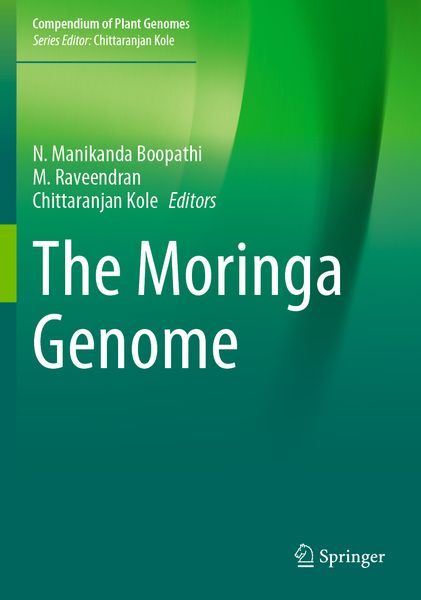
  • Produktbild: The Moringa Genome
  • Produktbild: The Moringa Genome
- 13%

The Moringa Genome

13% sparen

166,99 € UVP 192,59 €

inkl. gesetzl. MwSt., Versandkostenfrei


Beschreibung

Produktdetails

Einband

Taschenbuch

Erscheinungsdatum

16.09.2022

Abbildungen

XXIII, 185 p. 32 illus., 27 illus. in color.

Herausgeber

N. Manikanda Boopathi + weitere

Verlag

Springer

Seitenzahl

185

Maße (L/B/H)

25,4/17,8/1,2 cm

Gewicht

409 g

Auflage

1st ed. 2021

Sprache

Englisch

ISBN

978-3-030-80958-4

Beschreibung

Portrait


Dr. N. Manikanda Boopathi is presently working as Associate Professor (Biotechnology) at Department of Plant Biotechnology, CPMB&B, Tamil Nadu Agricultural University (TNAU), Coimbatore, India. He is an agricultural graduate, did his Masters and Doctoral studies in Plant Biotechnology at TNAU and trained at International Rice Research Institute, The Philippines. He has handled more than 25 courses for UG and PG students in his university and offered invited lectures and demonstrations at several institutions both in India and abroad. His scientific works were recognized on several occasions and brought him laurels and awards. He has been awarded with gold medals and travel grants. He has rich experience in QTL mapping, marker-assisted selection and structural and functional genomics in rice, cotton, mung bean, tomato, moringa and chillies. He had successfully completed several national and international research projects and currently working in countrywide and worldwide network projects that address the problems of biotic and abiotic stresses besides popularizing the cultivation aspects and health benefits of tissue culture Moringa among the rural poor of South Interior India.

Dr. M. Raveendran is a molecular geneticist, working on genetic improvement of rice for abiotic stress tolerance and nutritional traits through genomics-assisted breeding since his Ph.D. thesis research. So far, he has obtained 15 externally funded research projects on rice improvement sponsored by DBT, BMGF (USA) and IRRI (Philippines). He has developed a submergence tolerant version of popular rice variety CO 43 through marker-assisted backcross breeding which is released by CVRC during 2018. He has also developed abiotic stress-tolerant rice genotypes, viz. CBMAS14065, CBMAS14142, CBMAS14110 and improved white Ponni Saltol through MAS which are at various stages (OFT/ART/MLT) of evaluation. He is also involved in the development and release of a fine grain rice variety CO 52through MAS. He is involved in the development and characterization of herbicide-tolerant rice (Imazethapyr resistant) through EMS mutagenesis. Dr. Raveendran’s team has characterized a traditional rice genotype Kavuni for its therapeutic properties which is supported under Grand Challenges Program of India funded by BIRAC, New Delhi. He is also involved in unraveling molecular genetic basis of MYMV resistance. He has more than 150 research publications in his credit, including 96 articles in peer-reviewed international journals.

Prof. Chittaranjan Kole is an internationally reputed scientist with an illustrious professional career of spanning over thirty-seven years and original contributions in the fields of plant genomics, biotechnology, and molecular breeding leading to the publication of more than 160 quality research articles and reviews. He has edited over 140 books for the leading publishers of the world including Springer Nature, Wiley-Blackwell, and Taylor andFrancis Group. His scientific contributions and editing acumen have been appreciated by seven Nobel Laureates including Profs. Norman Borlaug, Arthur Kornberg, Werner Arber, Phillip Sharp, Günter Blobel, Lee Hartwell, and Roger Kornberg. He has been honored with a number of Fellowships, Honorary Fellowships, and national and international awards including the Outstanding Crop Scientist Award conferred by the International Crop Science Society. He has served at all prestigious positions in academia including as Vice-Chancellor of BC Agricultural university, Project Coordinator of Indo-Russian Center of Biotechnology in India, and Director of Research of Institute of Nutraceutical Research of Clemson University, in USA. He worked also in the Pennsylvania State University and Clemson University as Visiting Professor in USA. He is also heading the International Climate-Resilient Crop Genomics Consortium and International Phytomedomics and Nutriomics Consortium as their Founding PrincipalCoordinator and now President.

Produktdetails

Einband

Taschenbuch

Erscheinungsdatum

16.09.2022

Abbildungen

XXIII, 185 p. 32 illus., 27 illus. in color.

Herausgeber

Verlag

Springer

Seitenzahl

185

Maße (L/B/H)

25,4/17,8/1,2 cm

Gewicht

409 g

Auflage

1st ed. 2021

Sprache

Englisch

ISBN

978-3-030-80958-4

Herstelleradresse

Springer-Verlag GmbH
Tiergartenstr. 17
69121 Heidelberg
DE

Email: ProductSafety@springernature.com

Noch keine Bewertungen vorhanden

Verfassen Sie die erste Bewertung zu diesem Artikel

Helfen Sie anderen Kundinnen und Kunden durch Ihre Meinung.

Kundinnen und Kunden meinen

Bewertungen (0)

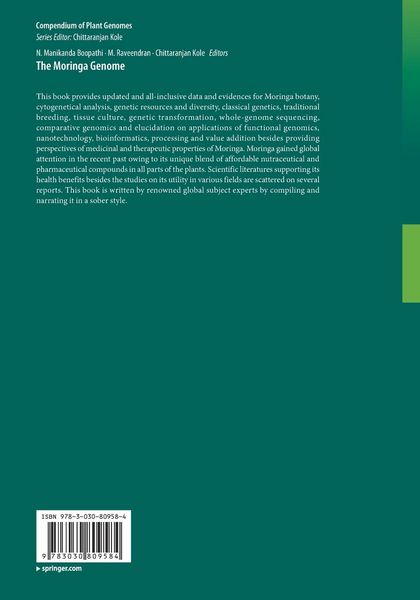
  • Produktbild: The Moringa Genome
  • Produktbild: The Moringa Genome

  • Chapter 1. Moringa and Its Importance.- Chapter 2. Botanical Descriptions of
    Moringa
    spp.- Chapter 3. Effect of Different Processing Methods on Nutritional Content of
    Moringa Oleifera
    .- Chapter 4. Medicinal and Therapeutic Properties of Moringa.- Chapter 5. Classical Genetics and Traditional Breeding in Moringa.- Chapter 6. Cytogenetical Analysis of Moringa Genome.- Chapter 7. Genetic Diversity of Moringa (
    Moringa oleifera
    Lam.).- Chapter 8. Tissue Culture and Genetic Engineering in Moringa.- Chapter 9. Molecular Markers and DNA Barcoding in Moringa.- Chapter 10. Genome Sequencing, Organellar Genomes and Comparative Genomics in Moringa.- Chapter 11. Moringa Functional Genomics: Implications of Long Read Sequencing Technologies.- Chapter 12. Bioinformatics Tools and Moringa Genomics.- Chapter 13. Biogenic Nanomaterials Using Moringa and their Applications.- Chapter 14. Moringa Processing and Value Addition: Rice Analogue from Broken Rice Fortified with Moringa Leaves and Its Effect on Iron Availability.- Chapter 15. Moringa and Its Genome: Future Prospects.