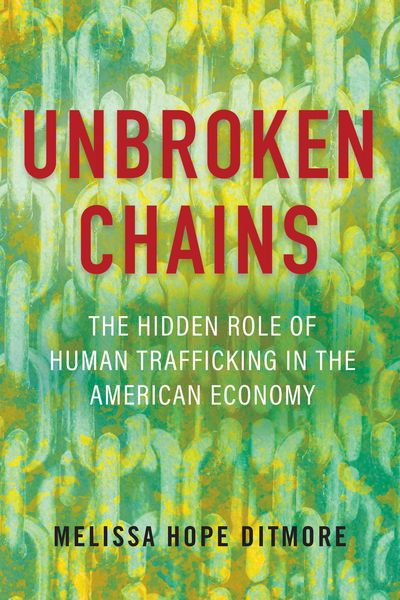
Unbroken Chains The Hidden Role of Human Trafficking in the American Economy
-
- Hardcover
- Taschenbuch
- eBook ausgewählt
-
Form:Einzelkauf Download
-
Sprache:Englisch
15,49 €
inkl. gesetzl. MwSt.Beschreibung
Produktdetails
Format
ePUB 3
Kopierschutz
Ja
Family Sharing
Ja
Text-to-Speech
Ja
Erscheinungsdatum
09.05.2023
Verlag
Beacon PressSeitenzahl
240 (Printausgabe)
Dateigröße
18994 KB
Sprache
Englisch
EAN
9780807006795
An urgent exposition of the pervasive human trafficking that lies just beneath the surface of the US economy-from the stories of its survivors
The years of the COVID-19 pandemic have brought to light the exploitation of workers. In this moment of heightened visibility, Unbroken Chains demands that readers examine the hidden sector of American trafficked labor and understand its prevalence across our economy.
Drawing from nearly two decades of research on US and international human trafficking, Melissa Hope Ditmore sets forth the harrowing stories of human trafficking survivors and grounds their accounts in the long history of US indentured servitude, looking to its iterations in chattel slavery, Chinese contract labor, and prison labor. In this groundbreaking investigation of American trafficking, Ditmore unveils the unnerving reality that forced labor permeates many industries beyond sex work: in almost every aspect of consumption, people who create our everyday necessities are working amid inescapable exploitation, often without pay.
Unbroken Chains tells these workers' stories: They are nannies for New York City's diplomatic elites and door-to-door magazine salespeople in the American South. A trafficked person may have harvested your produce, sewn your clothes, or cleaned your apartment lobby. Ditmore offers readers an illuminating window on the world of forced labor, which exists within our own, and a road map for participating in its destruction.
Unbroken Chains will include more than a dozen images, including detailed maps, archival pictures, and trafficking documents. Among these images are a modern map of the Sonoran Desert in the American Southwest, a bill of sale for an enslaved woman forced into sex work, letters from men in compulsory plantation labor after the Civil War, and 19th-century "white slave" panic propaganda.
The years of the COVID-19 pandemic have brought to light the exploitation of workers. In this moment of heightened visibility, Unbroken Chains demands that readers examine the hidden sector of American trafficked labor and understand its prevalence across our economy.
Drawing from nearly two decades of research on US and international human trafficking, Melissa Hope Ditmore sets forth the harrowing stories of human trafficking survivors and grounds their accounts in the long history of US indentured servitude, looking to its iterations in chattel slavery, Chinese contract labor, and prison labor. In this groundbreaking investigation of American trafficking, Ditmore unveils the unnerving reality that forced labor permeates many industries beyond sex work: in almost every aspect of consumption, people who create our everyday necessities are working amid inescapable exploitation, often without pay.
Unbroken Chains tells these workers' stories: They are nannies for New York City's diplomatic elites and door-to-door magazine salespeople in the American South. A trafficked person may have harvested your produce, sewn your clothes, or cleaned your apartment lobby. Ditmore offers readers an illuminating window on the world of forced labor, which exists within our own, and a road map for participating in its destruction.
Unbroken Chains will include more than a dozen images, including detailed maps, archival pictures, and trafficking documents. Among these images are a modern map of the Sonoran Desert in the American Southwest, a bill of sale for an enslaved woman forced into sex work, letters from men in compulsory plantation labor after the Civil War, and 19th-century "white slave" panic propaganda.
Kundinnen und Kunden meinen
Verfassen Sie die erste Bewertung zu diesem Artikel
Helfen Sie anderen Kund*innen durch Ihre Meinung
Kurze Frage zu unserer Seite
Vielen Dank für dein Feedback
Wir nutzen dein Feedback, um unsere Produktseiten zu verbessern. Bitte habe Verständnis, dass wir dir keine Rückmeldung geben können. Falls du Kontakt mit uns aufnehmen möchtest, kannst du dich aber gerne an unseren Kund*innenservice wenden.
zum Kundenservice