Gutscheinbedingungen

**Gültig bis 10.06.2026 / Gültig für gebrauchte Bücher / Mindestbestellwert 20,00 € / Einzelne Artikel können ausgeschlossen sein / Online auf www.bücher.de.de / Nicht kombinierbar mit anderen Gutscheinen oder Preisaktionen / Nur einmal pro Einkauf einlösbar / Gutschein wird auf max. 500€ Bestellwert angerechnet / Keine Barauszahlung / Nicht gültig für Versandkosten und Services

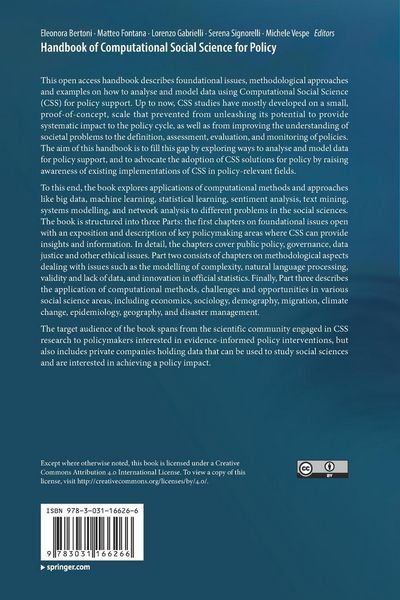
  • Produktbild: Handbook of Computational Social Science for Policy
  • Produktbild: Handbook of Computational Social Science for Policy

Handbook of Computational Social Science for Policy

39,99 €

inkl. gesetzl. MwSt., Versandkostenfrei

Lieferung nach Hause

Beschreibung

Produktdetails

Einband

Taschenbuch

Erscheinungsdatum

25.01.2023

Herausgeber

Eleonora Bertoni + weitere

Verlag

Springer

Seitenzahl

490

Maße (L/B/H)

23,5/15,5/2,8 cm

Gewicht

768 g

Auflage

1st ed. 2023

Sprache

Englisch

ISBN

978-3-031-16626-6

Beschreibung

Portrait

Eleonora Bertoni is a Project Officer – Computational Social Scientist at the European Commission, Joint Research Centre (JRC), where she works for the Centre of Advanced Studies (CAS). She coordinates the activities of the CAS group on Computational Social Science for Policy which aims at building capacity in accessing and analysing non-traditional data, as well as exploring applications of computational methods in different social sciences domains to address specific policy questions.

Matteo Fontana is a Project Officer - Data Scientist at the Joint Research Centre of the European Commission. His main research interest is the application and development of data science and statistical learning techniques to evaluate complex data sources in the social sciences field. He is particularly interested in nonparametric inference and prediction, with a focus on conformal methods for complex data. From an applicative point of view, he is interested in macro-economic forecasting, migration modelling and environmental economics.

Lorenzo Gabrielli is a Data Scientist in the JRC Centre for Advanced Studies (CAS) Project on Computational Social Science for Policy to carry out scientific tasks, i.e. harness non-traditional data including big data, analyse it and draw conclusions on its impact on society. He has gained experience in the analysis of big data with data mining and machine learning techniques in national and international contexts by collaborating with several public and private research institutes.

Serena Signorelli works as a Data Partnership and Management Officer at the Joint Research Centre. Her current project focuses on Computational Social Science for Policy, and it is part of the Centre for Advanced Studies of the Scientific Development unit. Her research interests have mainly focused on the use of Wikipedia page views to study tourism flows, and they havebeen exploited through a traineeship and a subsequent contract with the Eurostat Big Data task force.

Michele Vespe is a Team Leader at the European Commission, Joint Research Centre, where he coordinates the activities of teams of researchers for investigating societal consequences associated with the improved availability of digital trace data, including research in the fields of data governance. He also leads the Computational Social Science for Policy project team.

Produktdetails

Einband

Taschenbuch

Erscheinungsdatum

25.01.2023

Herausgeber

Verlag

Springer

Seitenzahl

490

Maße (L/B/H)

23,5/15,5/2,8 cm

Gewicht

768 g

Auflage

1st ed. 2023

Sprache

Englisch

ISBN

978-3-031-16626-6

Herstelleradresse

Springer-Verlag KG
Sachsenplatz 4-6
1201 Wien
AT

Email: [email protected]

Kundinnen und Kunden meinen

0 Bewertungen

Informationen zu Bewertungen

Zur Abgabe einer Bewertung ist eine Anmeldung im Konto notwendig. Die Authentizität der Bewertungen wird von uns nicht überprüft. Wir behalten uns vor, Bewertungstexte, die unseren Richtlinien widersprechen, entsprechend zu kürzen oder zu löschen.

Die Bewertungen sind nach Format, Anzahl Sterne und Datum sortiert.

Verfassen Sie die erste Bewertung zu diesem Artikel

Helfen Sie anderen Kund*innen durch Ihre Meinung

Kundinnen und Kunden meinen

0 Bewertungen filtern

  • Produktbild: Handbook of Computational Social Science for Policy
  • Produktbild: Handbook of Computational Social Science for Policy
  • -  Part I Foundational Issues . - 1. Computational Social Science for Public Policy. - 2. Computational Social Science for the Public Good: Towards a Taxonomy of Governance and Policy Challenges. - 3. Data Justice, Computational Social Science and Policy. - 4. The Ethics of Computational Social Science. - Part II Methodological Aspects . - 5.  Modelling Complexity with Unconventional Data: Foundational Issues in Computational Social Science. - 6. From Lack of Data to Data Unlocking. - 7. Natural Language Processing for Policymaking. - 8. Describing Human Behaviour Through Computational Social Science. - 9. Data and Modelling for the Territorial Impact Assessment (TIA) of Policies. - 10. Challenges and Opportunities of Computational Social Science for Official Statistics. -  Part III Applications . - 11. Agriculture, Food and Nutrition Security: Concept, Datasets and Opportunities for Computational Social Science Applications. - 12. Big Data and Computational Social Science for Economic Analysis and Policy. - 13. Changing Job Skills in a Changing World. - 14. Computational Climate Change: How Data Science and Numerical Models Can Help Build Good Climate Policies and Practices. - 15. Digital Epidemiology. - 16. Learning Analytics in Education for the Twenty-First Century. - 17. Leveraging Digital and Computational Demography for Policy Insights. - 18. New Migration Data: Challenges and Opportunities. - 19. New Data and Computational Methods Opportunities to Enhance the Knowledge Base of Tourism. - 20. Computational Social Science for Policy and Quality of Democracy: Public Opinion, Hate Speech, Misinformation, and Foreign Influence Campaigns. - 21. Social Interactions, Resilience, and Access to Economic Opportunity: A Research Agenda for the Field of Computational Social Science. - 22. Social Media Contribution to the Crisis Management Processes: Towards a More Accurate Response Integrating Citizen-Generated Content and Citizen-Led Activities. - 23. The Empirical Study of Human Mobility: Potentials and Pitfalls of Using Traditional and Digital Data. - 24. Towards a More Sustainable Mobility.