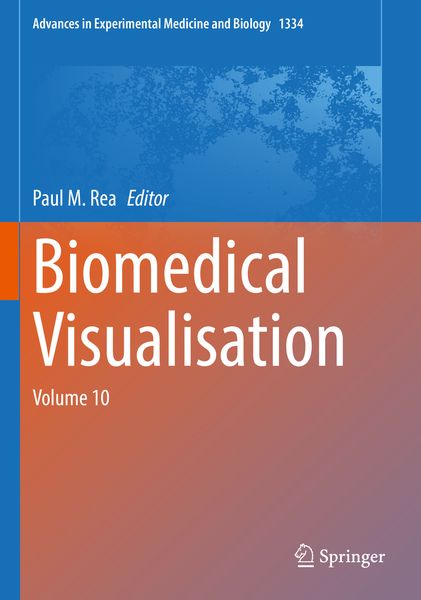

Biomedical Visualisation Volume 10
-
- Hardcover
- Taschenbuch ausgewählt
- eBook
-
Sprache:Englisch
138,99 €
UVP
160,49 €
inkl. gesetzl. MwSt.,
Lieferung nach Hause
Beschreibung
Produktdetails
Einband
Taschenbuch
Erscheinungsdatum
04.09.2022
Herausgeber
Paul M. ReaVerlag
SpringerSeitenzahl
223
Maße (L/B/H)
25,4/17,8/1,4 cm
Gewicht
460 g
Auflage
1st ed. 2021
Sprache
Englisch
ISBN
978-3-030-76953-6
This edited book explores the use of technology to enable us to visualise the life sciences in a more meaningful and engaging way. It will enable those interested in visualisation techniques to gain a better understanding of the applications that can be used in visualisation, imaging and analysis, education, engagement and training. The reader will also be able to learn about the use of visualisation techniques and technologies for the historical and forensic settings.
The reader will be able to explore the utilisation of technologies from a number of fields to enable an engaging and meaningful visual representation of the biomedical sciences.
The chapters presented in this volume cover such a diverse range of topics, with something for everyone. We present here chapters on technology enhanced learning in neuroanatomy; 3D printing and surgical planning; changes in higher education utilising technology, decolonising the curriculum and visual representations of the humanbody in education. We also showcase how not to use protective personal equipment inspired by the pandemic; anatomical and historical visualisation of obstetrics and gynaecology; 3D modelling of carpal bones and augmented reality for arachnid phobias for public engagement. In addition, we also present face modelling for surgical education in a multidisciplinary setting, military medical museum 3D digitising of historical pathology specimens and finally computational fluid dynamics.
Noch keine Bewertungen vorhanden
Verfassen Sie die erste Bewertung zu diesem Artikel
Helfen Sie anderen Kundinnen und Kunden durch Ihre Meinung.
Kurze Frage zu unserer Seite
Vielen Dank für dein Feedback
Wir nutzen dein Feedback, um unsere Produktseiten zu verbessern. Bitte habe Verständnis, dass wir dir keine Rückmeldung geben können. Falls du Kontakt mit uns aufnehmen möchtest, kannst du dich aber gerne an unseren Kund*innenservice wenden.
zum Kundenservice