KI-Beratung Beta

Gutscheinbedingungen

**Gültig vom 23.11. bis 30.11.2026 | Gültig für nicht preisgebundene fremdsprachige Bücher | Einzelne Artikel können ausgeschlossen sein | Online auf www.bücher.de einlösbar | Click & Collect nur mit Online-Zahlung (Paypal/Kreditkarte) vorab | Nicht kombinierbar mit anderen Gutscheinen oder Preisaktionen | Nur einmal pro Einkauf einlösbar | Gutschein wird auf max. 500€ Bestellwert angerechnet | Keine Barauszahlung | Nicht gültig für Versandkosten und Services

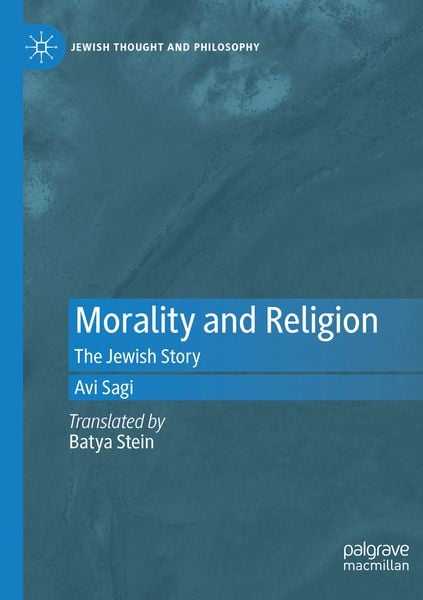
  • Produktbild: Morality and Religion
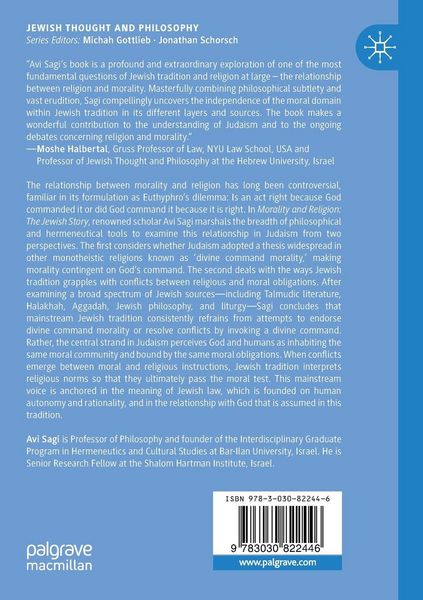
  • Produktbild: Morality and Religion
- 13%

Morality and Religion The Jewish Story

13% sparen

129,99 € UVP 149,79 €

inkl. gesetzl. MwSt., Versandkostenfrei


Beschreibung

The relationship between morality and religion has long been controversial, familiar in its formulation as Euthyphro’s dilemma: Is an act right because God commanded it or did God command it because it is right. In Morality and Religion: The Jewish Story , renowned scholar Avi Sagi marshals the breadth...

Beschreibung

The relationship between morality and religion has long been controversial, familiar in its formulation as Euthyphro’s dilemma: Is an act right because God commanded it or did God command it because it is right. In
Morality and Religion: The Jewish Story
, renowned scholar Avi Sagi marshals the breadth of philosophical and hermeneutical tools to examine this relationship in Judaism from two perspectives. The first considers whether Judaism adopted a thesis widespread in other monotheistic religions known as 'divine command morality,' making morality contingent on God’s command. The second deals with the ways Jewish tradition grapples with conflicts between religious and moral obligations. After examining a broad spectrum of Jewish sources—including Talmudic literature, Halakhah, Aggadah, Jewish philosophy, and liturgy—Sagi concludes that mainstream Jewish tradition consistently refrains from attempts to endorse divine command morality or resolve conflicts by invoking a divine command. Rather, the central strand in Judaism perceives God and humans as inhabiting the same moral community and bound by the same moral obligations. When conflicts emerge between moral and religious instructions, Jewish tradition interprets religious norms so that they ultimately pass the moral test. This mainstream voice is anchored in the meaning of Jewish law, which is founded on human autonomy and rationality, and in the relationship with God that is assumed in this tradition. 

Produktdetails

Einband

Taschenbuch

Erscheinungsdatum

29.08.2022

Abbildungen

XI, 346 p.

Verlag Springer

Produktdetails

Einband

Taschenbuch

Erscheinungsdatum

29.08.2022

Abbildungen

XI, 346 p.

Verlag Springer
Seitenzahl

346

Maße (L/B/H)

21/14,8/2 cm

Gewicht

466 g

Auflage

22001 Auflage 1st edition 2021

Originaltitel Yahadut: Bein Dat L'Mussar
Sprache

Englisch

ISBN

978-3-030-82244-6

Herstelleradresse

Springer-Verlag GmbH
Tiergartenstr. 17
69121 Heidelberg
DE

Email: ProductSafety@springernature.com

Noch keine Bewertungen vorhanden

Verfassen Sie die erste Bewertung zu diesem Artikel

Helfen Sie anderen Kundinnen und Kunden durch Ihre Meinung.

Kundinnen und Kunden meinen

Bewertungen (0)

  • Produktbild: Morality and Religion
  • Produktbild: Morality and Religion

  • 1. Introduction.- Part I Morality’s  Dependence on Religion in Jewish Tradition.- 2. Between the Duty of Obedience and the Thesis of Dependence.- 3. DCM in Rabbinic Literature.- 4. DCM in Jewish Thought.- 5. The Autonomous Perspective in Jewish Thought.- Part II The Autonomous Perspective in Halakhah.- 6. R. Israel Moses Hazan: Particularism and Universalism.- 7. R. Shimon Shkop: Religious Commands and Legal Obligations.- 8. R. Ben-Zion Meir Hai Uziel: Exclusivity and Moral Autonomy.- Part III The Conflict Between Morality and Religion.- 9. “You Are Called Men”: Between Jew and Gentile.- 10. “He Slew the Egyptian”: On Moses’ Act and Morality.- 11. “Her Ways Are Ways of Pleasantness”: Uprooting a Torah Law.- 12. The
    Akedah
    in Jewish Tradition.- Part IV Theoretical Foundations.- 13. Halakhah and the Dependence Thesis.- 14. Concluding Reflections.