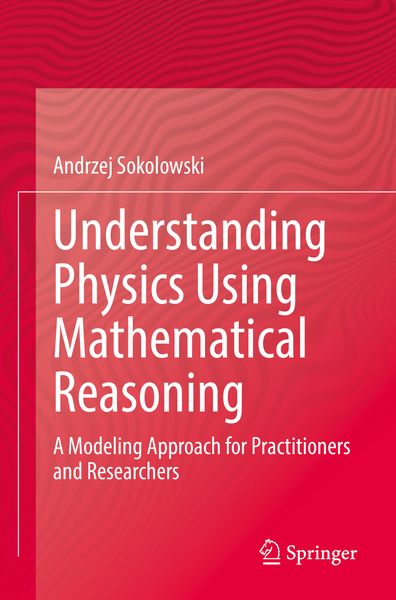
Understanding Physics Using Mathematical Reasoning A Modeling Approach for Practitioners and Researchers
-
- Hardcover
- Taschenbuch ausgewählt
- eBook
-
Sprache:Englisch
121,99 €
UVP
139,09 €
inkl. gesetzl. MwSt.,
Beschreibung
Produktdetails
Einband
Taschenbuch
Erscheinungsdatum
22.08.2022
Abbildungen
XI, 208 p. 57 illus., 39 illus. in color.
Verlag
SpringerSeitenzahl
208
Maße (L/B/H)
23,5/15,5/1,3 cm
Gewicht
341 g
Auflage
1st edition 2021
Sprache
Englisch
ISBN
978-3-030-80207-3
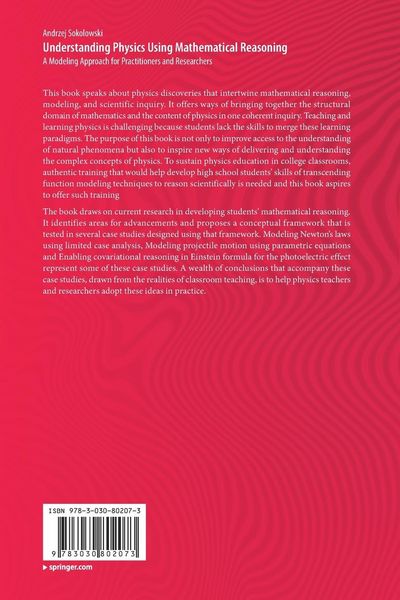
This book speaks about physics discoveries that intertwine mathematical reasoning, modeling, and scientific inquiry. It offers ways of bringing together the structural domain of mathematics and the content of physics in one coherent inquiry. Teaching and learning physics is challenging because students lack the skills to merge these learning paradigms. The purpose of this book is not only to improve access to the understanding of natural phenomena but also to inspire new ways of delivering and understanding the complex concepts of physics. To sustain physics education in college classrooms, authentic training that would help develop high school students’ skills of transcending function modeling techniques to reason scientifically is needed and this book aspires to offer such training
The book draws on current research in developing students’ mathematical reasoning. It identifies areas for advancements and proposes a conceptual framework that is tested in several case studies designed using that framework. Modeling Newton’s laws using limited case analysis, Modeling projectile motion using parametric equations and Enabling covariational reasoning in Einstein formula for the photoelectric effect represent some of these case studies. A wealth of conclusions that accompany these case studies, drawn from the realities of classroom teaching, is to help physics teachers and researchers adopt these ideas in practice.Noch keine Bewertungen vorhanden
Verfassen Sie die erste Bewertung zu diesem Artikel
Helfen Sie anderen Kundinnen und Kunden durch Ihre Meinung.
Kurze Frage zu unserer Seite
Vielen Dank für dein Feedback
Wir nutzen dein Feedback, um unsere Produktseiten zu verbessern. Bitte habe Verständnis, dass wir dir keine Rückmeldung geben können. Falls du Kontakt mit uns aufnehmen möchtest, kannst du dich aber gerne an unseren Kund*innenservice wenden.
zum Kundenservice