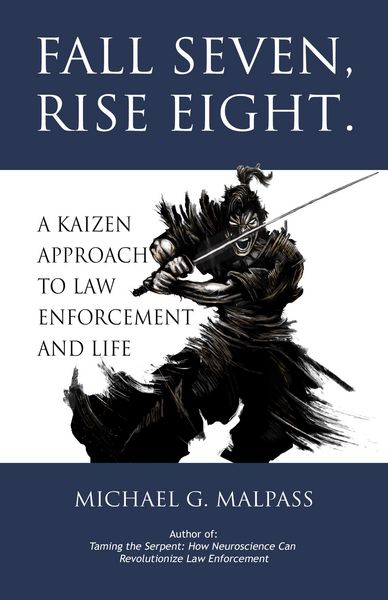
Fall Seven, Rise Eight. A Kaizen Approach to Law Enforcement and Life
-
- Einzelkauf Download ausgewählt
-
Sprache:Englisch
9,99 €
inkl. gesetzl. MwSt.Beschreibung
Produktdetails
Format
ePUB
Kopierschutz
Ja
Family Sharing
Ja
Text-to-Speech
Ja
Erscheinungsdatum
15.08.2022
Verlag
Bad Road PublishingSeitenzahl
(Printausgabe)
Dateigröße
443 KB
Sprache
Englisch
EAN
9798201264512
Have you ever wondered why it is so easy to watch a sport on television and comment on how easy a play should have been or how you could have made that play, hit that ball, beaten that professional fighter or caught that pass? It turns out that different regions of the brain are involved in thinking about doing something and actually doing it and these regions have associations with the biases that develop subconsciously in the brain. The same biases that drive us to wax philosophical on any and every topic are the same biases that influence how law enforcement officers prepare for real life conflict as well as how these real life conflicts are judged by the public, the media, judges, and even other law enforcement officers.
By understanding the underlying mechanisms of the brain during decision making in situations with and without fear, anxiety, stress and pressure, we can form a better understanding of how to develop better training for law enforcement as well as a better conversation about why it is easy to know what to do from the comfort of your own EZ chair and so difficult to actually make the same decisions when you are involved directly in life threatening or potentially life threatening situations.
Fall Seven, Rise Eight, explains the science of how the brain makes decisions with and without stress and pressure. Stress involves the physiological sensations happening in the body in response to some external stimulus and how we interpret those sensations. Pressure is the friction between the stress we feel and the need to solve an external problem. There may be many solutions to a problem but if you can't think of any of them stress and pressure will increase. Along with this friction comes a performance measure of the subconscious brain that predicts how likely you are to succeed in any given endeavor based on past associations of competency.
This book provides ways to leverage that information so that individual officers, law enforcement trainers, police organizations or anyone looking to increase their ability to perform under stress and pressure can use real time tools to decrease levels of fear, anxiety, stress, and pressure while attempting to perform at their best in time compressed and potentially volatile situations.
With these real time tools, these same individuals can start to train with the understanding that the human brain is wired for predictions, not reactions. Even emotions are predictions of your brain that in past associations this is how you felt while something similar was happening to you. How we feel influences how we think and the opposite is also true. With this understanding, you can develop training programs so that in the future your brain does not predict massive emotional responses based on past behaviors. And when this happens, you will make better critical decisions in shorter time frames and increase your chances to perform at your absolute best.
Noch keine Bewertungen vorhanden
Verfassen Sie die erste Bewertung zu diesem Artikel
Helfen Sie anderen Kundinnen und Kunden durch Ihre Meinung.
Kurze Frage zu unserer Seite
Vielen Dank für dein Feedback
Wir nutzen dein Feedback, um unsere Produktseiten zu verbessern. Bitte habe Verständnis, dass wir dir keine Rückmeldung geben können. Falls du Kontakt mit uns aufnehmen möchtest, kannst du dich aber gerne an unseren Kund*innenservice wenden.
zum Kundenservice