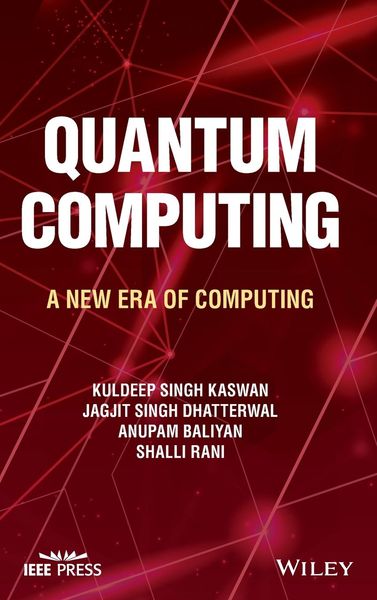
Produktbild: Quantum Computing
- 12%

Quantum Computing A New Era of Computing

12% sparen

108,99 € UVP 125,00 €

inkl. gesetzl. MwSt., Versandkostenfrei

Lieferung nach Hause

Beschreibung

Produktdetails

Einband

Gebundene Ausgabe

Erscheinungsdatum

01.08.2023

Verlag

John Wiley & Sons

Seitenzahl

336

Maße (L/B/H)

23,5/15,7/2,2 cm

Gewicht

635 g

Auflage

1. Auflage

Sprache

Englisch

ISBN

978-1-394-15781-5

Beschreibung

Produktdetails

Einband

Gebundene Ausgabe

Erscheinungsdatum

01.08.2023

Verlag

John Wiley & Sons

Seitenzahl

336

Maße (L/B/H)

23,5/15,7/2,2 cm

Gewicht

635 g

Auflage

1. Auflage

Sprache

Englisch

ISBN

978-1-394-15781-5

EU-Ansprechpartner

Zeitfracht Medien GmbH
Ferdinand-Jühlke-Straße 7
99095 Erfurt
DE
produktsicherheit@zeitfracht.de

Herstelleradresse

Wiley & Sons
1 Oldlands Way
PO22 9NQ Bognor Regis
GB
trade@wiley.com

Kundinnen und Kunden meinen

0 Bewertungen

Informationen zu Bewertungen

Zur Abgabe einer Bewertung ist eine Anmeldung im Konto notwendig. Die Authentizität der Bewertungen wird von uns nicht überprüft. Wir behalten uns vor, Bewertungstexte, die unseren Richtlinien widersprechen, entsprechend zu kürzen oder zu löschen.

Die Bewertungen sind nach Format, Anzahl Sterne und Datum sortiert.

Verfassen Sie die erste Bewertung zu diesem Artikel

Helfen Sie anderen Kund*innen durch Ihre Meinung

Kundinnen und Kunden meinen

0 Bewertungen filtern

Die Leseprobe wird geladen.
  • Produktbild: Quantum Computing
  • Preface xiii

    Author Biography xv

    1 Introduction of Quantum Computing 1

    1.1 Introduction 1

    1.2 What Is the Exact Meaning of Quantum Computing? 2

    1.2.1 What Is Quantum Computing in Simple Terms? 2

    1.3 Origin of Quantum Computing 3

    1.4 History of Quantum Computing 5

    1.5 Quantum Communication 19

    1.6 Build Quantum Computer Structure 19

    1.7 Principle Working of Quantum Computers 21

    1.7.1 Kinds of Quantum Computing 21

    1.8 Quantum Computing Use in Industry 23

    1.9 Investors Invest Money in Quantum Technology 24

    1.10 Applications of Quantum Computing 26

    1.11 Quantum Computing as a Solution Technology 29

    1.11.1 Quantum Artificial Intelligence 29

    1.11.2 How Close Are We to Quantum Supremacy? 30

    1.12 Conclusion 30

    References 31

    2 Pros and Cons of Quantum Computing 33

    2.1 Introduction 33

    2.2 Quantum as a Numerical Process 33

    2.3 Quantum Complexity 34

    2.4 The Pros and Cons of the Quantum Computational Framework 36

    2.5 Further Benefits of Quantum Computing 37

    2.6 Further Drawbacks to Quantum Computing 38

    2.7 Integrating Quantum and Classical Techniques 38

    2.8 Framework of QRAM 39

    2.9 Computing Algorithms in the Quantum World 40

    2.9.1 Programming Quantum Processes 42

    2.10 Modification of Quantum Building Blocks 42

    References 43

    3 Methods and Instrumentation for Quantum Computing 45

    3.1 Basic Information of Quantum Computing 45

    3.2 Signal Information in Quantum Computing 47

    3.3 Quantum Data Entropy 47

    3.4 Basics of Probability in Quantum Computing 50

    3.5 Quantum Theorem of No-Cloning 52

    3.6 Measuring Distance 53

    3.7 Fidelity in Quantum Theory 58

    3.8 Quantum Entanglement 62

    3.9 Information Content and Entropy 66

    References 71

    4 Foundations of Quantum Computing 73

    4.1 Single-Qubit 73

    4.1.1 Photon Polarization in Quantum Computing 73

    4.2 Multi-qubit 76

    4.2.1 Blocks of Quantum States 76

    4.2.2 Submission of Vector Space in Quantum Computing 77

    4.2.3 Vector Spacing in Quantum Blocks 77

    4.2.4 States of n-Qubit Technology 79

    4.2.5 States of Entangled 81

    4.2.6 Classical Measuring of Multi-Qubit 84

    4.3 Measuring of Multi-Qubit 87

    4.3.1 Mathematical Functions in Quantum Operations 87

    Example 88

    4.3.2 Operator Measuring Qubits Projection 89

    4.3.3 The Measurement Postulate 94

    4.3.4 EPR Paradox and Bell's Theorem 99

    4.3.5 Layout of Bell's Theorem 101

    4.3.6 Statistical Predicates of Quantum Mechanics 101

    4.3.7 Predictions of Bell's Theorem 102

    4.3.8 Bell's Inequality 103

    4.4 States of Quantum Metamorphosis 105

    4.4.1 Solitary Steps Metamorphosis 106

    4.4.2 Irrational Metamorphosis: The No-Cloning Principle 107

    4.4.3 The Pauli Transformations 109

    4.4.4 The Hadamard Metamorphosis 109

    4.4.5 Multi-Qubit Metamorphosis from Single-Qubit 109

    4.4.6 The Controlled-NOT and Other Singly Controlled Gates 110

    4.4.7 Opaque Coding 113

    4.4.8 Basic Bits in Opaque Coding 114

    4.4.9 Quantum Message Teleportation 114

    4.4.10 Designing and Constructing Quantum Circuits 116

    4.4.11 Single Qubit Manipulating Quantum State 116

    4.4.12 Controlling Single-Qubit Metamorphosis 117

    4.4.13 Controlling Multi Single-Qubit Metamorphosis 117

    4.4.14 Simple Metamorphosis 119

    4.4.15 Unique Setup Gates 121

    4.4.16 The Standard Circuit Model 122

    References 123

    5 Computational Algorithm Design in Quantum Systems 125

    5.1 Introduction 125

    5.2 Quantum Algorithm 125

    5.3 Rule 1 Superposition 126

    5.4 Rule 2 Quantum Entanglement 130

    5.5 Rule 3 Quantum Metrology 132

    5.6 Rule 4 Quantum Gates 133

    5.7 Rule 5 Fault-Tolerant Quantum Gates 134

    5.8 Quantum Concurrency 138

    5.9 Rule 7 Quantum Interference 139

    5.10 Rule 8 Quantum Parallelism 141

    5.11 Summary 143

    References 144

    6 Optimization of an Amplification Algorithm 145

    6.1 Introduction 145

    6.2 The Effect of Availability Bias 146

    6.2.1 Optimization of an Amplification Algorithm 147

    6.2.2 Specifications of the Mathematical Amplification Algorithm 149

    6.3 Quantum Amplitude Estimation and Quantum Counting 149

    6.4 An Algorithm for Quantitatively Determining Amplitude 150

    6.4.1 Mathematical Description of Amplitude Estimation Algorithm 151

    6.5 Counting Quantum Particles: An Algorithm 151

    6.5.1 Mathematical Description of Quantum Counting Algorithm 152

    6.5.2 Related Algorithms and Techniques 152

    References 153

    7 Error-Correction Code in Quantum Noise 155

    7.1 Introduction 155

    7.2 Basic Forms of Error-Correcting Code in Quantum Technologies 156

    7.2.1 Single Bit-Flip Errors in Quantum Computing 156

    7.2.2 Single-Qubit Coding in Quantum Computing 161

    7.2.3 Error-Correcting Code in Quantum Technology 162

    7.3 Framework for Quantum Error-Correcting Codes 163

    7.3.1 Traditional Based on Error-Correcting Codes 164

    7.3.2 Quantum Error Decode Mechanisms 166

    7.3.3 Correction Sets in Quantum Coding Error 167

    7.3.4 Quantum Errors Detection 168

    7.3.5 Basic Knowledge Representation of Error-Correcting Code 170

    7.3.6 Quantum Codes as a Tool for Error Detection and Correction 173

    7.3.7 Quantum Error Correction Across Multiple Blocks 176

    7.3.8 Computing on Encoded Quantum States 177

    7.3.9 Using Linear Transformation of Correctable Codes 177

    7.3.10 Model of Classical Independent Error 178

    7.3.11 Independent Quantum Inaccuracies Models 179

    7.4 Coding Standards for CSS 182

    7.4.1 Multiple Classical Identifiers 182

    7.4.2 Traditional CSS Codes Satisfying a Duality Consequence 183

    7.4.3 Code of Steane 186

    7.5 Codes for Stabilizers 187

    7.5.1 The Use of Binary Indicators in Quantum Correction of Errors 188

    7.5.2 Using Pauli Indicators to Fix Errors in Quantum Techniques 188

    7.5.3 Using Error-Correcting Stabilizer Algorithms 189

    7.5.4 Stabilizer State Encoding Computation 191

    7.6 A Stabilizer Role for CSS Codes 195

    References 196

    8 Tolerance for Inaccurate Information in Quantum Computing 197

    8.1 Introduction 197

    8.2 Initiating Stable Quantum Computing 198

    8.3 Computational Error Tolerance Using Steane's Code 200

    8.3.1 The Complexity of Syndrome-Based Computation 201

    8.3.2 Error Removal and Correction in Fault-Tolerant Systems 202

    8.3.3 Steane's Code Fault-Tolerant Gates 204

    8.3.4 Measurement with Fault Tolerance 206

    8.3.5 Readying the State for Fault Tolerance 207

    8.4 The Strength of Quantum Computation 208

    8.4.1 Combinatorial Coding 208

    8.4.2 A Threshold Theorem 210

    References 211

    9 Cryptography in Quantum Computing 213

    9.1 Introduction of RSA Encryption 213

    9.2 Concept of RSA Encryption 214

    9.3 Quantum Cipher Fundamentals 216

    9.4 The Controlled-Not Invasion as an Illustration 219

    9.5 Cryptography B92 Protocol 220

    9.6 The E91 Protocol (Ekert) 221

    References 221

    10 Constructing Clusters for Quantum Computing 223

    10.1 Introduction 223

    10.1.1 State of Clusters 223

    10.2 The Preparation of Cluster States 224

    10.3 Nearest Neighbor Matrix 227

    10.4 Stabilizer States 228

    10.4.1 Aside: Entanglement Witness 230

    10.5 Processing in Clusters 231

    References 233

    11 Advance Quantum Computing 235

    11.1 Introduction 235

    11.2 Computing with Superpositions 236

    11.2.1 The Walsh-Hadamard Transformation 236

    11.2.2 Quantum Parallelism 237

    11.3 Notions of Complexity 239

    11.3.1 Query Complexity 240

    11.3.2 Communication Complexity 241

    11.4 A Simple Quantum Algorithm 242

    11.4.1 Deutsch's Problem 242

    11.5 Quantum Subroutines 243

    11.5.1 The Importance of Unentangling Temporary Qubits in Quantum Subroutines 243

    11.5.2 Phase Change for a Subset of Basis Vectors 244

    11.5.3 State-Dependent Phase Shifts 246

    11.5.4 State-Dependent Single-Qubit Amplitude Shifts 247

    11.6 A Few Simple Quantum Algorithms 248

    11.6.1 Deutsch-Jozsa Problem 248

    11.6.2 Bernstein-Vazirani Problem 249

    11.6.3 Simon's Problem 252

    11.6.4 Distributed Computation 253

    11.7 Comments on Quantum Parallelism 254

    11.8 Machine Models and Complexity Classes 255

    11.8.1 Complexity Classes 257

    11.8.2 Complexity: Known Results 258

    11.9 Quantum Fourier Transformations 260

    11.9.1 The Classical Fourier Transform 261

    11.9.2 The Quantum Fourier Transform 263

    11.9.3 A Quantum Circuit for Fast Fourier Transform 263

    11.10 Shor's Algorithm 265

    11.10.1 Core Quantum Phenomena 266

    11.10.2 Periodic Value Measurement and Classical Extraction 267

    11.10.3 Shor's Algorithm and Its Effectiveness 268

    11.10.4 The Efficiency of Shor's Algorithm 269

    11.11 Omitting the Internal Measurement 270

    11.12 Generalizations 271

    11.12.1 The Problem of Discrete Logarithms 272

    11.12.2 Hidden Subgroup Issues 272

    11.13 The Application of Grover's Algorithm It's Time to Solve Some Difficulties 274

    11.13.1 Explanation of the Superposition Technique 275

    11.13.2 The Black Box's Initial Configuration 275

    11.13.3 The Iteration Step 276

    11.13.4 Various of Iterations 277

    11.14 Effective State Operations 279

    11.14.1 2D Geometry 281

    11.15 Grover's Algorithm and Its Optimality 283

    11.15.1 Reduction to Three Inequalities 284

    11.16 Amplitude Amplification using Discrete Event Randomization of Grover's Algorithm 286

    11.16.1 Altering Each Procedure 286

    11.16.2 Last Stage Variation 287

    11.16.3 Solutions: Possibly Infinite 288

    11.16.4 Varying the Number of Iterations 289

    11.16.5 Quantum Counting 290

    11.17 Implementing Grover's Algorithm with Gain Boosting 291

    References 292

    12 Applications of Quantum Computing 295

    12.1 Introduction 295

    12.2 Teleportation 295

    12.3 The Peres Partial Transposition Condition 298

    12.4 Expansion of Transportation 303

    12.5 Entanglement Swapping 304

    12.6 Superdense Coding 305

    References 307

    Index 309