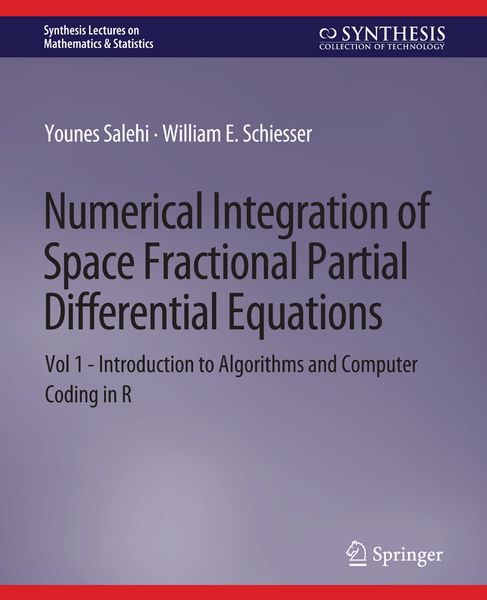
Numerical Integration of Space Fractional Partial Differential Equations Vol 1 - Introduction to Algorithms and Computer Coding in R
-
- Taschenbuch ausgewählt
- eBook
-
Sprache:Englisch
-
Verlag:Springer
- Springer 57,99 €
- Springer 57,99 € ausgewählt
57,99 €
inkl. gesetzl. MwSt.,
Beschreibung
Produktdetails
Einband
Taschenbuch
Erscheinungsdatum
27.11.2017
Abbildungen
XII, 188 p.
Verlag
SpringerSeitenzahl
188
Maße (L/B/H)
23,5/19,1/1,2 cm
Gewicht
392 g
Sprache
Englisch
ISBN
978-3-031-01283-9
Partial differential equations (PDEs) are one of the most used widely forms of mathematics in science and engineering. PDEs can have partial derivatives with respect to (1) an initial value variable, typically time, and (2) boundary value variables, typically spatial variables. Therefore, two fractional PDEs can be considered, (1) fractional in time (TFPDEs), and (2) fractional in space (SFPDEs). The two volumes are directed to the development and use of SFPDEs, with the discussion divided as:
Vol 1: Introduction to Algorithms and Computer Coding in R
Vol 2: Applications from Classical Integer PDEs.
Various definitions of space fractional derivatives have been proposed. We focus on the Caputo derivative, with occasional reference to the Riemann-Liouville derivative.
The Caputo derivative is defined as a convolution integral. Thus, rather than being local (with a value at a particular point in space), the Caputo derivative is non-local (it is based on an integration in space), which is one of the reasons that it has properties not shared by integer derivatives.
A principal objective of the two volumes is to provide the reader with a set of documented R routines that are discussed in detail, and can be downloaded and executed without having to first study the details of the relevant numerical analysis and then code a set of routines.
In the first volume, the emphasis is on basic concepts of SFPDEs and the associated numerical algorithms. The presentation is not as formal mathematics, e.g., theorems and proofs. Rather, the presentation is by examples of SFPDEs, including a detailed discussion of the algorithms for computing numerical solutions to SFPDEs and a detailed explanation of the associated source code.
Noch keine Bewertungen vorhanden
Verfassen Sie die erste Bewertung zu diesem Artikel
Helfen Sie anderen Kundinnen und Kunden durch Ihre Meinung.
Kurze Frage zu unserer Seite
Vielen Dank für dein Feedback
Wir nutzen dein Feedback, um unsere Produktseiten zu verbessern. Bitte habe Verständnis, dass wir dir keine Rückmeldung geben können. Falls du Kontakt mit uns aufnehmen möchtest, kannst du dich aber gerne an unseren Kund*innenservice wenden.
zum Kundenservice