
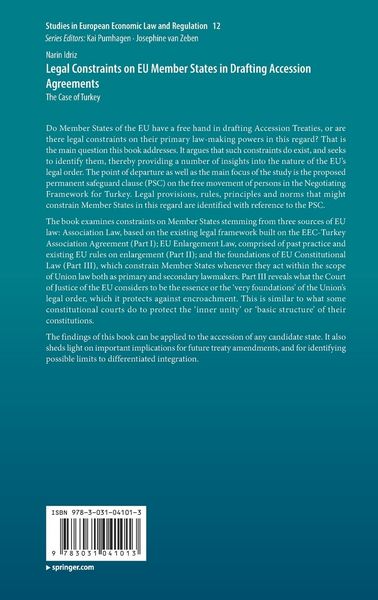
Legal Constraints on EU Member States in Drafting Accession Agreements The Case of Turkey
-
- Hardcover ausgewählt
- Taschenbuch
- eBook
-
Sprache:Englisch
121,99 €
UVP
139,09 €
inkl. gesetzl. MwSt.,
Lieferung nach Hause
Beschreibung
Produktdetails
Einband
Gebundene Ausgabe
Erscheinungsdatum
23.06.2022
Verlag
SpringerSeitenzahl
333
Maße (L/B/H)
24,1/16/2,5 cm
Gewicht
682 g
Auflage
1st ed. 2022
Sprache
Englisch
ISBN
978-3-031-04101-3
Do Member States of the EU have a free hand in drafting Accession Treaties, or are there legal constraints on their primary law-making powers in this regard? That is the main question this book addresses. It argues that such constraints do exist, and seeks to identify them, thereby providing a number of insights into the nature of the EU’s legal order. The point of departure as well as the main focus of the study is the proposed permanent safeguard clause (PSC) on the free movement of persons in the Negotiating Framework for Turkey. Legal provisions, rules, principles and norms that might constrain Member States in this regard are identified with reference to the PSC.
The book examines constraints on Member States stemming from three sources of EU law: Association Law, based on the existing legal framework built on the EEC-Turkey Association Agreement (Part I); EU Enlargement Law, comprised of past practice and existing EU rules on enlargement (Part II); and the foundationsof EU Constitutional Law (Part III), which constrain Member States whenever they act within the scope of Union law both as primary and secondary lawmakers. Part III reveals what the Court of Justice of the EU considers to be the essence or the ‘very foundations’ of the Union’s legal order, which it protects against encroachment. This is similar to what some constitutional courts do to protect the ‘inner unity’ or ‘basic structure’ of their constitutions.
The findings of this book can be applied to the accession of any candidate state. It also sheds light on important implications for future treaty amendments, and for identifying possible limits to differentiated integration.
Noch keine Bewertungen vorhanden
Verfassen Sie die erste Bewertung zu diesem Artikel
Helfen Sie anderen Kundinnen und Kunden durch Ihre Meinung.
Kurze Frage zu unserer Seite
Vielen Dank für dein Feedback
Wir nutzen dein Feedback, um unsere Produktseiten zu verbessern. Bitte habe Verständnis, dass wir dir keine Rückmeldung geben können. Falls du Kontakt mit uns aufnehmen möchtest, kannst du dich aber gerne an unseren Kund*innenservice wenden.
zum Kundenservice