KI-Beratung Beta

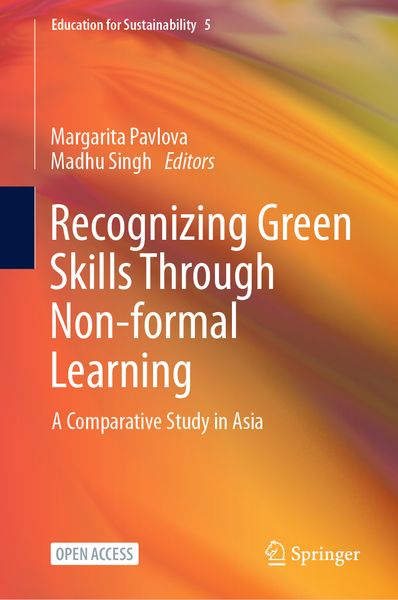
Produktbild: Recognizing Green Skills Through Non-formal Learning
Band 5 - 11%

Recognizing Green Skills Through Non-formal Learning A Comparative Study in Asia

11% sparen

112,99 € UVP 128,39 €

inkl. gesetzl. MwSt., Versandkostenfrei


Beschreibung

Produktdetails

Einband

Gebundene Ausgabe

Erscheinungsdatum

10.08.2022

Abbildungen

XII, 286 p. 10 illus., 9 illus. in color.

Herausgeber

Margarita Pavlova + weitere

Verlag

Springer Singapore

Seitenzahl

286

Maße (L/B/H)

24,1/16/2,2 cm

Gewicht

617 g

Auflage

1st ed. 2022

Sprache

Englisch

ISBN

978-981-19-2071-4

Beschreibung

Portrait

Dr. Margarita Pavlova (PhD Australia; PhD Russia; MEd USA; BEd Hons Russia) is the Director of the UNEVOC Centre (Hong Kong), which is a member of the global UNESCO-UNEVOC network, and an Associate Professor at the Department of International Education, the Education University of Hong Kong. Her research focus is on policy, planning and curriculum development in vocational education at both national and international levels, with a particular emphasis on green skills development and greening of the vocational education sector. Dr. Pavlova’s regional research and development projects in Asia have been funded by different agencies including the Asian Development Bank, The World Bank, UNESCO and the European Training Foundation (ETF). Dr. Pavlova has published widely in the fields of her expertise. She currently serves on the editorial advisory boards of two book series published by Springer: Technical and Vocational Education and Training: Issues, Concerns and Prospects ,and Education in the Asia-Pacific Region: Issues, Concerns and Prospects . 

Dr. Madhu Singh is a Senior Programme Specialist at UNESCO Institute for Lifelong Learning, Hamburg (Germany). Her specialisations are mainly research, policy advice, organising North-South and South-South policy dialogues and capacity building workshops; networking with relevant stakeholders across sectors in UNESCO Member States; establishing state-of-the-art reviews in the fields of lifelong learning policies and strategies; recognition of non-formal and informal learning; national qualifications frameworks; adult learning and the world of work; and quality assurance issues in lifelong learning. 

Produktdetails

Einband

Gebundene Ausgabe

Erscheinungsdatum

10.08.2022

Abbildungen

XII, 286 p. 10 illus., 9 illus. in color.

Herausgeber

Verlag

Springer Singapore

Seitenzahl

286

Maße (L/B/H)

24,1/16/2,2 cm

Gewicht

617 g

Auflage

1st ed. 2022

Sprache

Englisch

ISBN

978-981-19-2071-4

Herstelleradresse

Springer-Verlag GmbH
Europaplatz 3
69115 Heidelberg
DE

Email: ProductSafety@springernature.com

Noch keine Bewertungen vorhanden

Verfassen Sie die erste Bewertung zu diesem Artikel

Helfen Sie anderen Kundinnen und Kunden durch Ihre Meinung.

Kundinnen und Kunden meinen

Bewertungen (0)

  • Produktbild: Recognizing Green Skills Through Non-formal Learning
  • Part 1 Debate on the need for green Skills inclusion in the recognition, validation and accreditation (RVA) framework.- Chapter 1 Introduction: Unpacking greening and skills recognition in micro, small and medium enterprises.- Chapter 2 Overview of the regional practices and challenges on environmental protection in four industries.- Chapter 3 RVA in Asia and the Pacific region.- Part 2 Case studies from Asia: Environmentally friendly practices and RVA applications.- Chapter 4 Case study: Bangladesh. The demand side of environmental sustainability through skills recognition.- Chapter 5 Case study: People’s Republic of China. Utilising workers’ skills for improving green competitiveness to address the challenges of greening of industries.- Chapter 6 Case study: Hong Kong Special Administrative Region, People’s Republic of China. Realities of MSME: What green skills are included in the RVAs?.- Chapter 7 Case study: India. The role of the Skill Council for Green Jobs (SCGJ) in recognizinggreen skills and upskilling workers in micro, small and medium enterprises.- Chapter 8 Case study: Kazakhstan. Educational challenges in transitioning to a green economy.- Chapter 9 Case study: Malaysia. Recognising green skills in non-formal learning settings.- Chapter 10 Case study: Nepal. The inclusion of green competences in the recognition of prior learning.- Chapter 11 Case study: Philippines. Recognising green skills for environmental and sustainable development in four selected industries.- Part 3 Identifying patterns and building blocks in green skills inclusion in RVA.- Chapter 12 Increasing awareness: Good Practices to Promote Skills Recognition Among Micro, Small and Medium enterprises.- Chapter 13 Recommendations for supporting green skills inclusion in RVA.