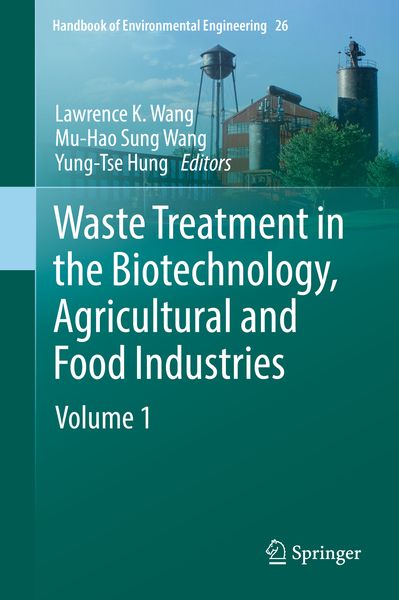
Waste Treatment in the Biotechnology, Agricultural and Food Industries Volume 1
-
- Hardcover ausgewählt
- Taschenbuch
- eBook
-
Sprache:Englisch
-
Auflage:1st edition 2022
- 1st edition 2022 139,99 € ausgewählt
- 1st ed. 2024 121,99 €
139,99 €
UVP
160,49 €
inkl. gesetzl. MwSt.,
Lieferung nach Hause
Beschreibung
Produktdetails
Einband
Gebundene Ausgabe
Erscheinungsdatum
08.09.2022
Herausgeber
Lawrence K. Wang + weitereVerlag
SpringerSeitenzahl
485
Maße (L/B/H)
24,1/16/3,1 cm
Gewicht
1008 g
Auflage
1st edition 2022
Sprache
Englisch
ISBN
978-3-031-03589-0
This book and its 2 sister books (Volumes 2 and 3) of the Handbook of Environmental Engineering (HEE) series have been designed to serve as a mini-series covering agricultural and green biotechnologies. It is expected to be of value to advanced undergraduate and graduate students, to designers of sustainable biological resources systems, and to scientists and researchers. The aim of these books is to provide information on treatment and management of agricultural, pharmaceutical and food wastes and to serve as a basis for advanced study or specialized investigation of the theory and analysis of various integrated environmental control and waste recycle systems.
Volume 1 covers topics on: treatment and management of livestock wastes; waste treatment in the pharmaceutical biotechnology industry using green environmental technologies; vermicomposting process for treating agricultural and food wastes; the impacts of climate change on agricultural, food, andpublic utility industries; innovative PACT activated sludge, CAPTOR activated sludge, activated bio-filter, vertical loop reactor, and PHOSTRIP processes; agricultural waste treatment by water hyacinth aquaculture, wetland aquaculture, evapotranspiration, rapid rate land treatment , slow rate land treatment, and subsurface infiltration; production and applications of crude polyhydroxyalkanoate-containing bioplastic from agricultural and food-processing wastes; optimization processes of biodiesel production from pig and neem seeds blend oil using alternative catalysts from waste biomass; making castor oil a promising source for the production of flavor and fragrance through lipase mediated biotransformation; and waste treatment and minimization in baker's yeast industry.
Kundinnen und Kunden meinen
Verfassen Sie die erste Bewertung zu diesem Artikel
Helfen Sie anderen Kund*innen durch Ihre Meinung
Kurze Frage zu unserer Seite
Vielen Dank für dein Feedback
Wir nutzen dein Feedback, um unsere Produktseiten zu verbessern. Bitte habe Verständnis, dass wir dir keine Rückmeldung geben können. Falls du Kontakt mit uns aufnehmen möchtest, kannst du dich aber gerne an unseren Kund*innenservice wenden.
zum Kundenservice