• Produktbild: The SAGE Handbook of Social Media Research Methods
  • Produktbild: The SAGE Handbook of Social Media Research Methods
- 30%

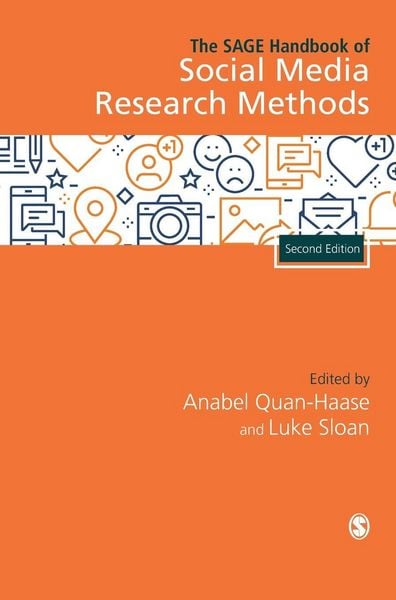
The SAGE Handbook of Social Media Research Methods

30% sparen

129,99 € UVP 186,40 €

inkl. gesetzl. MwSt., Versandkostenfrei

Lieferung nach Hause

Beschreibung

Produktdetails

Einband

Gebundene Ausgabe

Erscheinungsdatum

08.09.2022

Herausgeber

Quan-Haase Anabel + weitere

Verlag

Sage Publications

Seitenzahl

768

Maße (L/B/H)

25/17,5/4,5 cm

Gewicht

1420 g

Auflage

2. Auflage

Sprache

Englisch

ISBN

978-1-5297-2096-9

Beschreibung

Produktdetails

Einband

Gebundene Ausgabe

Erscheinungsdatum

08.09.2022

Herausgeber

Verlag

Sage Publications

Seitenzahl

768

Maße (L/B/H)

25/17,5/4,5 cm

Gewicht

1420 g

Auflage

2. Auflage

Sprache

Englisch

ISBN

978-1-5297-2096-9

EU-Ansprechpartner

Zeitfracht Medien GmbH
Ferdinand-Jühlke-Straße 7
99095 Erfurt
DE

Herstelleradresse

SAGE Publications
1 Oliver's Yard 55 City Road
EC1Y 1SP London
GB

Kundinnen und Kunden meinen

0 Bewertungen

Informationen zu Bewertungen

Zur Abgabe einer Bewertung ist eine Anmeldung im Konto notwendig. Die Authentizität der Bewertungen wird von uns nicht überprüft. Wir behalten uns vor, Bewertungstexte, die unseren Richtlinien widersprechen, entsprechend zu kürzen oder zu löschen.

Die Bewertungen sind nach Format, Anzahl Sterne und Datum sortiert.

Verfassen Sie die erste Bewertung zu diesem Artikel

Helfen Sie anderen Kund*innen durch Ihre Meinung

Kundinnen und Kunden meinen

0 Bewertungen filtern

Die Leseprobe wird geladen.
  • Produktbild: The SAGE Handbook of Social Media Research Methods
  • Produktbild: The SAGE Handbook of Social Media Research Methods
  • Chapter 1: Introduction - Anabel Quan-Haase & Luke Sloan
    Part 1: Conceptualising and Designing Social Media Research
    Chapter 2: Defining Social Media and Asking Social Media Research Questions: How Well Does the Swiss Army Knife Metaphor Apply? - Charlotte Nau, Anabel Quan-Haase, & Lori McCay-Peet
    Chapter 3: Before Methods: Social Media Research Considerations - Bree McEwan & Jesse Fox
    Chapter 4: Building Social Media Interdisciplinary Research Teams across Academia, Industry, and Community: Motivations, Challenges, and Policy Frameworks - Anabel Quan-Haase, Riley McLaughlin, & Lori McCay-Peet
    Chapter 5: Key Consideration in the Interpretation of Digital Trace Data - Andrew D. Nevin, Yimin Chen, Shuzhe Yang, & Anabel Quan-Haase
    Chapter 6: Who Uses Social Media? - Grant Blank
    Chapter 7: Representativeness and Bias in Social Media Research: Quantitative and Qualitative Approaches to Sampling - William Hollingshead, Anabel Quan-Haase, & Grant Blank
    Part 2: Collecting Data
    Chapter 8: Sourcing Data from Social Media via APIs - Dietmar Janetzko
    Chapter 9: Using Social Media in Data Collection: Designing Studies with the Qualitative E-Research Framework - Janet Salmons
    Chapter 10: Understanding Individual Web Browsing: Social Media Use in Context - Ericka Menchen-Trevino & Chris J. Karr
    Chapter 11: Gathering Behavioural Data from User-Provided Social Media Downloads - Jazmin A. Reyes-Portillo, Chris J. Karr, & Marya E. Corden
    Part 3: Qualitative Approaches to Social Media Data
    Chapter 12: Small Data, Thick Data: Data Thickening Strategies for Social Media Research - Guillaume Latzko-Toth, Claudine Bonneau, & Melanie Millette
    Chapter 13: Scaling Up Qualitative Research Methods with Natural Language Processing Tools: The Case-Study of the Columbia's 2018 Presidential Election in Twitter - Erin Huner & Juan Luis Suárez
    Chapter 14: The Visual in Social Media: Understanding Visual Objects, Mobilities, and Practices - Martin Hand
    Chapter 15: Twitter as Method: Using Twitter as a Tool to Conduct Ethnographic Research - Bonnie Stewart
    Chapter 16: Netnography - An Approach to Ethnography in the Digital Age - Alex Fenton & Keith Parry
    Chapter 17: Corpus-Assisted Critical Discourse Analysis of Social Media Data: Tools and Techniques - Jaigris Hodson & Laura M. Lefevre
    Chapter 18: Small Stories Research: A Narrative Paradigm for the Analysis of Social Media - Alexandra Georgakopoulou
    Part 4: Quantitative Approaches to Social Media Data
    Chapter 19: Geospatial Analysis - Olga Buchel & Diane Rasmussen Pennington
    Chapter 20: Predictive Analytics with Social Media Data - Niels Buus Lassen, Lisbeth la Cour, & Ravi Vatrapu
    Chapter 21: Machine Learning and Neural Network Language Models for Sentiment Analysis - John McLevey & Tyler Crick
    Chapter 22: The Multi-Scalar Complexities of Analysing the City through Social Media Data - Pablo Marti & Leticia Serrano-Estrada
    Chapter 23: Multiscale Functional Communities - Olga Buchel & Leila Hedayatifar
    Part 5: Diverse Approaches to Social Media Data
    Chapter 24: Innovative Social Location-Aware Services for Mobile Phones - Bernhard Klein & Ulf-Dietrich Reips
    Chapter 25: The Good, the Bad and the How-To of Analyzing Social Media Data - Frauke Zeller
    Chapter 26: Situating Location Data in Social Media Research - Darryl Pieber
    Chapter 27: Content Verification for Social Media: From Deception Detection to Automated Fact-Checking - Victoria L. Rubin
    Part 6: Research & Analytical Tools
    Chapter 28: COSMOS 2.0: The Journey of Developing a Social Analytic Tool - Mohamed Mostafa & Arron Cullen
    Chapter 29: Social Lab: An 'Open Source Facebook' - Ulf-Dietrich Reips & Pablo Garaizar
    Chapter 30: A Python Tutorial for Social Scientists: Using the YouTube API and Advanced Supervised Text Classification Methods to Detect COVID-19 Toxic (Misinformation) Comments on YouTube - Morteza Shahrezaye, Fabienne Marco, Joana Bayraktar, & Simon Hegelich
    Chapter 31: R for Social Media Analysis - Saurabh Dhawan & Simon Hegelich
    Chapter 32: Using Netlytic to Analyze Twitter Conversation about the 2014 Euromaidan Revolution in Ukraine - Anatoliy Gruzd, Philip Mai, & Andrea Kampen
    Chapter 33: Computational Temporal Thematic Analysis of Social Media Data - Danial Angus
    Chapter 34: NodeXL - Twitter Social Media Network Insights in Just a Few Clicks - Wasim Ahmed, Harald Meier, & Marc Smith
    Chapter 35: Studying Anti-Social Behaviour on Reddit with Communalytic - Anatoliy Gruzd, Philip Mai, & Zahra Vahedi
    Chapter 36: Sentiment Analysis - Mike Thelwall
    Part 7: Social Media Platforms
    Chapter 37: Coding Twitter Data Using Qualitative and Computational Methods: A Mixed Methods Framework - Dhiraj Murthy
    Chapter 38: The Reddit Data Analysis Pipeline for Researchers - Yadira Lizama-Mué & Juan Luis Suárez
    Chapter 39: Turning to Alternative Social Media - Gordon Gow
    Chapter 40: Instagram Revisited - Linnea Laestadius & Alice Witt
    Chapter 41: WeChat - Jimman Zhang & Anabel Quan-Haase
    Chapter 42: Collecting and Analyzing Weibo Data: A Roadmap for Social Research - Zhifan Luo & Muyang Li
    Chapter 43: Social Media for Joint Experimental, Survey, and Observational Data Collection: The case of VKontakte (VK) - Olessia Koltsova
    Chapter 44: Researching YouTube: Methods, Tools, and Analytics - M. Laeeq Khan & Aqdas Malik
    Chapter 45: Researching TikTok: Themes, Methods, and Future Directions - Alex Miltsov
    Part 8: Privacy, Ethics and Inequalities
    Chapter 46: Inequalities in Social Media Use and their Implications for Digital Methods Research - Christoph Lutz
    Chapter 47: Linking Twitter and Survey Data: Gaining Consent, Making the Link, and Maintaining Data Security - Luke Sloan, Tarek Al Baghal, & Curtis Jessop
    Chapter 48: Ethics of Using Social Media Data in Research: Users' Views - Jenna Jacobson & Irina Gorea
    Chapter 49: Privacy, Consent, and Confidentiality in Social Media Research - Jacquie Burkell, Priscilla M. Regan, & Valerie Steeves