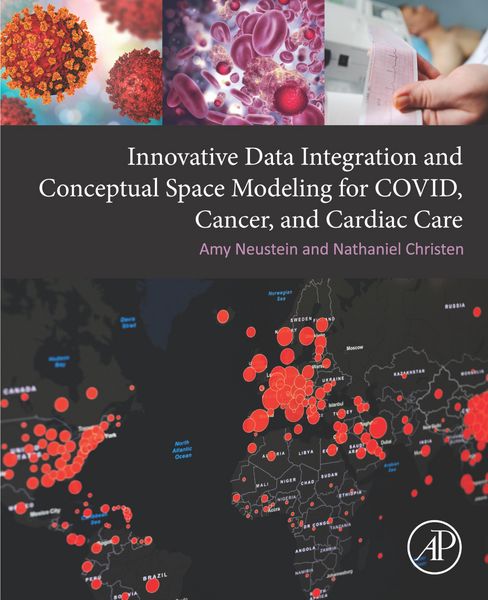
Innovative Data Integration and Conceptual Space Modeling for COVID, Cancer, and Cardiac Care
-
- Taschenbuch
- eBook ausgewählt
-
Form:Einzelkauf Download
-
Sprache:Englisch
148,00 €
inkl. gesetzl. MwSt.Beschreibung
Produktdetails
Format
ePUB 3
Kopierschutz
Nein
Family Sharing
Nein
Text-to-Speech
Ja
Erscheinungsdatum
18.01.2022
Verlag
Elsevier Science & Techn.Seitenzahl
286 (Printausgabe)
Dateigröße
16924 KB
Sprache
Englisch
EAN
9780323853569
In recent years, scientific research and translation medicine have placed increased emphasis on computational methodology and data curation across many disciplines, both to advance underlying science and to instantiate precision-medicine protocols in the lab and in clinical practice. The nexus of concerns related to oncology, cardiology, and virology (SARS-CoV-2) presents a fortuitous context within which to examine the theory and practice of biomedical data curation.
Innovative Data Integration and Conceptual Space Modeling for COVID, Cancer, and Cardiac Care argues that a well-rounded approach to data modeling should optimally embrace multiple perspectives inasmuch as data-modeling is neither a purely formal nor a purely conceptual discipline, but rather a hybrid of both. On the one hand, data models are designed for use by computer software components, and are, consequently, constrained by the mechanistic demands of software environments; data modeling strategies must accept the formal rigors imposed by unambiguous data-sharing and query-evaluation logic. In particular, data models are not well-suited for software-level deployment if such models do not translate seamlessly to clear strategies for querying data and ensuring data integrity as information is moved across multiple points. On the other hand, data modeling is, likewise, constrained by human conceptual tendencies, because the information which is managed by databases and data networks is ultimately intended to be visualized/utilized by humans as the end-user.
Thus, at the intersection of both formal and humanistic methodology, data modeling takes on elements of both logico-mathematical frameworks (e.g., type systems and graph theory) and conceptual/philosophical paradigms (e.g., linguistics and cognitive science). The authors embrace this two-sided aspect of data models by seeking non-reductionistic points of convergence between formal and humanistic/conceptual viewpoints, and by leveraging biomedical contexts (viz., COVID, Cancer, and Cardiac Care) so as to provide motivating examples and case-studies in this volume.
- Provides an analysis of how conceptual spaces and related cognitive linguistic approaches can inspire programming and query-processing models
- Outlines the vital role that data modeling/curation has played in significant medical breakthroughs
- Presents readers with an overview of how information-management approaches intersect with precision medicine, providing case studies of data-modeling in concrete scientific practice
- Explores applications of image analysis and computer vision in the context of precision medicine
- Examines the role of technology in scientific publishing, replication studies, and dataset curation
Innovative Data Integration and Conceptual Space Modeling for COVID, Cancer, and Cardiac Care argues that a well-rounded approach to data modeling should optimally embrace multiple perspectives inasmuch as data-modeling is neither a purely formal nor a purely conceptual discipline, but rather a hybrid of both. On the one hand, data models are designed for use by computer software components, and are, consequently, constrained by the mechanistic demands of software environments; data modeling strategies must accept the formal rigors imposed by unambiguous data-sharing and query-evaluation logic. In particular, data models are not well-suited for software-level deployment if such models do not translate seamlessly to clear strategies for querying data and ensuring data integrity as information is moved across multiple points. On the other hand, data modeling is, likewise, constrained by human conceptual tendencies, because the information which is managed by databases and data networks is ultimately intended to be visualized/utilized by humans as the end-user.
Thus, at the intersection of both formal and humanistic methodology, data modeling takes on elements of both logico-mathematical frameworks (e.g., type systems and graph theory) and conceptual/philosophical paradigms (e.g., linguistics and cognitive science). The authors embrace this two-sided aspect of data models by seeking non-reductionistic points of convergence between formal and humanistic/conceptual viewpoints, and by leveraging biomedical contexts (viz., COVID, Cancer, and Cardiac Care) so as to provide motivating examples and case-studies in this volume.
- Provides an analysis of how conceptual spaces and related cognitive linguistic approaches can inspire programming and query-processing models
- Outlines the vital role that data modeling/curation has played in significant medical breakthroughs
- Presents readers with an overview of how information-management approaches intersect with precision medicine, providing case studies of data-modeling in concrete scientific practice
- Explores applications of image analysis and computer vision in the context of precision medicine
- Examines the role of technology in scientific publishing, replication studies, and dataset curation
Kundinnen und Kunden meinen
Verfassen Sie die erste Bewertung zu diesem Artikel
Helfen Sie anderen Kund*innen durch Ihre Meinung
Kurze Frage zu unserer Seite
Vielen Dank für dein Feedback
Wir nutzen dein Feedback, um unsere Produktseiten zu verbessern. Bitte habe Verständnis, dass wir dir keine Rückmeldung geben können. Falls du Kontakt mit uns aufnehmen möchtest, kannst du dich aber gerne an unseren Kund*innenservice wenden.
zum Kundenservice