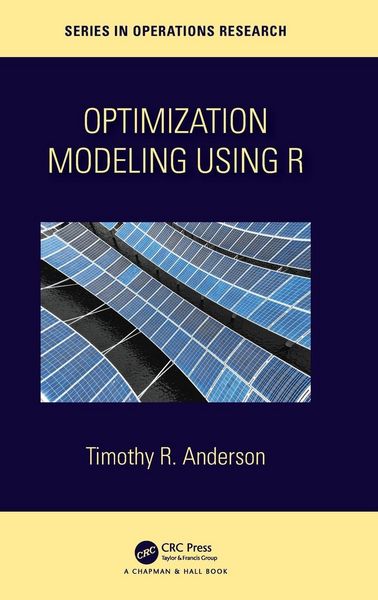
Optimization Modelling Using R
-
- Hardcover ausgewählt
- Taschenbuch
- eBook
-
Sprache:Englisch
155,99 €
inkl. gesetzl. MwSt.,
Beschreibung
Produktdetails
Einband
Gebundene Ausgabe
Erscheinungsdatum
05.07.2022
Abbildungen
41 SW-Abb., 41 SW-Zeichn., 117 Tabellen
Verlag
Taylor & FrancisSeitenzahl
300
Maße (L/B/H)
24/16,1/2,1 cm
Gewicht
566 g
Sprache
Englisch
ISBN
978-0-367-50789-3
This book covers using R for doing optimization, a key area of operations research, which has been applied to virtually every industry. The focus is on linear and mixed integer optimization. It uses an algebraic modeling approach for creating formulations that pairs naturally with an algebraic implementation in R.
With the rapid rise of interest in data analytics, a data analytics platform is key. Working technology and business professionals need an awareness of the tools and language of data analysis. R reduces the barrier to entry for people to start using data analytics tools.
Philosophically, the book emphasizes creating formulations before going into
implementation. Algebraic representation allows for clear understanding and generalization
of large applications, and writing formulations is necessary to explain and convey the modeling decisions made.
Appendix A introduces R. Mathematics is used at the level of subscripts and summations Refreshers are provided in Appendix B.
This book:
- Provides and explains code so examples are relatively clear and self-contained.
- Emphasizes creating algebraic formulations before implementing.
- Focuses on application rather than algorithmic details.
- Embodies the philosophy of reproducible research.
- Uses open-source tools to ensure access to powerful optimization tools.
- Promotes open-source: all materials are available on the author's github repository.
- Demonstrates common debugging practices with a troubleshooting emphasis specific to optimization modeling using R.
- Provides code readers can adapt to their own applications
.
This book can be used for graduate and undergraduate courses for students without a background in optimization and with varying mathematical backgrounds.
Noch keine Bewertungen vorhanden
Verfassen Sie die erste Bewertung zu diesem Artikel
Helfen Sie anderen Kundinnen und Kunden durch Ihre Meinung.
Kurze Frage zu unserer Seite
Vielen Dank für dein Feedback
Wir nutzen dein Feedback, um unsere Produktseiten zu verbessern. Bitte habe Verständnis, dass wir dir keine Rückmeldung geben können. Falls du Kontakt mit uns aufnehmen möchtest, kannst du dich aber gerne an unseren Kund*innenservice wenden.
zum Kundenservice