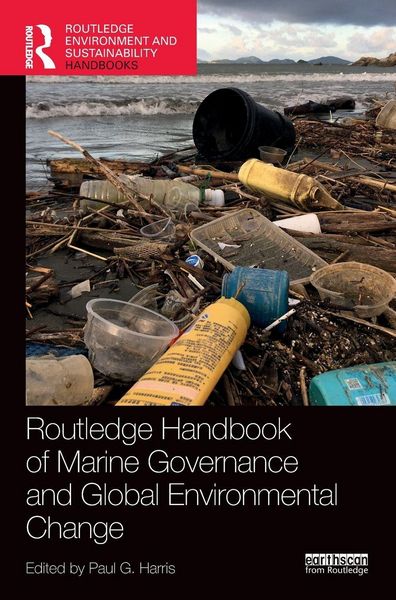
Routledge Handbook of Marine Governance and Global Environmental Change
-
- Hardcover ausgewählt
- Taschenbuch
- eBook
-
Sprache:Englisch
275,99 €
UVP
313,40 €
inkl. gesetzl. MwSt.,
Beschreibung
Produktdetails
Einband
Gebundene Ausgabe
Erscheinungsdatum
16.06.2022
Abbildungen
12 SW-Abb., 1 SW-Fotos, 11 SW-Zeichn., 15 Tabellen
Herausgeber
Harris Paul G.Verlag
Taylor & FrancisSeitenzahl
344
Maße (L/B/H)
25/17,5/2,3 cm
Gewicht
774 g
Sprache
Englisch
ISBN
978-1-138-55591-4
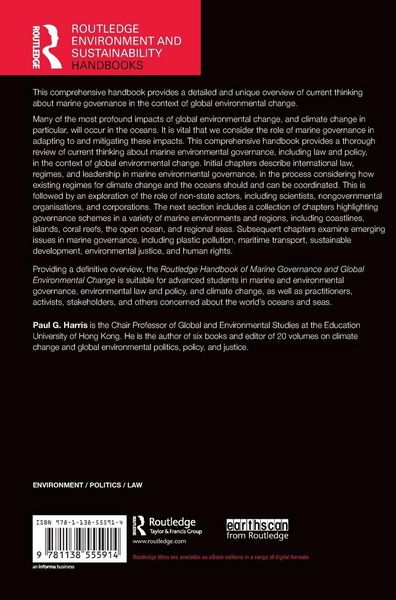
This comprehensive handbook provides a detailed and unique overview of current thinking about marine governance in the context of global environmental change.
Many of the most profound impacts of global environmental change, and climate change in particular, will occur in the oceans . It is vital that we consider the role of marine governance in adapting to and mitigating these impacts. This comprehensive handbook provides a thorough review of current thinking about marine environmental governance, including law and policy, in the context of global environmental change. Initial chapters describe international law, regimes, and leadership in marine environmental governance, in the process considering how existing regimes for climate change and the oceans should and can be coordinated. This is followed by an exploration of the role of non-state actors, including scientists, nongovernmental organisations, and corporations. The next section includes a collection of chapters highlighting governance schemes in a variety of marine environments and regions, including coastlines, islands, coral reefs, the open ocean, and regional seas. Subsequent chapters examine emerging issues in marine governance, including plastic pollution, maritime transport, sustainable development, environmental justice, and human rights.
Providing a definitive overview, the Routledge Handbook of Marine Governance and Global Environmental Change is suitable for advanced students in marine and environmental governance, environmental law and policy, and climate change, as well as practitioners, activists, stakeholders , and others concerned about the world's oceans and seas.
Noch keine Bewertungen vorhanden
Verfassen Sie die erste Bewertung zu diesem Artikel
Helfen Sie anderen Kundinnen und Kunden durch Ihre Meinung.
Kurze Frage zu unserer Seite
Vielen Dank für dein Feedback
Wir nutzen dein Feedback, um unsere Produktseiten zu verbessern. Bitte habe Verständnis, dass wir dir keine Rückmeldung geben können. Falls du Kontakt mit uns aufnehmen möchtest, kannst du dich aber gerne an unseren Kund*innenservice wenden.
zum Kundenservice