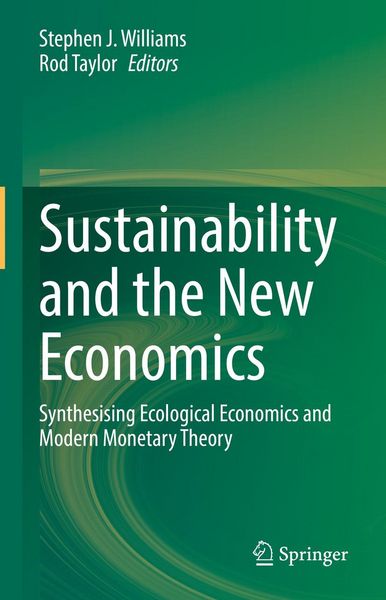
Sustainability and the New Economics Synthesising Ecological Economics and Modern Monetary Theory
-
- Hardcover
- Taschenbuch
- eBook ausgewählt
-
Form:Einzelkauf Download
-
Sprache:Englisch
160,49 €
inkl. gesetzl. MwSt.Beschreibung
Produktdetails
Format
Kopierschutz
Nein
Family Sharing
Nein
Text-to-Speech
Nein
Erscheinungsdatum
09.12.2021
Herausgeber
Stephen J. Williams + weitereVerlag
Springer Nature SwitzerlandSeitenzahl
344 (Printausgabe)
Dateigröße
7084 KB
Sprache
Englisch
EAN
9783030787950
This multidisciplinary book provides new insights and hope for sustainable prosperity given recent developments in economics - but only if swift and strong actions consistent with Earth's biophysical limits and principles of justice are universally taken.
It is one thing to put limits on resource throughput and waste generation to conform with the ecosphere's biocapacity. It is another thing to efficiently allocate a sustainable rate of resource throughput and ensure it is equitably distributed in the form of final goods and services. While the separate but interdependent decisions regarding throughput, distribution, and allocation are the essence of ecological economics, dealing with them in a world that needs to cure its growth addiction requires a realistic understanding of macroeconomics and the fiscal capacity of currency-issuing central governments. Sustainable prosperity demands that we harness this understanding to carefully regulate the rate of resource throughput and manipulate macroeconomic outcomes to facilitate human flourishing.
The book begins by outlining humanity's current predicament of gross ecological overshoot and laments the half-century of missed opportunities since The Limits to Growth (1972). What was once economic growth has become, in many high-income countries, uneconomic growth (additional costs exceeding additional benefits), which is no longer advancing wellbeing. Meanwhile, low-income nations need a dose of efficient and equitable growth to escape poverty while protecting their environments and the global commons.
The book argues for a synthesis of our increasing knowledge of the ecosphere's limited carrying capacity and the power of governments to harness, transform, and distribute resources for the common good. Central to this synthesis must be a correct understanding of the difference between financial constraints and real resource constraints. While the latter apply to everyone, the former do not apply to currency-issuing central governments, which have much more capacity for corrective action than mainstream thinking perceives.
The book joins the growing chorus of authoritative voices calling for a complete overhaul of the dominant economic system. We conclude with policy recommendations based on a new economics that, if implemented, would come close to guaranteeing a sustainable and prosperous future.
Upon reading this book, at least one thing should be crystal clear: business as usual is not a viable option.
Kundinnen und Kunden meinen
Verfassen Sie die erste Bewertung zu diesem Artikel
Helfen Sie anderen Kund*innen durch Ihre Meinung
Kurze Frage zu unserer Seite
Vielen Dank für dein Feedback
Wir nutzen dein Feedback, um unsere Produktseiten zu verbessern. Bitte habe Verständnis, dass wir dir keine Rückmeldung geben können. Falls du Kontakt mit uns aufnehmen möchtest, kannst du dich aber gerne an unseren Kund*innenservice wenden.
zum Kundenservice