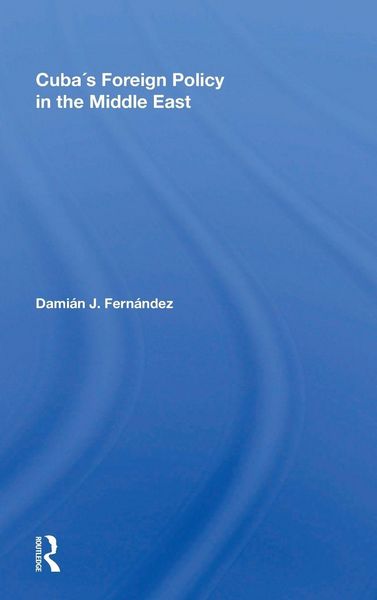
Cuba's Foreign Policy In The Middle East
-
- Hardcover ausgewählt
- Taschenbuch
- eBook
-
Sprache:Englisch
235,99 €
inkl. gesetzl. MwSt.,
Beschreibung
Produktdetails
Einband
Gebundene Ausgabe
Erscheinungsdatum
29.11.2021
Verlag
Taylor & FrancisSeitenzahl
172
Maße (L/B/H)
22,9/15,2/1,1 cm
Gewicht
404 g
Sprache
Englisch
ISBN
978-0-367-01388-2
In spite of the growing academic interest in Cuba's international relations in the revolutionary period. Cuba's policy toward the Middle East has been a neglected field of study. Although the Middle East has not been a high priority item on Fidel Castro's agenda, various factors have combined to propel the regime into taking a more active stance in the region, not least of which is the importance of the Middle East to the Soviet Union. Some of these factors have been ideological, such as the nature of Castroism itself. Other factors have been more pragmatic: the need to increase Cuba's leverage with the Soviet Union; the desire to establish spheres of interest of its own in the Third World; the attempt to use external politics to soothe internal problems and the wish to maximize the prestige of the Cuban revolution, and, by extension, that of its lider maximo. Since 1959, Havana's Middle Eastern policy has experienced four stages: (1) 1959-1973: Autonomous foreign policy, marked by a dual relationship with both Israel and the Arab states. (2) 1973-1977: Accommodation to the Soviet line; anti-Israeli policy combined with an expansion of relations with progressive states, signalled by the establishment of Cuban military missions. (3) 1977-1980: Activist policy in the region, expanded role and development of diplomatic relationships. (4) 1981 to the present (1985): Cautious involvement; restrained activism, emphasizing socio-economic cooperation. Cuba's incursion into the Arab world illuminates how Cuban foreign policy works, especially in relation to autonomy, convergence, and subordination; dependence, pragmatism, and ideology. The island's entrance into Middle East politics has introduced new risks into the island's foreign policy in return for the benefits which have been derived. A theory to explain Cuba's foreign policy in its interaction with the Soviet Union in the Third World must include heretofore neglected variables: time; regime type; and factionalism (bureaucratic politics), in addition to external events. The study of Cuba's initiatives in the Middle East will serve to test this theory.
Noch keine Bewertungen vorhanden
Verfassen Sie die erste Bewertung zu diesem Artikel
Helfen Sie anderen Kundinnen und Kunden durch Ihre Meinung.
Kurze Frage zu unserer Seite
Vielen Dank für dein Feedback
Wir nutzen dein Feedback, um unsere Produktseiten zu verbessern. Bitte habe Verständnis, dass wir dir keine Rückmeldung geben können. Falls du Kontakt mit uns aufnehmen möchtest, kannst du dich aber gerne an unseren Kund*innenservice wenden.
zum Kundenservice