Gutscheinbedingungen

**Gültig vom 24.08.2026 bis 26.08.2026 | Gültig für nicht preisgebundene fremdsprachige Bücher | Einzelne Artikel können ausgeschlossen sein | Online auf www.bücher.de einlösbar | Click & Collect nur mit Online-Zahlung (Paypal/Kreditkarte) vorab | Nicht kombinierbar mit anderen Gutscheinen oder Preisaktionen | Nur einmal pro Einkauf einlösbar | Gutschein wird auf max. 500€ Bestellwert angerechnet | Keine Barauszahlung | Nicht gültig für Versandkosten und Services

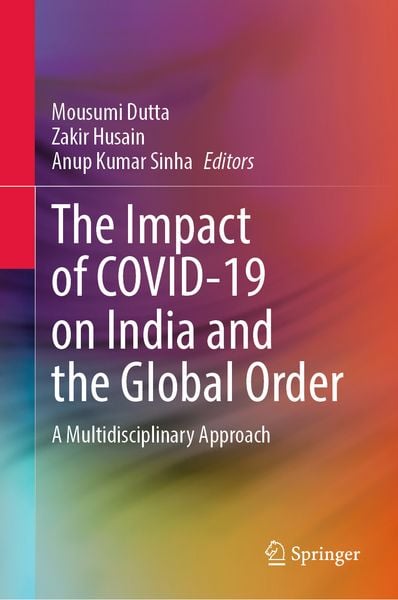
  • Produktbild: The Impact of COVID-19 on India and the Global Order
  • Produktbild: The Impact of COVID-19 on India and the Global Order

The Impact of COVID-19 on India and the Global Order A Multidisciplinary Approach

106,99 €

inkl. gesetzl. MwSt., Versandkostenfrei


Beschreibung

Produktdetails

Einband

Gebundene Ausgabe

Erscheinungsdatum

19.02.2022

Abbildungen

XVI, 334 p. 60 illus., 53 illus. in color.

Herausgeber

Mousumi Dutta + weitere

Verlag

Springer Singapore

Seitenzahl

334

Maße (L/B/H)

24,1/16/2,5 cm

Gewicht

694 g

Auflage

1st ed. 2022

Sprache

Englisch

ISBN

978-981-16-8471-5

Beschreibung

Portrait


Mousumi Dutta is currently Professor and Head of the Economics Department, Presidency University, Kolkata. She is Gold Medalist in M.Sc. (Economics) from Calcutta University and completed her doctoral degree on “Economics of conservation of built heritage: the case of Kolkata” from the same University. She has been Principal or Co Investigator in projects funded by The International Growth Center, London School of Economics; Rosa Luxemburg Society, Berlin, ICSSR, and UGC. Professor Dutta has worked extensively on the built environment, health and gender issues and published in journals like Tourism Management, Journal of Cultural Heritage, Social Indicators Research, and Journal of International Development. Professor Dutta has also published books on gender and reproductive health. She is also Co-Editor of a book on Opportunities and Challenges in Development. She has also presented her work in Stockholm University, Gutenburg University, Corvinus University, Leeds University,Winchester University, Liverpool University, Cardiff University, and Shanghai University.


Zakir Husain is Professor in the Economics Department, Presidency University, Kolkata. A graduate from Presidency College, he passed his Masters from Calcutta University; his Ph.D., also from Calcutta University, was on community management of natural resources. He uses econometric tools and methods to study issues related to exclusion and discrimination in gerontology, education, demography, and health. He has been Faculty in Institute of Economic Growth and Indian Institute of Technology Kharagpur, Senior Consultant in the Prime Minister’s High Level Committee to prepare report on status of Muslims, and Member of West Bengal Planning Board. He has presented in several Universities in Asia and Europe and has been involved with projects funded by The World Bank, Rosa Luxemburg Society, The Indian Growth Centre, Cancer Research UK, Niti Ayog, etc., as one of the investigators.


AnupSinha is currently Chief Mentor, Heritage Business School and Chairman Bandhan Bank Limited. He was Professor of Economics at IIM Calcutta where he taught economics from 1991 to 2016 when he retired. He was educated at Presidency College Calcutta, University of Rochester, New York, and University of Southern California, Los Angeles, from where he received his Ph.D. He has taught at Presidency College, University of Calcutta, Indian Statistical Institute, and held visiting appointments at University of Southern California, Washington University in St. Louis, and Curtin University of Technology at Perth and Kyoto University. His academic interests including publications are in the areas of macroeconomic policy, development strategies, and sustainable development and ethics. He has served three terms on the Board of Governors IIM Calcutta and had also served as Dean of the Institute during 2003–2006. In 2004 and 2005, he received the Best Faculty Award from the Alumni of IIM Calcutta. In2012, 2014, and 2015, he was chosen as the Most Popular Teacher by outgoing MBA students.


Produktdetails

Einband

Gebundene Ausgabe

Erscheinungsdatum

19.02.2022

Abbildungen

XVI, 334 p. 60 illus., 53 illus. in color.

Herausgeber

Verlag

Springer Singapore

Seitenzahl

334

Maße (L/B/H)

24,1/16/2,5 cm

Gewicht

694 g

Auflage

1st ed. 2022

Sprache

Englisch

ISBN

978-981-16-8471-5

Herstelleradresse

Springer-Verlag KG
Sachsenplatz 4-6
1201 Wien
AT

Email: GPSR Kontakt

Noch keine Bewertungen vorhanden

Verfassen Sie die erste Bewertung zu diesem Artikel

Helfen Sie anderen Kundinnen und Kunden durch Ihre Meinung.

Kundinnen und Kunden meinen

Bewertungen (0)

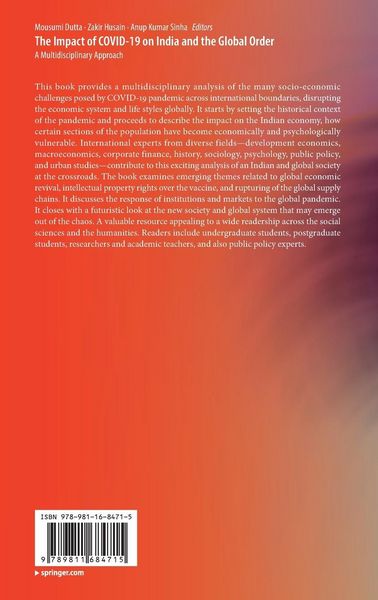
  • Produktbild: The Impact of COVID-19 on India and the Global Order
  • Produktbild: The Impact of COVID-19 on India and the Global Order

  • Chapter 1. Zoonotic pathogens, human lives, and pandemics in the age of the Anthropocene.- Chapter 2. India’s lockdown: An Interim Report.- Chapter 3. The Covid-19 Shock and the Indian Economy – A Cross-Country Comparative Analysis.- Chapter 4. Data as Guide to Policy: Bills of Mortality of 17th Century and Covid-19 of 2020.- Chapter 5. Regional Disparity Migration and Pandemic: Issues of Labour market Integration and Future of Cities.- Chapter 6. How can we facilitate psychological recovery following the COVID-19 pandemic?.- Chapter 7. How susceptible is the black and ethnic minority (bame)? An analysis of covid-19 mortality in england.- Chapter 8. Effects from pandemics and stagnation.- Chapter 9. Festival of Death:  Global Stock Markets during the Pandemic.- Chapter 10. The Pandemic and the New Corporate Sector: “Winners”and “Losers" and what lies ahead.- Chapter 11. Populists, pragmatists and pandemics: explaining the variance in response of democracies to sars-covid-19.- Chapter 12. Patent protection and access to covid-19 medical Products in Developing Countries.- Chapter 13. Pandemic, Market structures and Institutions.- Chapter 14. Integration without Coordination: Revisiting Globalization in the Light of the Pandemic.- Chapter 15. The Covid-19 pandemic and happiness.