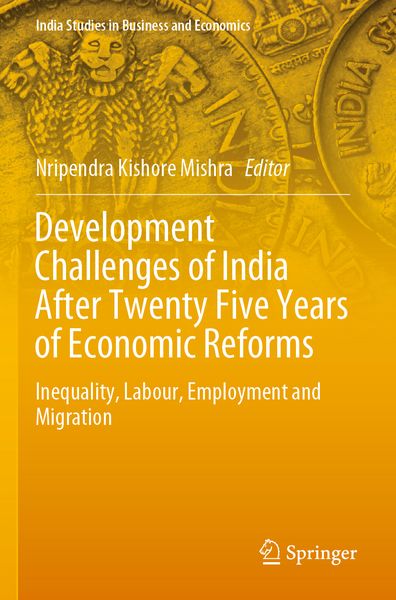
Development Challenges of India After Twenty Five Years of Economic Reforms Inequality, Labour, Employment and Migration
-
- Hardcover
- Taschenbuch ausgewählt
- eBook
-
Sprache:Englisch
97,99 €
inkl. gesetzl. MwSt.,
Beschreibung
Produktdetails
Einband
Taschenbuch
Erscheinungsdatum
16.10.2021
Abbildungen
XIII, 469 p. 51 illus., 49 illus. in color.
Herausgeber
Nripendra Kishore MishraVerlag
Springer SingaporeSeitenzahl
469
Maße (L/B/H)
23,5/15,5/2,7 cm
Gewicht
727 g
Auflage
1st ed. 2020
Sprache
Englisch
ISBN
978-981-15-8267-7
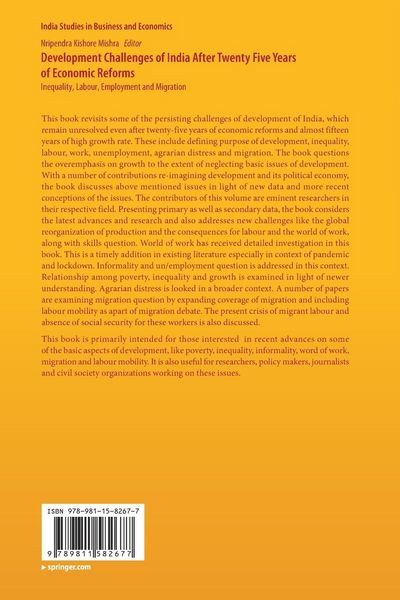
This book revisits some of the persisting challenges of development of India, which remain unresolved even after twenty-five years of economic reforms and almost fifteen years of high growth rate. These include defining purpose of development, inequality, labour, work, unemployment, agrarian distress and migration. The book questions the overemphasis on growth to the extent of neglecting basic issues of development. With a number of contributions re-imagining development and its political economy, the book discusses above mentioned issues in light of new data and more recent conceptions of the issues. The contributors of this volume are eminent researchers in their respective field. Presenting primary as well as secondary data, the book considers the latest advances and research and also addresses new challenges like the global reorganization of production and the consequences for labour and the world of work, along with skills question. World of work has received detailed investigation in this book. This is a timely addition in existing literature especially in context of pandemic and lockdown. Informality and un/employment question is addressed in this context. Relationship among poverty, inequality and growth is examined in light of newer understanding. Agrarian distress is looked in a broader context. A number of papers are examining migration question by expanding coverage of migration and including labour mobility as apart of migration debate. The present crisis of migrant labour and absence of social security for these workers is also discussed.
This book is primarily intended for those interested in recent advances on some of the basic aspects of development, like poverty, inequality, informality, word of work, migration and labour mobility. It is also useful for researchers, policy makers, journalists and civil society organizations working on these issues.Noch keine Bewertungen vorhanden
Verfassen Sie die erste Bewertung zu diesem Artikel
Helfen Sie anderen Kundinnen und Kunden durch Ihre Meinung.
Kurze Frage zu unserer Seite
Vielen Dank für dein Feedback
Wir nutzen dein Feedback, um unsere Produktseiten zu verbessern. Bitte habe Verständnis, dass wir dir keine Rückmeldung geben können. Falls du Kontakt mit uns aufnehmen möchtest, kannst du dich aber gerne an unseren Kund*innenservice wenden.
zum Kundenservice