Produktbild: Aphasia
- 20%

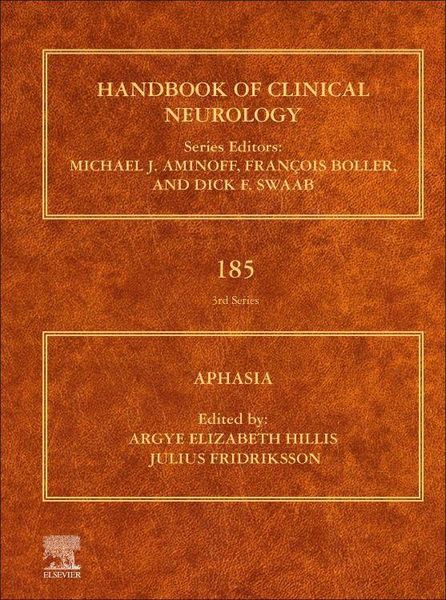
Aphasia Volume 185

20% sparen

207,99 € UVP 260,50 €

inkl. gesetzl. MwSt., Versandkostenfrei

Lieferung nach Hause

Beschreibung

Produktdetails

Einband

Gebundene Ausgabe

Erscheinungsdatum

06.07.2022

Herausgeber

Argye Elizabeth Hillis + weitere

Verlag

Elsevier Science & Technology

Seitenzahl

336

Maße (L/B/H)

19,7/27/2,5 cm

Gewicht

940 g

Sprache

Englisch

ISBN

978-0-12-823384-9

Beschreibung

Portrait

Dr. Argye Elizabeth Hillis is a Professor of Neurology, with joint faculty appointments in Physical Medicine and Rehabilitation and in Cognitive Science at Johns Hopkins University. Dr. Hillis serves as the Executive Vice Chair of the Department of Neurology, and Director of the Cerebrovascular Division of Neurology.
Dr. Hillis is Deputy Editor of Stroke and Associate Editor of Aphasiology and has served as Co-Editor-in Chief of Behavioural Neurology, Associate Editor of Brain, Annals of Neurology, American Journal of Speech-Language Pathology, Cognitive Neuropsychology, and Language and Cognitive Processes. She also currently serves on the editorial boards of Annals of Neurology and International Journal of Stroke. Dr. Hillis was the 2003 recipient of the Derek Denny Brown Neurological Scholar Award from the American Neurological Association and the Norman Geschwind Award in Behavioral Neurology from the American Academy of Neurology. Her current research is supported by the National Institutes of Health (NINDS and NIDCD). She is on the Board of Directors of the World Stroke Organization.
Dr. Hillis' current research combines longitudinal task-related and task-free functional imaging and structural imaging from the acute stage of stroke through the first year of recovery, with detailed cognitive and language assessments to improve our understanding how language and other cognitive and emotional functions recover after stroke. She is investigating the most effective timing of neuromodulatory treatments, such as transcranial direct current stimulation and medications, to augment behavioral therapies after stroke. Her other avenue of research involves novel treatment studies and longitudinal imaging and language studies of Primary Progressive Aphasia. (PPA). She is currently studying three forms of treatment of PPA: language therapy and transcranial Direct Current Stimulation (in studies funded by NIDCD) and neurofeedback with aphasia therapy.

Dr. Fridriksson is a Professor and Interim Vice President for Research, University of South Carolina. He research focuses on the rehabilitation of aphasia and the neurobiology of speech and language processing. Dr. Fridriksson has a long history of external research funding (exceeding $40M), primarily from the National Institutes of Health (NIH). He also leads UofSC’s Center for the Study of Aphasia Recovery with collaborators at Johns Hopkins, the University of California-Irvine, and Emory University.
A USC Health Science Distinguished Professor and Co-Director of the McCausland Center for Brain Imaging since 2012, Dr. Fridriksson’s prior teaching experience includes various UofSC professorial positions of increasing responsibility, 2001-2021; and Research Fellow, University of Arizona, 1998-2001.
Dr. Fridriksson earned his Ph.D. in Speech and Hearing Sciences from the University of Arizona and both his M.A. in Speech-Language Pathology and B.A. in Communicative Disorders from University of Central Florida.

Produktdetails

Einband

Gebundene Ausgabe

Erscheinungsdatum

06.07.2022

Herausgeber

Verlag

Elsevier Science & Technology

Seitenzahl

336

Maße (L/B/H)

19,7/27/2,5 cm

Gewicht

940 g

Sprache

Englisch

ISBN

978-0-12-823384-9

Herstelleradresse

Libri GmbH
Europaallee 1
36244 Bad Hersfeld
DE

Email: gpsr@libri.de

Noch keine Bewertungen vorhanden

Verfassen Sie die erste Bewertung zu diesem Artikel

Helfen Sie anderen Kundinnen und Kunden durch Ihre Meinung.

Kundinnen und Kunden meinen

Bewertungen (0)

Die Leseprobe wird geladen.
  • Produktbild: Aphasia
  • Section 1. History and Conceptual Models of Language and the Brain
    1. History of aphasia: A broad overview
    2. Broca-Wernicke theories: A historical perspective
    Section 2. Neuroanatomy of Speech and Language
    3. Vascular syndromes: Revisiting classification of post-stroke aphasia
    4. The dual stream model of speech and language processing
    5. Types of motor speech impairments associated with neurologic diseases
    6. Clinical and neuroimaging characteristics of primary progressive aphasia
    7. The role of disrupted functional connectivity in aphasia
    8. The role of disrupted structural connectivity in aphasia
    Section 3. Language Recovery
    9. Functional MRI evidence for reorganization of language networks after stroke
    10. The contribution of positron emission tomography to the study of aphasia
    11. Electrophysiologic evidence of reorganization in post-stroke aphasia
    12. Assessment of language impairment and function
    Section 4. Language Intervention
    13. Behavioral interventions for post-stroke aphasia
    14. Behavioral interventions for primary progressive aphasia
    15. Noninvasive brain stimulation to augment language therapy for post-stroke aphasia
    16. Noninvasive brain stimulation to augment language therapy for primary progressive aphasia
    17. Better language through chemistry: Augmenting speech-language therapy with pharmacotherapy in the treatment of aphasia
    Section 5. Recent Advances
    18. Ethical considerations in the management of post-stroke aphasia
    19. Genetics in aphasia recovery
    20. Sign language aphasia