
Business Practice in Socialist Hungary, Volume 1 Creating the Theft Economy, 1945–1957
-
- Hardcover ausgewählt
- Taschenbuch
- eBook
-
Sprache:Englisch
126,99 €
inkl. gesetzl. MwSt.,
Beschreibung
Produktdetails
Einband
Gebundene Ausgabe
Erscheinungsdatum
30.01.2022
Abbildungen
XXIII, 306 p. 18 illus., 3 illus. in color.
Verlag
SpringerSeitenzahl
306
Maße (L/B/H)
21,6/15,3/2,3 cm
Gewicht
504 g
Auflage
22001 Auflage 1st edition 2022
Sprache
Englisch
ISBN
978-3-030-89183-1
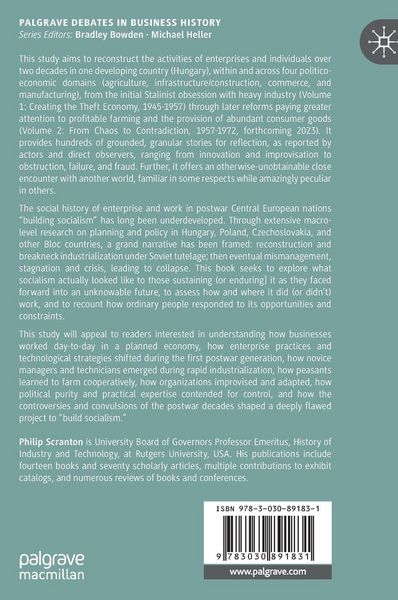
This study aims to reconstruct the activities of enterprises and individuals over two decades in one developing country (Hungary), within and across four politico-economic domains (agriculture, infrastructure/construction, commerce, and manufacturing), from the initial Stalinist obsession with heavy industry (Volume 1: Creating the Theft Economy, 1945-1957) through later reforms paying greater attention to profitable farming and the provision of abundant consumer goods (Volume 2: From Chaos to Contradiction, 1957-1972, forthcoming 2023). It provides hundreds of grounded, granular stories for reflection, as reported by actors and direct observers, ranging from innovation and improvisation to obstruction, failure, and fraud. Further, it offers an otherwise-unobtainable close encounter with another world, familiar in some respects while amazingly peculiar in others.
The social history of enterprise and work in postwar Central European nations “building socialism” has longbeen underdeveloped. Through extensive macro-level research on planning and policy in Hungary, Poland, Czechoslovakia, and other Bloc countries, a grand narrative has been framed: reconstruction and breakneck industrialization under Soviet tutelage; then eventual mismanagement, stagnation and crisis, leading to collapse. This book seeks to explore what socialism actually looked like to those sustaining (or enduring} it as they faced forward into an unknowable future, to assess how and where it did (or didn’t) work, and to recount how ordinary people responded to its opportunities and constraints.
This study will appeal to readers interested in understanding how businesses worked day-to-day in a planned economy, how enterprise practices and technological strategies shifted during the first postwar generation, how novice managers and technicians emerged during rapid industrialization, how peasants learned to farm cooperatively, how organizations improvised and adapted, howpolitical purity and practical expertise contended for control, and how the controversies and convulsions of the postwar decades shaped a deeply flawed project to “build socialism.”
Noch keine Bewertungen vorhanden
Verfassen Sie die erste Bewertung zu diesem Artikel
Helfen Sie anderen Kundinnen und Kunden durch Ihre Meinung.
Kurze Frage zu unserer Seite
Vielen Dank für dein Feedback
Wir nutzen dein Feedback, um unsere Produktseiten zu verbessern. Bitte habe Verständnis, dass wir dir keine Rückmeldung geben können. Falls du Kontakt mit uns aufnehmen möchtest, kannst du dich aber gerne an unseren Kund*innenservice wenden.
zum Kundenservice