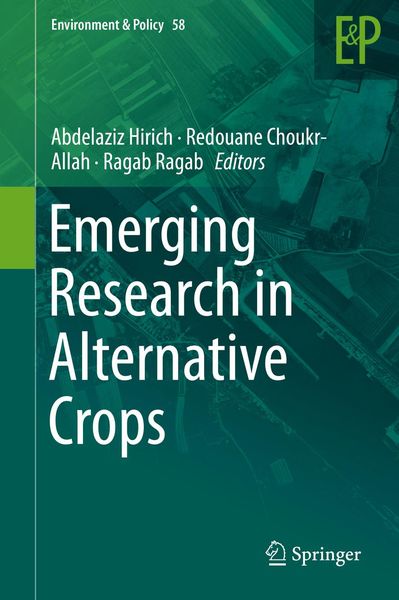
Emerging Research in Alternative Crops
160,49 €
inkl. gesetzl. MwSt.Beschreibung
Produktdetails
Format
Kopierschutz
Nein
Family Sharing
Nein
Text-to-Speech
Nein
Erscheinungsdatum
15.09.2020
Herausgeber
Abdelaziz Hirich + weitereVerlag
Springer Nature SwitzerlandSeitenzahl
376 (Printausgabe)
Dateigröße
12145 KB
Auflage
1st ed. 2020
Sprache
Englisch
EAN
9783319904726
This book provides case studies on cultivating alternative crops and presents new cropping systems in many regions of the world. It focusses on new emerging research topics aiming to study all aspects of adaptation under several stresses including agricultural, environmental, biological and socioeconomic issues. The book also provides operational and practical solutions for scientists, producers, technology developers and managers to succeed the cultivation of new alternative crops and, consequently, to achieve food security.
Many regions in the world are suffering from water scarcity, soil and water salinization and climate change. These conditions make it difficult to achieve food security by cultivating conventional crops. A renaissance of interest for producing alternative crops under water scarcity and water salinization has been, therefore, implemented primarily among small-scale producers, researchers and academics.
The use of alternative crops (quinoa, amaranth,legume crops, halophytes, ...etc.) may provide some environmental benefits such as valorization of salt-affected soils, reduced pesticide application, enhanced soil and water quality and promotion of wildlife diversity. This also may provide some economic benefits such as providing the opportunity for producers to take advantage of new markets and premium prices, spreading the economic risk and strengthening local economies and communities. Furthermore, alternative crops are often rich in proteins and minerals, and even some of them are Gluten free (quinoa). This reflects their importance to achieve food security in quantity and quality scale. The year 2013 was exceptional for alternative crops as it was the international year of quinoa celebrated by Food and Agriculture Organization (FAO). This reflects the importance of research conducted on quinoa and other alternative crops in many regions of the world.
Noch keine Bewertungen vorhanden
Verfassen Sie die erste Bewertung zu diesem Artikel
Helfen Sie anderen Kundinnen und Kunden durch Ihre Meinung.
Kurze Frage zu unserer Seite
Vielen Dank für dein Feedback
Wir nutzen dein Feedback, um unsere Produktseiten zu verbessern. Bitte habe Verständnis, dass wir dir keine Rückmeldung geben können. Falls du Kontakt mit uns aufnehmen möchtest, kannst du dich aber gerne an unseren Kund*innenservice wenden.
zum Kundenservice