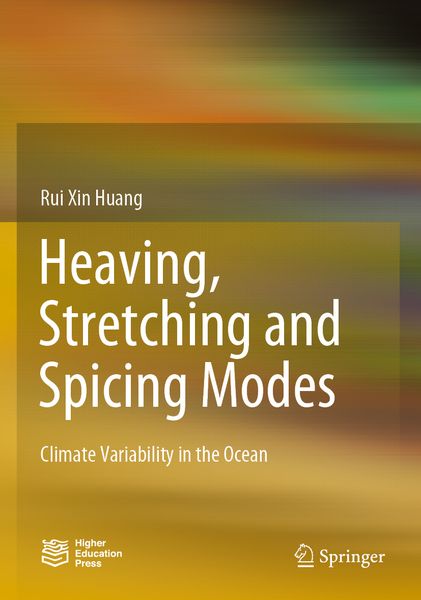
Heaving, Stretching and Spicing Modes Climate Variability in the Ocean
-
- Hardcover
- Taschenbuch ausgewählt
- eBook
-
Sprache:Englisch
134,99 €
inkl. gesetzl. MwSt.,
Lieferung nach Hause
Beschreibung
Produktdetails
Einband
Taschenbuch
Erscheinungsdatum
21.08.2021
Verlag
Springer SingaporeSeitenzahl
391
Maße (L/B/H)
25,4/17,8/2,2 cm
Auflage
1st ed. 2020
Sprache
Englisch
ISBN
978-981-15-2943-6
This book is focused on fundamental aspects of climate variability in the ocean, in particular changes of the wind-driven circulation. The vertical movement of isopycnal (isothermal) layers, including their stretching and compression, is called heaving and stretching. A major part of climate variability in the ocean is heaving in nature. Heave is primarily associated with the adiabatic motions of isopycnal layers due to change of wind stress. It is rather difficult to separate the contributions from adiabatic and diabatic processes.
Isopycnal analysis has been widely used in climate study; however, it is much more accurate to study the isopycnal layers. Here climate signals are examined in terms of changes of layer depth, layer thickness, layer temperature/salinity, spicity and others.
In addition to the traditional Theta-S diagram, the sigma-pi (potential density – potential spicity) diagram can also be used in analyzing water mass property distribution and climatevariability. In fact, a radius of signal can be defined rigorously for signals in the sigma-pi diagram; the combination of isopycnal analysis and evaluation of radius of signal provides a powerful tool in analyzing climate variability in the world oceans.
Noch keine Bewertungen vorhanden
Verfassen Sie die erste Bewertung zu diesem Artikel
Helfen Sie anderen Kundinnen und Kunden durch Ihre Meinung.
Kurze Frage zu unserer Seite
Vielen Dank für dein Feedback
Wir nutzen dein Feedback, um unsere Produktseiten zu verbessern. Bitte habe Verständnis, dass wir dir keine Rückmeldung geben können. Falls du Kontakt mit uns aufnehmen möchtest, kannst du dich aber gerne an unseren Kund*innenservice wenden.
zum Kundenservice