• Produktbild: Advances in Oil-Water Separation
  • Produktbild: Advances in Oil-Water Separation
- 24%

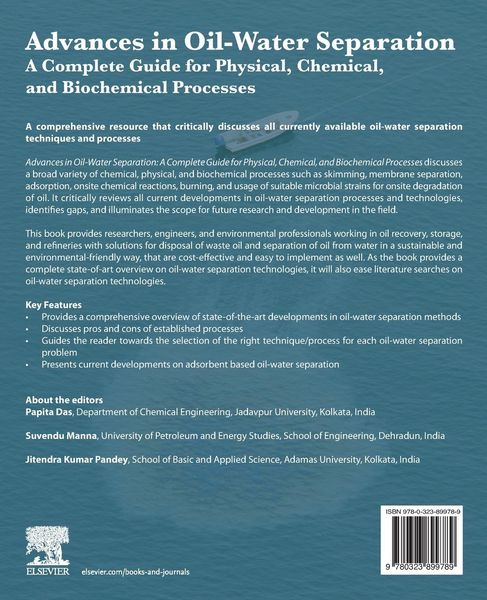
Advances in Oil-Water Separation A Complete Guide for Physical, Chemical, and Biochemical Processes

24% sparen

173,99 € UVP 229,50 €

inkl. gesetzl. MwSt., Versandkostenfrei

Lieferung nach Hause

Beschreibung

Produktdetails

Einband

Taschenbuch

Erscheinungsdatum

25.02.2022

Abbildungen

Approx. 150 illustrations, Illustrationen, nicht spezifiziert

Herausgeber

Papita Das + weitere

Verlag

Elsevier Science & Technology

Seitenzahl

568

Maße (L/B/H)

23,5/19,1/2,9 cm

Gewicht

910 g

Sprache

Englisch

ISBN

978-0-323-89978-9

Beschreibung

Portrait

Prof. (Dr) Papita Das is Professor, Department of Chemical Engineering and Director, School of Advanced Studies in Industrial Pollution Control Engineering, Jadavpur University, Kolkata. She has expertise in highly topical domains of chemical engineering related to Environmental Pollution Control. The research done in her laboratory addresses known and emerging environmental concerns that continues to plague us, with an emphasis on clay-based liner materials, nanoparticles, bio-polymeric film for the clean-up of contaminated soil, water, and other environmental compartments. Over the years, her research team has made notable contributions on several key areas related to “Environmental Sustainability”, which have been recognized with various awards in recent years. Further, her research has produced over 175 International Journal publications, 50+ Book Chapters, 12 Books, 2 Edited Books and 100+ Conferences which have been well received by the global scientific community.

Dr. Suvendu Manna received his PhD in wastewater treatment in 2015. He is an assistant professor in University of Petroleum and Energy Studies, Dehradun, India. Dr. Manna authored or co-authored more than 20 international research and review articles in SCI- and Scopus- indexed journals. He has also written more than 11 book chapters.

Professor Jitendra Kumar Pandey is a professor in University of Petroleum and Energy Studies, Dehradun, India. He completed his PhD in chemistry, and his research interests include materials synthesis, characterizations and their application in energy storage, and water treatment. He has published more than 50 research articles and reviews in peer-reviewed journals.

Produktdetails

Einband

Taschenbuch

Erscheinungsdatum

25.02.2022

Abbildungen

Approx. 150 illustrations, Illustrationen, nicht spezifiziert

Herausgeber

Verlag

Elsevier Science & Technology

Seitenzahl

568

Maße (L/B/H)

23,5/19,1/2,9 cm

Gewicht

910 g

Sprache

Englisch

ISBN

978-0-323-89978-9

Herstelleradresse

Libri GmbH
Europaallee 1
36244 Bad Hersfeld
DE

Email: gpsr@libri.de

Noch keine Bewertungen vorhanden

Verfassen Sie die erste Bewertung zu diesem Artikel

Helfen Sie anderen Kundinnen und Kunden durch Ihre Meinung.

Kundinnen und Kunden meinen

Bewertungen (0)

Die Leseprobe wird geladen.
  • Produktbild: Advances in Oil-Water Separation
  • Produktbild: Advances in Oil-Water Separation
  • Section A: Overview on oil pollution and its effect on environment
    1. An overview of oil pollution and oil-spilling incidents
    2. Spatio-temporal distribution of Oil spill effect in the estuarine terrain of Bhagirathi-Hooghly river, West Bengal, India
    3. Oil pollution and municipal wastewater treatment: issues and impact
    4. Overview on worldwide regulations on oil pollution control
    5. Technological aspects of different oil and water separation advanced techniques
    6. Impact analysis of oil pollution on environment, marine and soil communities
    7. Impact of Oil Exploration and Spillage on Marine Environments

    Section B: Physical processes
    8. Super-hydrophobic polymeric adsorbents as an efficient oil separator
    9. Oil Spill Treatment Using Porous Materials
    10. Nanotechnological advances for oil spill management: Removal, recovery and remediation
    11. Carbon nanotube (CNT) based oil-water separation
    12. Nanocoated membrane for oil treatment

    Section C: Thermo-chemical processes
    13. Chemical Stabilisation of oil by elastomizers
    14. Advances in burning processes and their impact to the environment
    15. Use of chemical dispersants for management of oil pollution
    16. Use of emulsifier as the agent for oil spill mitigation

    Section D: Biological processes
    17. Use of live microbes for oil degradation in-situ
    18. Metagenomics- An Approach for Selection of Oil Degrading Microbes and its Application in Remediation of Oil Pollution
    19. Potentiality of Enzymes as a green tool in Degradation of Petroleum Hydrocarbons
    20. Bioremediation: an ecofriendly approach for the treatment of oil spills
    21. Bioremediation of black tides: Strategies involving genetically modified organisms
    22. Microbes and marine oil spills: Oil-eating bugs can cure oily sea-sickness
    23. Hybrid biological processes for the treatment of oily wastewater

    Section E: Miscellaneous
    24. Efficient management of oil waste: Chemical and physiochemical approaches
    25. Membrane bioreactors for the treatment of oily wastewater: pros and cons
    26. Overview on natural materials for oil water separation
    27. Extraction and separation of oils: the journey from distillation to pervaporation