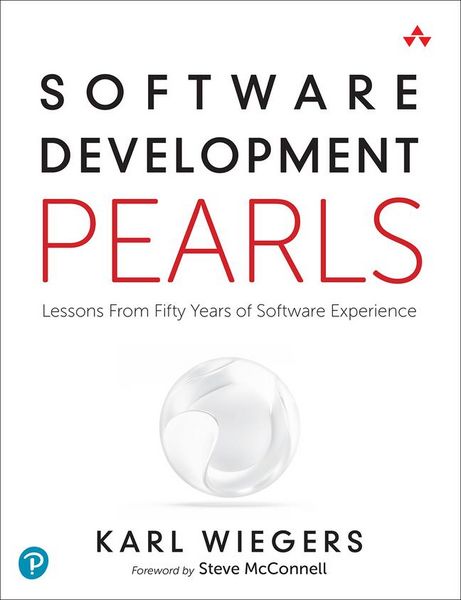
Software Development Pearls Lessons from Fifty Years of Software Experience
-
- Taschenbuch ausgewählt
- eBook
-
Sprache:Englisch
38,99 €
inkl. gesetzl. MwSt.,
Lieferung nach Hause
Beschreibung
Produktdetails
Einband
Taschenbuch
Erscheinungsdatum
04.11.2021
Verlag
Pearson AcademicSeitenzahl
336
Maße (L/B/H)
23/17,5/1,6 cm
Gewicht
540 g
Auflage
1. Auflage
Sprache
Englisch
ISBN
978-0-13-748777-6
Accelerate Your Pursuit of Software Excellence by Learning from Others' Hard-Won Experience
Wiegers's insights and specific recommendations cover six crucial elements of success: requirements, design, project management, culture and teamwork, quality, and process improvement. For each, Wiegers offers First Steps for reflecting on your own experiences before you start; detailed Lessons with core insights, real case studies, and actionable solutions; and Next Steps for planning adoption in your project, team, or organization. This is knowledge you weren't taught in college or boot camp. It can boost your performance as a developer, business analyst, quality professional, or manager.
"Karl is one of the most thoughtful software people I know. He has reflected deeply on the software development irritants he has encountered over his career, and this book contains 60 of his most valuable responses."
-- From the Foreword by Steve McConnell, Construx Software and author of Code Complete
"Wouldn't it be great to gain a lifetime's experience without having to pay for the inevitable errors of your own experience? Karl Wiegers is well versed in the best techniques of business analysis, software engineering, and project management. You'll gain concise but important insights into how to recover from setbacks as well as how to avoid them in the first place."Experience is a powerful teacher, but it's also slow and painful. You can't afford to make every mistake yourself! Software Development Pearls helps you improve faster and bypass much of the pain by learning from others who already climbed the learning curves. Drawing on 25+ years helping software teams succeed, Karl Wiegers has crystallized 60 concise, practical lessons for all your projects, regardless of your role, industry, technology, or methodology.
--Meilir Page-Jones, Senior Business Analyst, Wayland Systems Inc.
Wiegers's insights and specific recommendations cover six crucial elements of success: requirements, design, project management, culture and teamwork, quality, and process improvement. For each, Wiegers offers First Steps for reflecting on your own experiences before you start; detailed Lessons with core insights, real case studies, and actionable solutions; and Next Steps for planning adoption in your project, team, or organization. This is knowledge you weren't taught in college or boot camp. It can boost your performance as a developer, business analyst, quality professional, or manager.
- Clarify requirements to gain a shared vision and understanding of your real problem
- Create robust designs that implement the right functionality and quality attributes and can evolve
- Anticipate and avoid ubiquitous project management pitfalls
- Grow a culture in which behaviors actually align with what people claim to value
- Plan realistically for quality and build it in from the outset
- Use process improvement to achieve desired business results, not as an end in itself
- Choose your next steps to get full value from all these lessons
Kundinnen und Kunden meinen
Verfassen Sie die erste Bewertung zu diesem Artikel
Helfen Sie anderen Kund*innen durch Ihre Meinung
Kurze Frage zu unserer Seite
Vielen Dank für dein Feedback
Wir nutzen dein Feedback, um unsere Produktseiten zu verbessern. Bitte habe Verständnis, dass wir dir keine Rückmeldung geben können. Falls du Kontakt mit uns aufnehmen möchtest, kannst du dich aber gerne an unseren Kund*innenservice wenden.
zum Kundenservice