
Food Safety Engineering
-
- Hardcover
- Taschenbuch ausgewählt
- eBook
-
Sprache:Englisch
243,99 €
UVP
299,59 €
inkl. gesetzl. MwSt.,
Beschreibung
Produktdetails
Einband
Taschenbuch
Erscheinungsdatum
29.05.2021
Abbildungen
IX, 760 p. 132 illus., 75 illus. in color.
Herausgeber
Ali Demirci + weitereVerlag
SpringerSeitenzahl
760
Maße (L/B/H)
23,5/15,5/4,2 cm
Gewicht
1147 g
Auflage
1st edition 2020
Sprache
Englisch
ISBN
978-3-030-42662-0
Food Safety Engineering
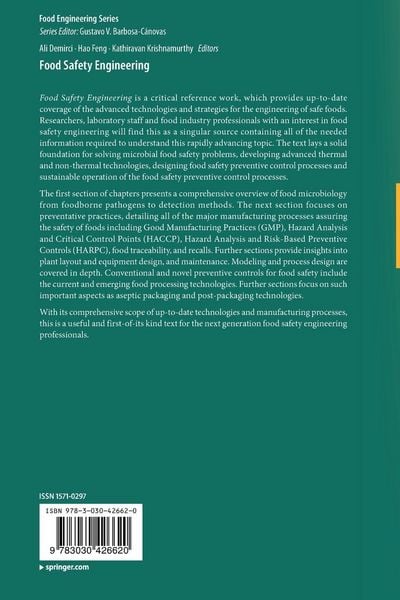
is the first reference work to provide up-to-date coverage of the advanced technologies and strategies for the engineering of safe foods. Researchers, laboratory staff and food industry professionals with an interest in food engineering safety will find a singular source containing all of the needed information required to understand this rapidly advancing topic. The text lays a solid foundation for solving microbial food safety problems, developing advanced thermal and non-thermal technologies, designing food safety preventive control processes and sustainable operation of the food safety preventive control processes.
The first section of chapters presents a comprehensive overview of food microbiology from foodborne pathogens to detection methods. The next section focuses on preventative practices, detailing all of the major manufacturing processes assuring the safety of foods including Good Manufacturing Practices (GMP), Hazard Analysis and Critical Control Points (HACCP), Hazard Analysis and Risk-Based Preventive Controls (HARPC), food traceability, and recalls. Further sections provide insights into plant layout and equipment design, and maintenance. Modeling and process design are covered in depth. Conventional and novel preventive controls for food safety include the current and emerging food processing technologies. Further sections focus on such important aspects as aseptic packaging and post-packaging technologies.
With its comprehensive scope of up-to-date technologies and manufacturing processes, this is a useful and first-of-its kind text for the next generation food safety engineering professionals.
Noch keine Bewertungen vorhanden
Verfassen Sie die erste Bewertung zu diesem Artikel
Helfen Sie anderen Kundinnen und Kunden durch Ihre Meinung.
Kurze Frage zu unserer Seite
Vielen Dank für dein Feedback
Wir nutzen dein Feedback, um unsere Produktseiten zu verbessern. Bitte habe Verständnis, dass wir dir keine Rückmeldung geben können. Falls du Kontakt mit uns aufnehmen möchtest, kannst du dich aber gerne an unseren Kund*innenservice wenden.
zum Kundenservice