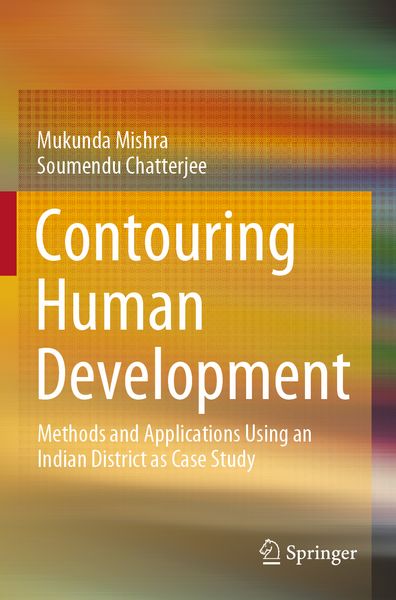
Contouring Human Development Methods and Applications Using an Indian District as Case Study
-
- Hardcover
- Taschenbuch ausgewählt
- eBook
-
Sprache:Englisch
95,99 €
UVP
106,99 €
inkl. gesetzl. MwSt.,
Beschreibung
Produktdetails
Einband
Taschenbuch
Erscheinungsdatum
12.05.2021
Abbildungen
XXXIII, 358 p. 104 illus., 102 illus. in color.
Verlag
Springer SingaporeSeitenzahl
358
Maße (L/B/H)
23,5/15,5/2,2 cm
Gewicht
593 g
Auflage
1st ed. 2020
Sprache
Englisch
ISBN
978-981-15-4085-1
This book acquaints readers with a range of techniques to help them effectively identify, record, map, analyze and report on patterns in various dimensions of human development (HD) with spatial scales down to the village level. It is impossible to capture HD at the local and global scale with only a single index, because differences in HD at the international scale are caused by ‘general’ factors, whereas local-scale differences are influenced by ‘specific’ factors. This book offers a variety of methods for scientifically mapping HD at any spatial scale. It covers how to rationally select variables; how to test the models; how to validate the results, and how to analyze them. For this purpose, it employs a case study on an Indian district.
The socio-economic factors regulating the patterns of HD are now more complex than they were only a few decades ago, making it essential to incorporate newer models in order to successfully ‘replicate’ the real-world situation. Accordingly, the book offers essential methodological tools & techniques for mapping HD. It sheds new light on a handful of statistical multivariate analysis and machine learning algorithms that are rarely used in the social sciences when dealing with HD, yet have sound mathematical and statistical bases. These techniques can be successfully used for predictive analysis in the earth & natural sciences, decision sciences and management disciplines, and are equally effective in terms of capturing, predicting and projecting the composite HD ‘landscape.’
This book will especially benefit two groups of readers: firstly, HD practitioners who want to find out ‘why some areas are doing better than others’ by exploring the complex interactions of spatially linked variables with different HD parameters. And secondly, practitioners in other branches of the social sciences who are not concerned with HD but are looking for ‘hands-on training’ with techniques they can apply in their respectivefield of spatial investigations.
Noch keine Bewertungen vorhanden
Verfassen Sie die erste Bewertung zu diesem Artikel
Helfen Sie anderen Kundinnen und Kunden durch Ihre Meinung.
Kurze Frage zu unserer Seite
Vielen Dank für dein Feedback
Wir nutzen dein Feedback, um unsere Produktseiten zu verbessern. Bitte habe Verständnis, dass wir dir keine Rückmeldung geben können. Falls du Kontakt mit uns aufnehmen möchtest, kannst du dich aber gerne an unseren Kund*innenservice wenden.
zum Kundenservice