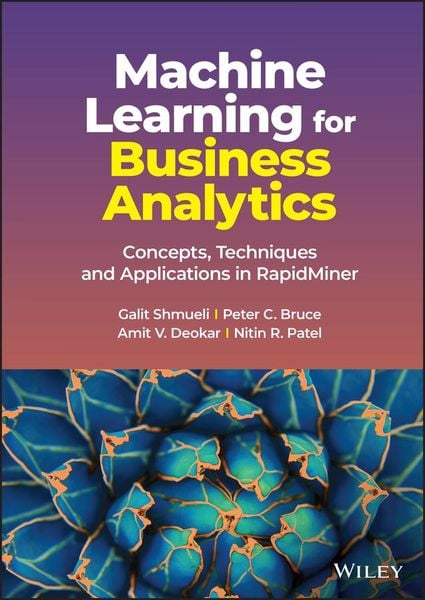
Machine Learning for Business Analytics Concepts, Techniques and Applications in Rapidminer
-
Sprache:Englisch
-
Verlag:John Wiley & Sons Inc
-
Auflage:1. Auflage
176,99 €
inkl. gesetzl. MwSt.,
Beschreibung
Produktdetails
Einband
Gebundene Ausgabe
Erscheinungsdatum
08.03.2023
Verlag
John Wiley & Sons IncSeitenzahl
736
Maße (L/B/H)
25,6/17,9/3,2 cm
Gewicht
1294 g
Auflage
1. Auflage
Sprache
Englisch
ISBN
978-1-119-82879-2
Machine learning--also known as data mining or data analytics--is a fundamental part of data science. It is used by organizations in a wide variety of arenas to turn raw data into actionable information.
Machine Learning for Business Analytics: Concepts, Techniques and Applications in RapidMiner provides a comprehensive introduction and an overview of this methodology. This best-selling textbook covers both statistical and machine learning algorithms for prediction, classification, visualization, dimension reduction, rule mining, recommendations, clustering, text mining, experimentation and network analytics. Along with hands-on exercises and real-life case studies, it also discusses managerial and ethical issues for responsible use of machine learning techniques.
This is the seventh edition of Machine Learning for Business Analytics, and the first using RapidMiner software. This edition also includes:
* A new co-author, Amit Deokar, who brings experience teaching business analytics courses using RapidMiner
* Integrated use of RapidMiner, an open-source machine learning platform that has become commercially popular in recent years
* An expanded chapter focused on discussion of deep learning techniques
* A new chapter on experimental feedback techniques including A/B testing, uplift modeling, and reinforcement learning
* A new chapter on responsible data science
* Updates and new material based on feedback from instructors teaching MBA, Masters in Business Analytics and related programs, undergraduate, diploma and executive courses, and from their students
* A full chapter devoted to relevant case studies with more than a dozen cases demonstrating applications for the machine learning techniques
* End-of-chapter exercises that help readers gauge and expand their comprehension and competency of the material presented
* A companion website with more than two dozen data sets, and instructor materials including exercise solutions, slides, and case solutions
This textbook is an ideal resource for upper-level undergraduate and graduate level courses in data science, predictive analytics, and business analytics. It is also an excellent reference for analysts, researchers, and data science practitioners working with quantitative data in management, finance, marketing, operations management, information systems, computer science, and information technology.
Noch keine Bewertungen vorhanden
Verfassen Sie die erste Bewertung zu diesem Artikel
Helfen Sie anderen Kundinnen und Kunden durch Ihre Meinung.
Kurze Frage zu unserer Seite
Vielen Dank für dein Feedback
Wir nutzen dein Feedback, um unsere Produktseiten zu verbessern. Bitte habe Verständnis, dass wir dir keine Rückmeldung geben können. Falls du Kontakt mit uns aufnehmen möchtest, kannst du dich aber gerne an unseren Kund*innenservice wenden.
zum Kundenservice