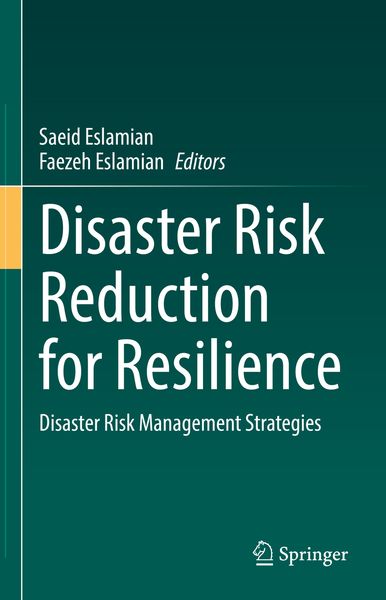
Disaster Risk Reduction for Resilience Disaster Risk Management Strategies
-
- Hardcover ausgewählt
- Taschenbuch
- eBook
-
Sprache:Englisch
-
Auflage:1st ed. 2022
145,99 €
inkl. gesetzl. MwSt.,
Lieferung nach Hause
Beschreibung
Produktdetails
Einband
Gebundene Ausgabe
Erscheinungsdatum
09.04.2022
Herausgeber
Saeid Eslamian + weitereVerlag
SpringerSeitenzahl
473
Maße (L/B/H)
24,1/16/3 cm
Gewicht
975 g
Auflage
1st ed. 2022
Sprache
Englisch
ISBN
978-3-030-72195-4
This book is part of a six-volume series on Disaster Risk Reduction and Resilience. The series aims to fill in gaps in theory and practice in the Sendai Framework, and provides additional resources, methodologies and communication strategies to enhance the plan for action and targets proposed by the Sendai Framework. The series will appeal to a broad range of researchers, academics, students, policy makers and practitioners in engineering, environmental science and geography, geoscience, emergency management, finance, community adaptation, atmospheric science and information technology.
This volume offers the international guidelines and global standards for resilient disaster risk reduction and lessons learned from disasters, particularly the COVID-19 and Cholera pandemics. A resilient health system and an effective disaster risk management Index are then suggested. The book further emphasizes urban resilience strategies with local authorities, adaptation strategies for urbanheat at regional, city and local scales, and lessons from community-level interventions.Also addressed are coastal erosion, displacement and resettlement strategies. Land use planning and green infrastructure are suggested as tools for natural hazards reduction. Human security in times of climate change and urban heat at regional, city and local scales is discussed for an integrated action, with case studies based in Manila, Burkina Faso, Chad, Mauritania, Niger, Senegal, Nigeria, India, Spain, and Ghana. Structure design for cascading disasters resulting from mining and flooding is presented and sustainable smart city planning using spatial data is recommended.
Kundinnen und Kunden meinen
Verfassen Sie die erste Bewertung zu diesem Artikel
Helfen Sie anderen Kund*innen durch Ihre Meinung
Kurze Frage zu unserer Seite
Vielen Dank für dein Feedback
Wir nutzen dein Feedback, um unsere Produktseiten zu verbessern. Bitte habe Verständnis, dass wir dir keine Rückmeldung geben können. Falls du Kontakt mit uns aufnehmen möchtest, kannst du dich aber gerne an unseren Kund*innenservice wenden.
zum Kundenservice