KI-Beratung Beta

Produktbild: Chemical Reactivity
- 17%

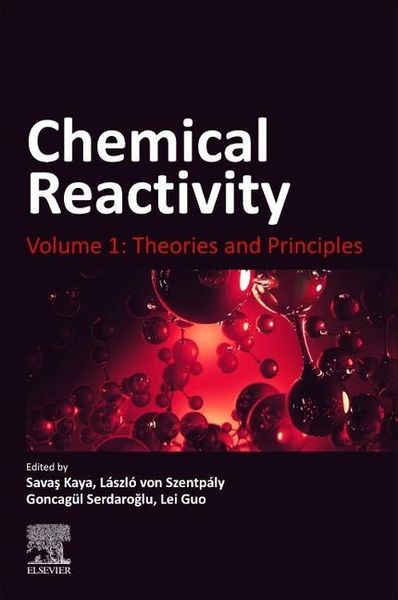
Chemical Reactivity Volume 1: Theories and Principles

17% sparen

151,99 € UVP 184,50 €

inkl. gesetzl. MwSt., Versandkostenfrei


Beschreibung

Produktdetails

Einband

Taschenbuch

Erscheinungsdatum

18.05.2023

Abbildungen

Approx. 115 illustrations

Herausgeber

Savaş Kaya + weitere

Verlag

Elsevier Science & Technology

Seitenzahl

606

Maße (B/H)

15,2/22,8 cm

Gewicht

950 g

Sprache

Englisch

ISBN

978-0-323-90257-1

Beschreibung

Portrait

Savas Kaya is associate professor at Sivas Cumhuriyet University, Turkey. His research interests lie in theoretical chemistry, computational chemistry, materials science, corrosion science, physical inorganic chemistry, and coordination chemistry.
László von Szentpâly currently works at the Faculty of Chemistry, Universität Stuttgart. A member of American Chemical Society with a good reputation in the field of theoretical chemistry, László's achievements include research on the valence states interaction model of chemical bonding (VSI model) and molecular modelling of ultimate intercalated carcinogens. He has more than 35 research articles, reviews and book chapters on concepts and applications in Density Functional Theory to his name.
Goncagül Serdaroglu obtained her PhD degree from Sivas Cumhuriyet University's Physical chemistry (Theoretical Chemistry) department and was a post-doctoral fellow with Prof. Joseph Vincent Ortiz (Auburn University, USA). At present, she works at Sivas Cumhuriyet University (Math. and Sci. Edu. Department) as Assistant Professor. Her primary research investigates the chemical reactivity behavior of pharmaceutically important molecules using computational tools. Recently, she has focused on the spectroscopic (IR, NMR, UV) and NLO (nonlinear optic) properties of molecular systems. She has published 30 research papers in key computational theoretical chemistry-related journals
Lei Guo received his PhD degree in materials chemistry from the Chongqing university of china. His research is dedicated to synthesis and characterization of organic molecules and their application towards corrosion inhibition property for the protection of metals and alloys from acid corrosion. His interests also encompass theoretical and experimental research in condensed matter physics

Produktdetails

Einband

Taschenbuch

Erscheinungsdatum

18.05.2023

Abbildungen

Approx. 115 illustrations

Herausgeber

Verlag

Elsevier Science & Technology

Seitenzahl

606

Maße (B/H)

15,2/22,8 cm

Gewicht

950 g

Sprache

Englisch

ISBN

978-0-323-90257-1

Noch keine Bewertungen vorhanden

Verfassen Sie die erste Bewertung zu diesem Artikel

Helfen Sie anderen Kundinnen und Kunden durch Ihre Meinung.

Kundinnen und Kunden meinen

Bewertungen (0)

Die Leseprobe wird geladen.
  • Produktbild: Chemical Reactivity
  • 1. The importance of correlation in the molecular orbital picture

    2. Dyson orbitals and chemical bonding

    3. Coupled-cluster theory and chemical reactivity

    4. New developments in the Interacting Quantum Atoms (IQA) approach

    5. Conceptual Ruedenberg theory of chemical bonds: the necessary step beyond conceptual DFT

    6. Electron-density-based analysis and electron density functional theory (DFT) methods

    7. Information-theoretic concepts in theory of electronic structure and chemical reactivity

    8. Excited-state density functional theory

    9. Reaction fragility method: monitoring evolution of atoms and bonds on a reaction path

    10. Looking behind the scenes of Grubbs catalysis with the Unified Reaction Valley Approach

    11. The diabatic model of intermediate stabilization for reaction mechanism analysis: a link to valence bond and Marcus theories

    12. Main concepts and applications of DFTB approach

    13. Chemical reactivity insights from the use of constrained methods

    14. On the analysis of the Fukui function

    15. Analytic calculation of Fukui functions and related reactivity descriptors

    16. New insights from a bonding evolution theory based on the topological analysis of the electron localization function

    17. Experimental quantum chemistry and chemical reactivity

    18. Quantum similarity description of a unique classical and quantum QSPR algorithm in molecular spaces: the connection with Boolean hypercubes, algorithmic intelligence, and Gödel's incompleteness theorems