Critical Problems in Physics
-
- Taschenbuch
- eBook ausgewählt
-
Form:Einzelkauf Download
-
Sprache:Englisch
79,49 €
inkl. gesetzl. MwSt.Beschreibung
Produktdetails
Format
Kopierschutz
Nein
Family Sharing
Nein
Text-to-Speech
Nein
Erscheinungsdatum
09.03.2021
Herausgeber
Val L. Fitch + weitereVerlag
Nyu PressSeitenzahl
301 (Printausgabe)
Sprache
Englisch
EAN
9780691227498
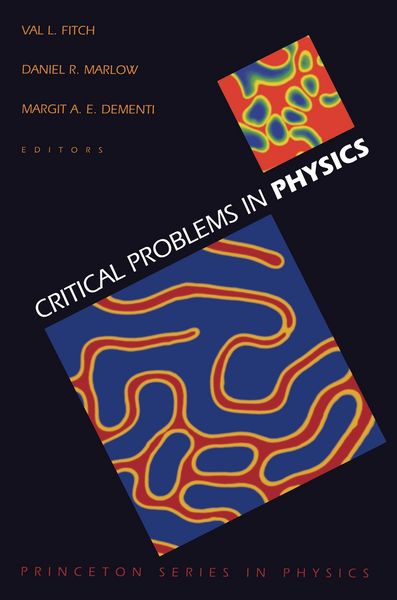
The past century has seen fantastic advances in physics, from the discovery of the electron, x-rays, and radioactivity, to the era of incredible solid state devices, computers, quarks and leptons, and the standard model. But what of the next? Many scientists think we are on the threshold of an even more exciting new era in which breakthroughs in a startling variety of directions will produce significant changes in our understanding of the natural world. In this book, a group of eminent scientists define and elaborate on these new directions.
Ed Witten and Frank Wilczek discuss string theory and the future of particle physics; Donald Perkins describes the search for neutrino oscillations; Alvin Tollestrup reveals dreams of a muon collider at Fermilab to probe the heart of "elementary" particles; and Robert Palmer anticipates a new generation of particle accelerators. Thibault Damour reviews classical gravitation and the relevant new high-precision experiments; Kip Thorne describes the exciting future for gravitational wave astronomy; and Paul Steinhardt examines the recent breakthroughs in observational cosmology and explains what future experiments might reveal. James Langer explores nonequilibrium statistics and relates it to the origins of complexity; Harry Swinney takes an experimentalist's view of the emergence of order in seemingly chaotic systems; and John Hopfield describes an extremely unusual dynamical system--the human brain. Bruce Hillman, M. D., discusses the recent developments in imaging techniques that have brought about outstanding advances in medical diagnostics. T.V. Ramakrishnan looks at high-temperature superconductors, which could eventually revolutionize the solid-state technology on which society is already highly dependent.
Kundinnen und Kunden meinen
Verfassen Sie die erste Bewertung zu diesem Artikel
Helfen Sie anderen Kund*innen durch Ihre Meinung
Kurze Frage zu unserer Seite
Vielen Dank für dein Feedback
Wir nutzen dein Feedback, um unsere Produktseiten zu verbessern. Bitte habe Verständnis, dass wir dir keine Rückmeldung geben können. Falls du Kontakt mit uns aufnehmen möchtest, kannst du dich aber gerne an unseren Kund*innenservice wenden.
zum Kundenservice