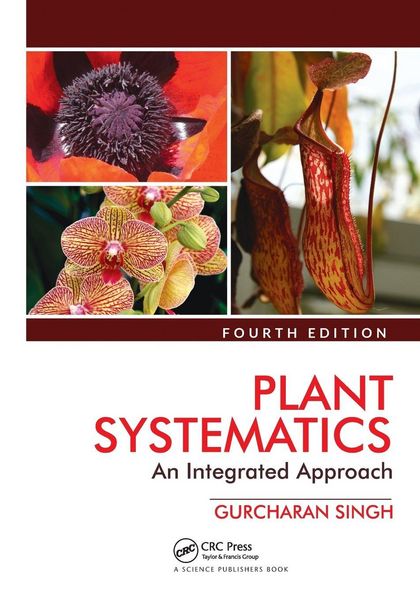
Plant Systematics An Integrated Approach, Fourth Edition
-
- Hardcover
- Taschenbuch ausgewählt
- eBook
-
Sprache:Englisch
58,99 €
UVP
71,90 €
inkl. gesetzl. MwSt.,
Beschreibung
Produktdetails
Einband
Taschenbuch
Erscheinungsdatum
31.03.2021
Verlag
Taylor & FrancisSeitenzahl
568
Maße (L/B/H)
25,4/17,8/3 cm
Gewicht
1054 g
Auflage
4. Auflage
Sprache
Englisch
ISBN
978-0-367-77966-5
This fourth edition of Plant Systematics is completely revised and updated. It incorporates the updated International Code of Nomenclature for Algae, Fungi and Plants (Shenzhen Code, 2018), the new version of PhyloCode (Beta version of Phylocode 5, 2014), APweb version 14 (September, 2018), revised Angiosperm Phylogeny Group classification (APG IV, 2016), new Pteridophyte Phylogeny Group Classification (PPG I, 2016), besides the updates since the publication of third edition.
The book is a blend of classical fundamental aspects and recent developments, especially in the field of molecular systematics, cladistics and computer identification. Special attention has been given to information on botanical nomenclature, identification, molecular systematics and phylogeny of angiosperms. The complicated concepts of phylogeny, taxometrics and cladistics have been explained with a view to providing a comparison between these diverse but interactive fields of study. An attempt has been made to build upon a common example when exploring different methods, especially in procedures of identification, taxometrics and cladistics. The major systems of classification are evaluated critically. Discussion on major families of Pteridophytes, Gymnosperms and Angiosperms, especially those of major phylogenetic interest, form a major portion of this edition. The ebook includes nearly 500 color photographs set out in 36 pages covering plants from different parts of the world. In addition, 305 black & white illustrations have been included to provide a better understanding of the plants covered in the book.
Noch keine Bewertungen vorhanden
Verfassen Sie die erste Bewertung zu diesem Artikel
Helfen Sie anderen Kundinnen und Kunden durch Ihre Meinung.
Kurze Frage zu unserer Seite
Vielen Dank für dein Feedback
Wir nutzen dein Feedback, um unsere Produktseiten zu verbessern. Bitte habe Verständnis, dass wir dir keine Rückmeldung geben können. Falls du Kontakt mit uns aufnehmen möchtest, kannst du dich aber gerne an unseren Kund*innenservice wenden.
zum Kundenservice