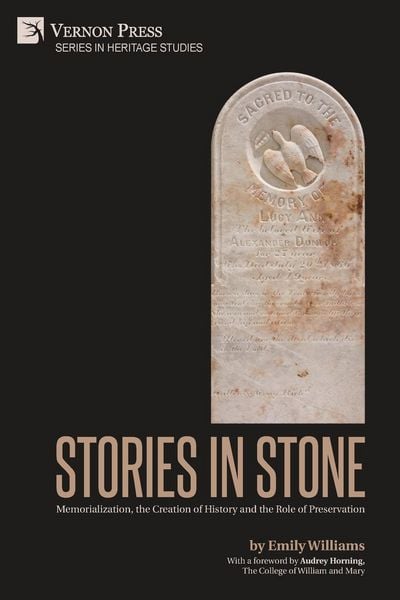
Stories in Stone Memorialization, the Creation of History and the Role of Preservation
-
- Englisch ausgewählt
71,99 €
inkl. gesetzl. MwSt.,
Lieferung nach Hause
Beschreibung
Produktdetails
Einband
Taschenbuch
Erscheinungsdatum
09.12.2020
Verlag
Vernon PressSeitenzahl
286
Maße (L/B/H)
22,9/15,2/1,6 cm
Gewicht
418 g
Sprache
Englisch
ISBN
978-1-64889-162-5
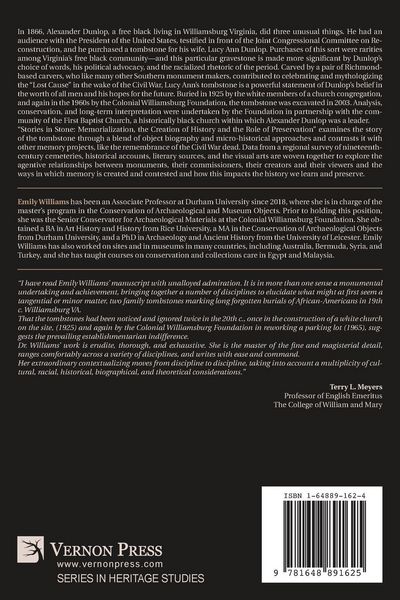
In 1866, Alexander Dunlop, a free black living in Williamsburg Virginia, did three unusual things. He had an audience with the President of the United States, testified in front of the Joint Congressional Committee on Reconstruction, and he purchased a tombstone for his wife, Lucy Ann Dunlop. Purchases of this sort were rarities among Virginia’s free black community—and this particular gravestone is made more significant by Dunlop’s choice of words, his political advocacy, and the racialized rhetoric of the period. Carved by a pair of Richmond-based carvers, who like many other Southern monument makers, contributed to celebrating and mythologizing the "Lost Cause" in the wake of the Civil War, Lucy Ann’s tombstone is a powerful statement of Dunlop’s belief in the worth of all men and his hopes for the future. Buried in 1925 by the white members of a church congregation, and again in the 1960s by the Colonial Williamsburg Foundation, the tombstone was excavated in 2003. Analysis, conservation, and long-term interpretation were undertaken by the Foundation in partnership with the community of the First Baptist Church, a historically black church within which Alexander Dunlop was a leader. "Stories in Stone: Memorialization, the Creation of History and the Role of Preservation" examines the story of the tombstone through a blend of object biography and micro-historical approaches and contrasts it with other memory projects, like the remembrance of the Civil War dead. Data from a regional survey of nineteenth-century cemeteries, historical accounts, literary sources, and the visual arts are woven together to explore the agentive relationships between monuments, their commissioners, their creators and their viewers and the ways in which memory is created and contested and how this impacts the history we learn and preserve.
Kundinnen und Kunden meinen
Verfassen Sie die erste Bewertung zu diesem Artikel
Helfen Sie anderen Kund*innen durch Ihre Meinung
Kurze Frage zu unserer Seite
Vielen Dank für dein Feedback
Wir nutzen dein Feedback, um unsere Produktseiten zu verbessern. Bitte habe Verständnis, dass wir dir keine Rückmeldung geben können. Falls du Kontakt mit uns aufnehmen möchtest, kannst du dich aber gerne an unseren Kund*innenservice wenden.
zum Kundenservice