
• Produktbild: Cognitive Linguistics and Religious Language
  • Produktbild: Cognitive Linguistics and Religious Language

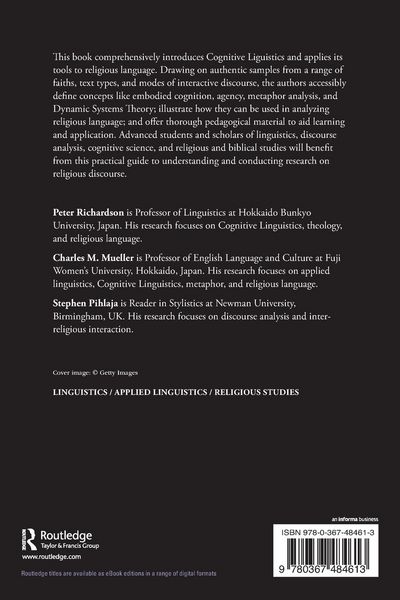
Cognitive Linguistics and Religious Language An Introduction

68,99 €

inkl. gesetzl. MwSt., Versandkostenfrei

Lieferung nach Hause

Beschreibung

Produktdetails

Einband

Taschenbuch

Erscheinungsdatum

29.03.2021

Abbildungen

schwarz-weiss Illustrationen, Zeichnungen, schwarz-weiss

Verlag

Taylor and Francis

Seitenzahl

164

Maße (L/B/H)

22,9/15,2/1 cm

Gewicht

244 g

Sprache

Englisch

ISBN

978-0-367-48461-3

Beschreibung

Produktdetails

Einband

Taschenbuch

Erscheinungsdatum

29.03.2021

Abbildungen

schwarz-weiss Illustrationen, Zeichnungen, schwarz-weiss

Verlag

Taylor and Francis

Seitenzahl

164

Maße (L/B/H)

22,9/15,2/1 cm

Gewicht

244 g

Sprache

Englisch

ISBN

978-0-367-48461-3

Herstelleradresse

Libri GmbH
Europaallee 1
36244 Bad Hersfeld
DE

Email: [email protected]

Kundinnen und Kunden meinen

0 Bewertungen

Informationen zu Bewertungen

Zur Abgabe einer Bewertung ist eine Anmeldung im Konto notwendig. Die Authentizität der Bewertungen wird von uns nicht überprüft. Wir behalten uns vor, Bewertungstexte, die unseren Richtlinien widersprechen, entsprechend zu kürzen oder zu löschen.

Die Bewertungen sind nach Format, Anzahl Sterne und Datum sortiert.

Verfassen Sie die erste Bewertung zu diesem Artikel

Helfen Sie anderen Kund*innen durch Ihre Meinung

Kundinnen und Kunden meinen

0 Bewertungen filtern

Die Leseprobe wird geladen.
  • Produktbild: Cognitive Linguistics and Religious Language
  • Produktbild: Cognitive Linguistics and Religious Language
  • Table of Contents

    Title Page *

    Table of Contents *

    Table of Figures *

    Acknowledgements *

    1 Chapter One: Introduction *

    1.1 Defining religion *

    1.2 Ways of being religious *

    1.3 Religious language *

    1.4 Cognitive Linguistics and religion *

    1.5 Overview of the book *

    Discussion questions *

    2 Chapter Two: Categorization *

    2.1 Categories in cognitive science *

    2.2 Elements of idealized cognitive models *

    2.3 LCCM theory and religious language *

    Discussion questions *

    3 Chapter Three: Conceptual Metaphor *

    3.1 Defining and identifying conceptual metaphor *

    3.1.1 Mapping across two domains *

    3.1.2 Identifying metaphor *

    3.2 The function of metaphor in religious language *

    3.2.1 Accessibility and understanding of mystery *

    3.2.2 Conveying perspective and marking membership *

    3.2.3 Construing the abstract as concrete and tangible *

    3.2.4 Providing structure to an ultimate purpose *

    3.2.5 Light metaphors *

    Discussion questions *

    4 Chapter 4: Metonymy *

    4.1 Identifying metonymy *

    4.2 Types of metonymy *

    4.3 The function of metonymy *

    4.4 The origins of metaphor and metonymy *

    4.5 Metonymy and metaphor in religious language *

    Discussion questions *

    5 Chapter Five: Agency *

    5.1 Agency in discourse analysis *

    5.2 Figurative and literal conceptions of divine agency *

    5.3 Levels and types of agency *

    5.3.1 Levels of agency *

    5.3.2 Agency and frames *

    Discussion questions *

    6 Chapter Six: Force Dynamics *

    6.1 Force dynamics basics *

    6.2 Force dynamics and religious language *

    6.3 Agency and force dynamics in mystical language *

    Discussion questions *

    7 Chapter Seven: Conceptual Blending *

    7.1 Types of conceptual blends *

    7.2 Blending in religious language *

    7.3 Strategic use of blends within discourse *

    7.4 The Ritual of the Four Instruments *

    7.5 Elaborate blends in ritual *

    Discussion questions *

    8 Complex System Theory *

    8.1 Complex Systems Theory *

    8.2 Discourse Dynamics Approach *

    8.3 Applying the DDA *

    Discussion questions *

    9 Conclusion *

    Discussion questions *

    References *

    Index *