Gutscheinbedingungen

**Gültig vom 07.09.2026 bis 09.09.2026 | Gültig für nicht preisgebundene fremdsprachige Bücher | Einzelne Artikel können ausgeschlossen sein | Online auf www.bücher.de einlösbar | Click & Collect nur mit Online-Zahlung (Paypal/Kreditkarte) vorab | Nicht kombinierbar mit anderen Gutscheinen oder Preisaktionen | Nur einmal pro Einkauf einlösbar | Gutschein wird auf max. 500€ Bestellwert angerechnet | Keine Barauszahlung | Nicht gültig für Versandkosten und Services

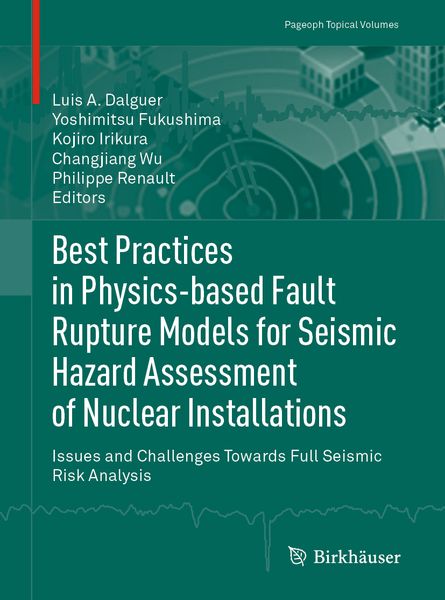
  • Produktbild: Best Practices in Physics-based Fault Rupture Models for Seismic Hazard Assessment of Nuclear Installations
  • Produktbild: Best Practices in Physics-based Fault Rupture Models for Seismic Hazard Assessment of Nuclear Installations

Best Practices in Physics-based Fault Rupture Models for Seismic Hazard Assessment of Nuclear Installations Issues and Challenges Towards Full Seismic Risk Analysis

Aus der Reihe Pageoph Topical Volumes

106,99 €

inkl. gesetzl. MwSt., Versandkostenfrei


Beschreibung

Produktdetails

Einband

Taschenbuch

Erscheinungsdatum

22.01.2021

Abbildungen

VII, 586 p. 1 illus.

Herausgeber

Luis A. Dalguer + weitere

Verlag

Springer

Seitenzahl

586

Maße (L/B/H)

26/19,3/3,2 cm

Gewicht

1226 g

Auflage

1st ed. 2021

Sprache

Englisch

ISBN

978-3-030-65512-9

Beschreibung

Produktdetails

Einband

Taschenbuch

Erscheinungsdatum

22.01.2021

Abbildungen

VII, 586 p. 1 illus.

Herausgeber

Verlag

Springer

Seitenzahl

586

Maße (L/B/H)

26/19,3/3,2 cm

Gewicht

1226 g

Auflage

1st ed. 2021

Sprache

Englisch

ISBN

978-3-030-65512-9

Herstelleradresse

Springer-Verlag GmbH
Tiergartenstr. 17
69121 Heidelberg
DE

Email: ProductSafety@springernature.com

Noch keine Bewertungen vorhanden

Verfassen Sie die erste Bewertung zu diesem Artikel

Helfen Sie anderen Kundinnen und Kunden durch Ihre Meinung.

Kundinnen und Kunden meinen

Bewertungen (0)

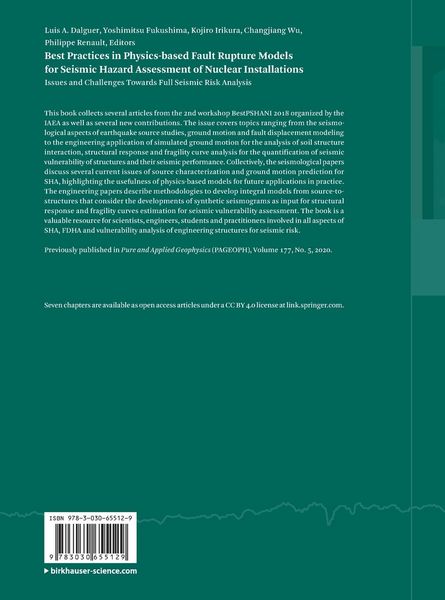
  • Produktbild: Best Practices in Physics-based Fault Rupture Models for Seismic Hazard Assessment of Nuclear Installations
  • Produktbild: Best Practices in Physics-based Fault Rupture Models for Seismic Hazard Assessment of Nuclear Installations

  • Introduction.- Computational Tools for Relaxing the Fault Segmentation in Probabilistic Seismic Hazard Modelling in Complex Fault Systems.- Testing Fault Models in Intraplate Settings: A Potential for Challenging the Seismic Hazard Assessment Inputs and Hypothesis.- Gutenberg–Richter’s b Value and Earthquake Asperity Models.- Eigenoscillations and Stability of Rocking Stones: The Case Study of ‘‘The Hus Pulpit’’ in The Central Bohemian Pluton.- Scaling Relationships of Source Parameters of Inland Crustal Earthquakes in Tectonically Active Regions.- Imaging of Seismogenic Asperities of the 2016 ML 6.0 Amatrice, Central Italy, Earthquake Through Dynamic Rupture Simulations.- Sensitivity of High-Frequency Ground Motion to Kinematic Source Parameters.- Large Stress Release During Normal-Faulting Earthquakes in Western Turkey Supported by Broadband Ground Motion Simulations.- Development of Dynamic Asperity Models to Predict Surface Fault Displacement Caused by Earthquakes.- Probabilistic Evaluation of Off-Fault Displacements of the 2016 Kumamoto Earthquake.- Extension of Characterized Source Model for Long-Period Ground Motions in Near-Fault Area.- Are the Standard VS-Kappa Host-to-Target Adjustments the Only Way to Get Consistent Hard-Rock Ground Motion Prediction?- The Interface Between Empirical and Simulation-Based Ground-Motion Models.- Ground Motion Characterization for Vertical Ground Motions in Turkey—Part 1: V/H Ratio Ground Motion Models.- Ground Motion Characterization for Vertical Ground Motions in Turkey—Part 2: Vertical Ground Motion Models and the Final Logic Tree.- Numerical Simulation of M9 Megathrust Earthquakes in the Cascadia Subduction Zone.- Dynamic Source Model for the 2011 Tohoku Earthquake in a Wide Period Range Combining Slip Reactivation with the Short-Period Ground Motion Generation Process.- Earthquake Cycle Modelling of Multi-segmented Faults: DynamicRupture and Ground Motion Simulation of the 1992 Mw 7.3 Landers Earthquake.- Hybrid Broadband Seismograms for Seismic Shaking Scenarios: An Application to the Po Plain Sedimentary Basin (Northern Italy).- Kinematic Rupture Modeling of Ground Motion from the M7 Kumamoto, Japan Earthquake.- Near-Source Strong Pulses During Two Large MJMA 6.5 and MJMA 7.3 Events in the 2016 Kumamoto, Japan, Earthquakes.- Estimation of Strong Motion Generation Area for the 2004 Parkfield Earthquake Using Empirical Green’s Function Method.- Optimization of a Simulation Code Coupling Extended Source (k-2 ) and Empirical Green’s Functions: Application to the Case of the Middle Durance Fault.- Empirical Green’s Function Simulations Toward Site-Specific Ground Motion Prediction in Vietnam.- ain Achievements of the Multidisciplinary SINAPS@ Research Project: Towards an Integrated Approach to Perform Seismic Safety Analysis of Nuclear Facilities.- Broadband Ground Motion Simulation Within the City of Duzce (Turkey) and Building Response Simulation.- Seismic Fragility Curve Assessment Based on Synthetic Ground Motions with Conditional Spectra.- Influence of Input Motion’s Control Point Location in Nonlinear SSI Analysis of Equipment Seismic Fragilities: Case Study on the Kashiwazaki-Kariwa NPP.- Should We Go Ahead with the Response Spectrum?