KI-Beratung Beta

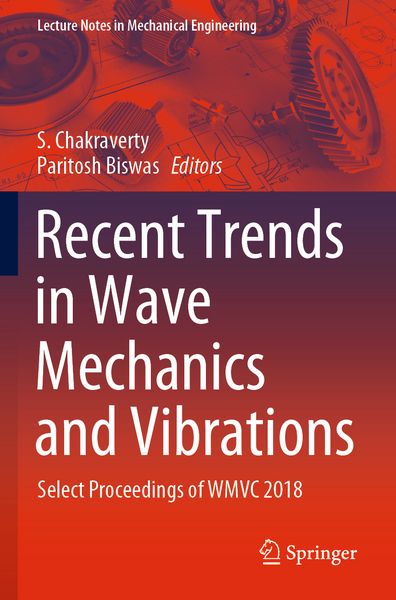
Produktbild: Recent Trends in Wave Mechanics and Vibrations

Recent Trends in Wave Mechanics and Vibrations Select Proceedings of WMVC 2018

145,99 €

inkl. gesetzl. MwSt., Versandkostenfrei


Beschreibung

Produktdetails

Einband

Taschenbuch

Erscheinungsdatum

13.11.2020

Abbildungen

XIII, 468 p. 247 illus., 152 illus. in color.

Herausgeber

S. Chakraverty + weitere

Verlag

Springer Singapore

Seitenzahl

468

Maße (L/B/H)

23,5/15,5/2,5 cm

Gewicht

829 g

Auflage

20001 Auflage 1st edition 2020

Sprache

Englisch

ISBN

978-981-15-0289-7

Beschreibung

Portrait


Dr. S. Chakraverty
 is working in the Department of Mathematics (Applied Mathematics Group),  National Institute of Technology Rourkela, Odisha as a full Professor (Higher Administrative Grade). Prior to this, he was with CSIR Central Building Research Institute, Roorkee, India. After completing his graduation from St. Columba’s College (Ranchi University), his career started from the University of Roorkee (presently Indian Institute of Technology Roorkee) where he did his M.Sc. (Applied

Mathematics) and M.Phil. (Computer Applications) securing the First position in the University. He received his Ph.D. from IIT Roorkee in 1992. Thereafter, he did his post doctoral research at Institute of Sound and Vibration Research (ISVR), University of Southampton, UK, and at the Faculty of Engineering and Computer Science, Concordia University, Canada. He was also a visiting professor at Concordia and McGill Universities, Canada, during 1997-1999 and visiting professor at the University of Johannesburg, South Africa during 2011-2014. He has authored/co-authored 16 books and published 327 research papers in journals and conferences. He is on the Editorial Boards of various international journals, book series and conferences. Dr. Chakraverty is the Chief Editor of the International Journal of Fuzzy Computation and Modelling (IJFCM). His current research areas include soft computing and machine intelligence, artificial neural network, fuzzy and interval computations, numerical analysis, differential equations, mathematical modeling, uncertainty modelling, and vibration and inverse vibration problems.


Dr. P. Biswas
 is a retired professor with over 50 year of experience in the fields of linear and non-linear analysis of plates and shells, specifically deformations, buckling and vibrations. He is the founder member and one of the co-organizers of the WMVC and ICOVP series of conferences. He has published morethan 100 research articles in international peer-reviewed journals and conference proceedings. He has also contributed four chapters to the Encyclopedia of Thermal Stresses, published by Springer. 


Produktdetails

Einband

Taschenbuch

Erscheinungsdatum

13.11.2020

Abbildungen

XIII, 468 p. 247 illus., 152 illus. in color.

Herausgeber

Verlag

Springer Singapore

Seitenzahl

468

Maße (L/B/H)

23,5/15,5/2,5 cm

Gewicht

829 g

Auflage

20001 Auflage 1st edition 2020

Sprache

Englisch

ISBN

978-981-15-0289-7

Herstelleradresse

Springer-Verlag KG
Sachsenplatz 4-6
1201 Wien
AT

Email: ProductSafety@springernature.com

Noch keine Bewertungen vorhanden

Verfassen Sie die erste Bewertung zu diesem Artikel

Helfen Sie anderen Kundinnen und Kunden durch Ihre Meinung.

Kundinnen und Kunden meinen

Bewertungen (0)

  • Produktbild: Recent Trends in Wave Mechanics and Vibrations
  • 1. Computational and analytical methods in vibration and wave mechanics problems.- 2. Dynamics of concrete and steel structures.- 3. Earthquake engineering, seismic vibrations and soil dynamics.- 4. Wave mechanics.- 5. Vibration problems associated with nuclear power reactors, aerospace and marine structures.- 6. Buckling and vibrations of beams, plates and shells.- 7. Theoretical astrophysics, celestial mechanics and related recent development.- 8. Fractional/arbitrary order differential equations in wave mechanics and vibrations.- 9. Uncertainty models in wave mechanics and vibrations.- 10. Soft computing, artificial intelligence and uncertainty in wave mechanics and vibrations.- 11. Robot dynamics