
Nonlinear Dispersive Partial Differential Equations and Inverse Scattering
-
- Hardcover
- Taschenbuch ausgewählt
- eBook
-
Sprache:Englisch
121,99 €
UVP
139,09 €
inkl. gesetzl. MwSt.,
Lieferung nach Hause
Beschreibung
Produktdetails
Einband
Taschenbuch
Erscheinungsdatum
14.11.2020
Herausgeber
Peter D. Miller + weitereVerlag
Springer UsSeitenzahl
528
Maße (L/B/H)
23,5/15,5/2,9 cm
Gewicht
809 g
Auflage
1st ed. 2019
Sprache
Englisch
ISBN
978-1-4939-9808-1
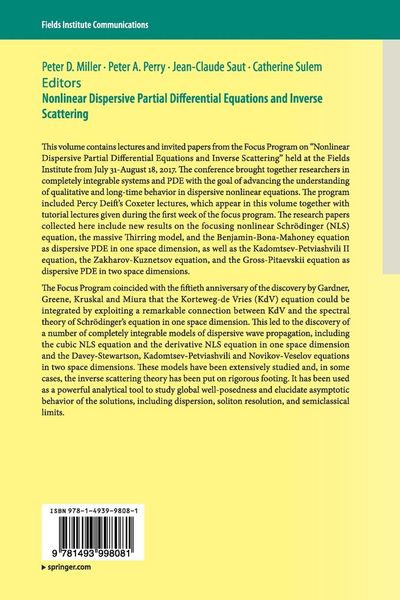
This volume contains lectures and invited papers from the Focus Program on "Nonlinear Dispersive Partial Differential Equations and Inverse Scattering" held at the Fields Institute from July 31-August 18, 2017. The conference brought together researchers in completely integrable systems and PDE with the goal of advancing the understanding of qualitative and long-time behavior in dispersive nonlinear equations. The program included Percy Deift’s Coxeter lectures, which appear in this volume together with tutorial lectures given during the first week of the focus program. The research papers collected here include new results on the focusing nonlinear Schrödinger (NLS) equation, the massive Thirring model, and the Benjamin-Bona-Mahoney equation as dispersive PDE in one space dimension, as well as the Kadomtsev-Petviashvili II equation, the Zakharov-Kuznetsov equation, and the Gross-Pitaevskii equation as dispersive PDE in two space dimensions.
The Focus Program coincided with the fiftieth anniversary of the discovery by Gardner, Greene, Kruskal and Miura that the Korteweg-de Vries (KdV) equation could be integrated by exploiting a remarkable connection between KdV and the spectral theory of Schrodinger's equation in one space dimension. This led to the discovery of a number of completely integrable models of dispersive wave propagation, including the cubic NLS equation, and the derivative NLS equation in one space dimension and the Davey-Stewartson, Kadomtsev-Petviashvili and Novikov-Veselov equations in two space dimensions. These models have been extensively studied and, in some cases, the inverse scattering theory has been put on rigorous footing. It has been used as a powerful analytical tool to study global well-posedness and elucidate asymptotic behavior of the solutions, including dispersion, soliton resolution, and semiclassical limits.Noch keine Bewertungen vorhanden
Verfassen Sie die erste Bewertung zu diesem Artikel
Helfen Sie anderen Kundinnen und Kunden durch Ihre Meinung.
Kurze Frage zu unserer Seite
Vielen Dank für dein Feedback
Wir nutzen dein Feedback, um unsere Produktseiten zu verbessern. Bitte habe Verständnis, dass wir dir keine Rückmeldung geben können. Falls du Kontakt mit uns aufnehmen möchtest, kannst du dich aber gerne an unseren Kund*innenservice wenden.
zum Kundenservice