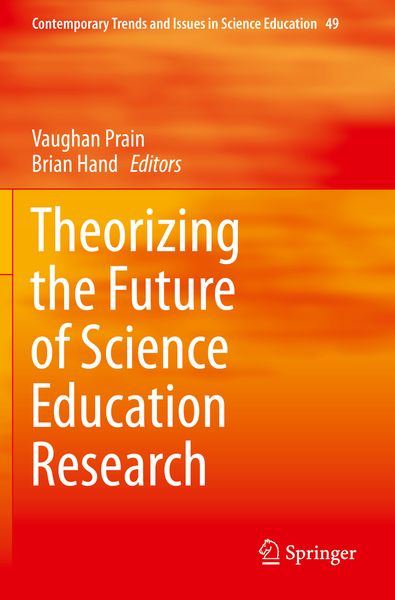
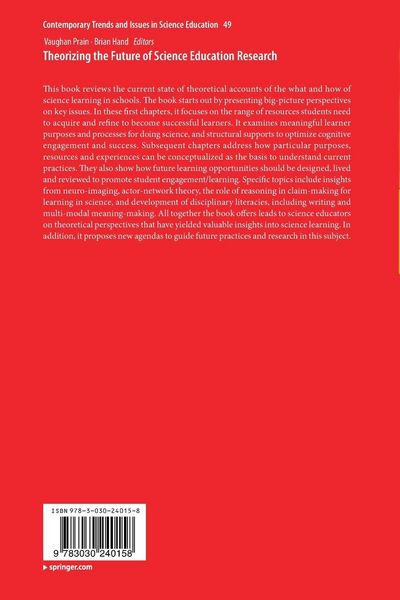
• Produktbild: Theorizing the Future of Science Education Research
  • Produktbild: Theorizing the Future of Science Education Research
Band 49

Theorizing the Future of Science Education Research

97,99 €

inkl. gesetzl. MwSt., Versandkostenfrei

Lieferung nach Hause

Beschreibung

Produktdetails

Einband

Taschenbuch

Erscheinungsdatum

05.11.2020

Herausgeber

Vaughan Prain + weitere

Verlag

Springer

Seitenzahl

196

Maße (L/B/H)

23,5/15,5/1,2 cm

Gewicht

318 g

Auflage

1st ed. 2019

Sprache

Englisch

ISBN

978-3-030-24015-8

Beschreibung

Rezension

“The book is well organized and structured. … the book proposes … a huge amount of new experimental data, many new interesting ideas, and solutions … . the book may be recommended as an excellent resource and background for further studies for a wide range of scientists in fields of education, cognitive and social psychology, and cultural, social, and crisis anthropology, as well as for experts and policymakers in education, who are involved in the strategic planning of science education.” (Yuriy Kostyuchenko, Victor Pushkar and Mohamed Abioui, Science & Education, Vol. 30, 2021)

Portrait

Vaughan Prain is a Professor in Science Interdisciplinary Education Research, Deakin University, Australia.  His research focus is on innovative teaching and learning approaches in primary and secondary science. Initially he focused on the role of writing for learning, and more recently on students engaging with representational affordances within and across visual, spatial, linguistic, mathematical and embodied modes in constructing accounts of scientific processes and claims.


Brian Hand is a Distinguished Professor of Science Education at the University of Iowa. He started his career as a chemistry and physics teacher (11 years) before moving into higher education. He has developed a strong research interest in writing and science argument. His focus has been on implementing the Science Writing Heuristic approach to learning for which he has been able to get a series of major grants to explore classroom implementation of the approach.

Produktdetails

Einband

Taschenbuch

Erscheinungsdatum

05.11.2020

Herausgeber

Verlag

Springer

Seitenzahl

196

Maße (L/B/H)

23,5/15,5/1,2 cm

Gewicht

318 g

Auflage

1st ed. 2019

Sprache

Englisch

ISBN

978-3-030-24015-8

Herstelleradresse

Springer-Verlag KG
Sachsenplatz 4-6
1201 Wien
AT

Email: ProductSafety@springernature.com

Kundinnen und Kunden meinen

0 Bewertungen

Informationen zu Bewertungen

Zur Abgabe einer Bewertung ist eine Anmeldung im Konto notwendig. Die Authentizität der Bewertungen wird von uns nicht überprüft. Wir behalten uns vor, Bewertungstexte, die unseren Richtlinien widersprechen, entsprechend zu kürzen oder zu löschen.

Die Bewertungen sind nach Format, Anzahl Sterne und Datum sortiert.

Verfassen Sie die erste Bewertung zu diesem Artikel

Helfen Sie anderen Kund*innen durch Ihre Meinung

Kundinnen und Kunden meinen

0 Bewertungen filtern

  • Produktbild: Theorizing the Future of Science Education Research
  • Produktbild: Theorizing the Future of Science Education Research
  • 1.Introduction: Theorizing future research for the science classroom; Vaughan Prain and Brian Hand.- SECTION ONE: Mapping the Big Picture.- 2. Merging cognitive and sociocultural approaches: Towards better understandings of the processes of developing thinking and reasoning; Paul Webb and Bill Whitlow.- 3. Frameworks, Committed Testers, and Science as a Form of Life; Jim Gee.- 4. Writers in Community Model: 15 Recommendations for Future Research in Using Writing to Promote Science Learning; Steve Graham.- SECTION TWO: Theorizing Aspects of Science Learning.- 5. An Exploratory Neuroimaging Study of Argumentative and Summary Writing Using Functional Near Infrared Spectroscopy; Richard Lamb, Brian Hand and Sae Yeol Yoon.- 6. Scientific Practices as an Actor-Network of Literacy Events: Forging a Convergence between Disciplinary Literacy and Scientific Practices; Kok-Sing Tang.- 7. Immersive approaches to science argumentation and literacy: What does it mean to “live” the languages of science?; Brian Hand, Andy Cavagnetto, and Lori Norton-Meier.- 8. Writing as an Epistemological Tool: Perspectives from personal, disciplinary, and sociocultural landscapes; Ying-Chih Chen.- 9. Scientific Literacy Practices from a concept of Discourse Space: Focusing on Resources and Demands for Learning; Sae Yeol Yoon.- 10. Future research in learning with, through and from scientific representations;  Vaughan Prain.- 11.  “I’m not a writer”: Shaping the literacy-related attitudes and beliefs of students and teachers in STEM disciplines; Lisa Emerson.- SECTION THREE: Review.- 12. Critical dialogues for emerging research agendas in science education; Greg Kelly.