• Produktbild: Decolonising Conflicts, Security, Peace, Gender, Environment and Development in the Anthropocene
  • Produktbild: Decolonising Conflicts, Security, Peace, Gender, Environment and Development in the Anthropocene
Band 30

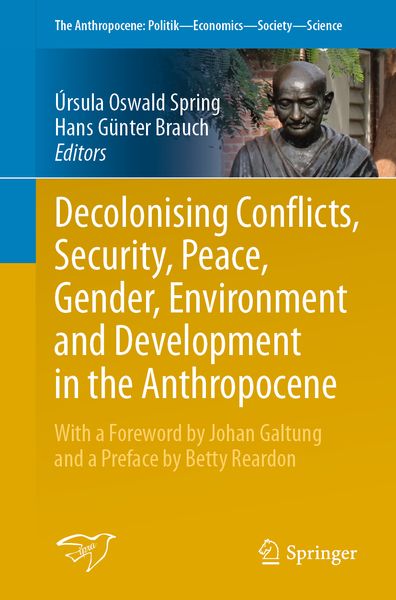
Decolonising Conflicts, Security, Peace, Gender, Environment and Development in the Anthropocene

49,99 €

inkl. gesetzl. MwSt., Versandkostenfrei


Beschreibung

Produktdetails

Einband

Taschenbuch

Erscheinungsdatum

26.01.2021

Abbildungen

XXX, 749 p. 47 illus., 33 illus. in color.

Herausgeber

Úrsula Oswald Spring + weitere

Verlag

Springer

Seitenzahl

749

Maße (L/B/H)

23,5/15,5/4,2 cm

Gewicht

1159 g

Auflage

1st ed. 2021

Sprache

Englisch

ISBN

978-3-030-62315-9

Beschreibung

Portrait

Ursula Oswald Spring, National Autonomous, University of Mexico(UNAM), Mexico.Hans Günter Brauch, Peace Research & European Security Studies.Mosbach, Germany.

Produktdetails

Einband

Taschenbuch

Erscheinungsdatum

26.01.2021

Abbildungen

XXX, 749 p. 47 illus., 33 illus. in color.

Herausgeber

Verlag

Springer

Seitenzahl

749

Maße (L/B/H)

23,5/15,5/4,2 cm

Gewicht

1159 g

Auflage

1st ed. 2021

Sprache

Englisch

ISBN

978-3-030-62315-9

Herstelleradresse

Springer-Verlag KG
Sachsenplatz 4-6
1201 Wien
AT

Email: GPSR Kontakt

Noch keine Bewertungen vorhanden

Verfassen Sie die erste Bewertung zu diesem Artikel

Helfen Sie anderen Kundinnen und Kunden durch Ihre Meinung.

Kundinnen und Kunden meinen

Bewertungen (0)

  • Produktbild: Decolonising Conflicts, Security, Peace, Gender, Environment and Development in the Anthropocene
  • Produktbild: Decolonising Conflicts, Security, Peace, Gender, Environment and Development in the Anthropocene

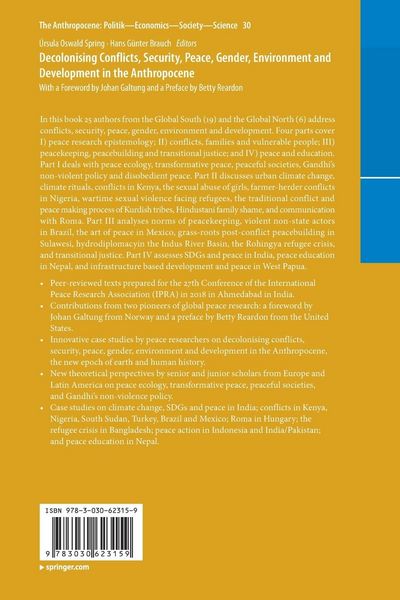
  • 1.Decolonising Peace in the Anthropocene: Introduction towards an Alternative Understanding of Peace and Security.-  2. Peace Ecology in the Anthropocene.- 3. Transformative and Participative Peace:A Theoretical and Methodological Proposal of Epistemology for Peace and Conflict studies.- 4. Peaceful Societies through Social Cohesion? The Power of Paradigms for Normative and Interdisciplinary Research.- 5. The National and Universal Importance of the Non-Violent Policy of Mohandas K. Gandhi.- 6. Disobedient Peace: Non-Cooperation With Inhuman Orders.- 7. Risks, Mitigation and Adaptation to Urban Climate Change Impacts in the Global South from a Gender Perspective.- 8. Conflicts in Kenya: Drivers of Conflicts and Assessing Mitigation Measures.- 9. Human Rights and Sexual Abuse of the Girl-Child in Nigeria: Implications for Development.- 10. The Farmer-Herder Conflicts in Nigeria’s Open Space: Taming the Tide.- 11. Climate Rituals: Cultural Response for Climate Change Adaptations in Africa.- 12. Ethnically-Charged Wartime Sexual Violence: The Agony of the South Sudanese Refugees in Uganda.- 13. Traditional Conflict and Peacemaking Process Through the Case of Kurdish Tribes in Mardin, Turkey.- 14. Family Shame and Eloping Couples: A Hindustani Warp in Time. Steps in Progress toward Nonviolence.- 15. We Are Not Victims:The Roma, an Outdoor Art Gallery and the Same Old Story – Critical Thinking in Communication for Development.- 16. Governance by Violent Non-State Actors as a Challenge to Sustainable Peace in Brazil.- 17.- Governance by Violent Non-State Actors as a Challenge to Sustainable Peace in Brazil.- 18. Art of Peace: Cultural Practices and Peacebuilding in Mexico.- 19. Grass-Roots Post-Conflict Peacebuilding: A Case Study of Mosintuwu Women School in Poso District, Central Sulawesi, Indonesia.- 20. Hydro-diplomacy Towards Peace Ecology: The Case of the Indus Water Treaty between India and Pakistan.- 21.- The Rohingya Refugee Crisis: Implications for Regional Security.- 22. An Unsustainable Price: The Opportunity Costs of Transitional Justice.- 23. Simultaneous Intervention Strategies at Local Ecosystems for Sustainable Development Goals and Peace: Design and Systems Perspectives.- 24. Citizen-Led Assessment and the Participatory Approach to Peace Education in Nepal.- 25. Can Infrastructure-Based Development Bring Peace to West Papua?.