KI-Beratung Beta

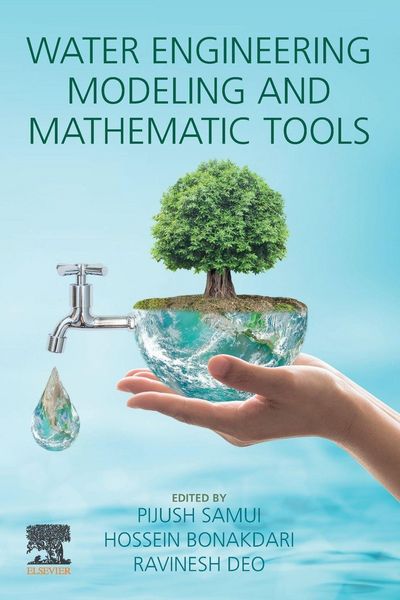
  • Produktbild: Water Engineering Modeling and Mathematic Tools
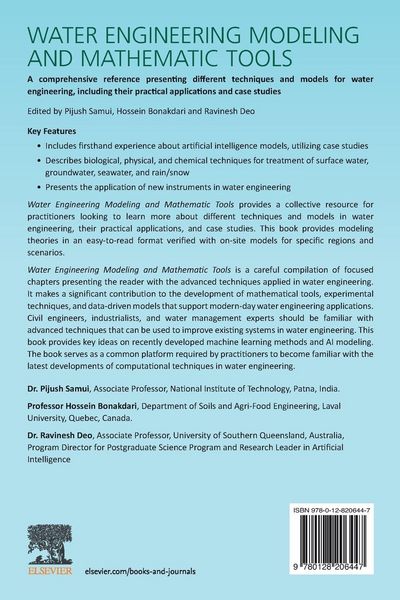
  • Produktbild: Water Engineering Modeling and Mathematic Tools

Water Engineering Modeling and Mathematic Tools

145,99 €

inkl. gesetzl. MwSt., Versandkostenfrei


Beschreibung

Produktdetails

Einband

Taschenbuch

Erscheinungsdatum

18.02.2021

Herausgeber

Pijush Samui + weitere

Verlag

Elsevier Science & Technology

Seitenzahl

592

Maße (L/B/H)

22,9/15,2/3 cm

Gewicht

783 g

Sprache

Englisch

ISBN

978-0-12-820644-7

Beschreibung

Portrait

Dr. Samui is an Associate Professor in the Department of Civil Engineering at NIT Patna, India. He received his PhD in Geotechnical Engineering from the Indian Institute of Science Bangalore, India, in 2008. His research interests include geohazard, earthquake engineering, concrete technology, pile foundation and slope stability, and application of AI for solving different problems in civil engineering. Dr. Samui is a repeat Elsevier editor but also a prolific contributor to journal papers, book chapters, and peer-reviewed conference proceedings.

Dr. Hossein Bonakdari is a distinguished professor in the Department of Civil Engineering at the University of Ottawa, specializing in mathematical modeling and artificial intelligence (AI). A leading expert in AI-driven data analysis, he has pioneered advanced algorithms for real-time forecasting and big data interpretation, significantly improving the understanding and management of environmental systems.

Dr. Bonakdari has authored four books, published over 320 peer-reviewed journal articles, contributed to more than 20 book chapters, and delivered over 100 presentations at national and international conferences. As a respected editorial board member of several leading journals, he continues to shape research in his field. His groundbreaking contributions have earned him global recognition, ranking him among the top 2% of the world's scientists from 2019 to 2024.

Professor Ravinesh Deo is an Associate Professor at University of Southern Queensland, Australia, Program Director for Postgraduate Science Program and Research Leader in Artificial Intelligence. He also serves as Associate Editor for two international journals: Stochastic Environmental Research and Risk Assessment and the ASCE Journal Hydrologic Engineering journal (USA). As an Applied Data Scientist with proven leadership in artificial intelligence, his research develops decision-systems with machine learning, heuristic and metaheuristic algorithms to improve real-life predictive systems especially using deep learning explainable AI, convolutional neural networks and long short-term memory networks. He was awarded internationally competitive fellowships including Queensland Government U.S. Smithsonian Fellowship, Australia-India Strategic Fellowship, Australia-China Young Scientist Exchange Award, Japan Society for Promotion of Science Fellowship, Chinese Academy of Science Presidential International Fellowship and Endeavour Fellowship. He is a member of scientific bodies, won Publication Excellence Awards, Head of Department Research Award, Dean's Commendation for Postgraduate Supervision, BSc Gold Medal for Academic Excellence and he was the Dux of Fiji in Year 13 examinations. Professor Deo held visiting positions at United States Tropical Research Institute, Chinese Academy of Science, Peking University, Northwest Normal University, University of Tokyo, Kyoto and Kyushu University, University of Alcala Spain, McGill University and National University of Singapore. He has undertaken knowledge exchange programs in Singapore, Japan, Europe, China, USA and Canada and secured international standing by researching innovative problems with global researchers. He has published Books with Springer Nature, Elsevier and IGI and over 190 publications of which over 140 are Q1 including refereed conferences, Edited Books and book chapters. Professor Deo's papers have been cited over 4,000 times with Google Scholar H-Index of 36 and a Field Weighted Citation Index exceeding 3.5.

Produktdetails

Einband

Taschenbuch

Erscheinungsdatum

18.02.2021

Herausgeber

Verlag

Elsevier Science & Technology

Seitenzahl

592

Maße (L/B/H)

22,9/15,2/3 cm

Gewicht

783 g

Sprache

Englisch

ISBN

978-0-12-820644-7

EU-Ansprechpartner

Elsevier B.V.
Radarweg 29
1043 NX Amsterdam
NL
productsafety@elsevier.com

Herstelleradresse

Elsevier Science & Technology
London Wall 125
EC2Y 5AS London
GB
tradeorders@elsevier.com

Noch keine Bewertungen vorhanden

Verfassen Sie die erste Bewertung zu diesem Artikel

Helfen Sie anderen Kundinnen und Kunden durch Ihre Meinung.

Kundinnen und Kunden meinen

Bewertungen (0)

Die Leseprobe wird geladen.
  • Produktbild: Water Engineering Modeling and Mathematic Tools
  • Produktbild: Water Engineering Modeling and Mathematic Tools
  • 1. Numerical insight into the sonolytic ozonation applied for water treatment
    2. Sea water desalination
    3. New Formulation for Predicting Soil Moisture Content using only Soil Temperature as Predictor: Multivariate Adaptive Regression Splines Vs Random Forest, MLPNN, M5Tree and MLR
    4. Numerical simulation of acoustic cavitation and its chemical effect in seawater: Toward understanding the multiple role of salinity in the sonochemical degradation of organic pollutants
    5. Computer simulation of N2O/argon gas mixture effect on the acoustic generation of hydroxyl radicals in water: Toward understanding the mechanism of N2O inhibited/improved-sonochemical processes
    6. Recent remediation technologies for contaminated water
    7. Water chemistry in the biological studies by using nuclear analytical techniques
    8. Protection from harmful effects of water - Examples from Serbia
    9. Gravity-driven Membrane Filtration for Water and Wastewater Treatment
    10. Modelling Hydraulics and Water Quality in Distribution Networks: Review of Existing Mathematical Techniques and Software
    11. Remediation of oil contaminated water for reuse using polymeric nanocomposites
    12. Hydrological contaminant transport
    13. Desalination technologies and potential mathematical modelling for sustainable water-energy nexus
    14. Emerging Trends of Water Quality Monitoring and Applications of Multivariate Tools
    15. Experimental study on bed deformations due to flows over macro-roughness conditions
    16. An Introduction to Hydraulics and Hydraulic Structures
    17. Mixing of Inclined Dense Jets: A Numerical Modelling
    18. Real-time Flood Forecasting with Weather Radar and Distributed Hydrological Model
    19. Flood susceptibility mapping in ungauged watersheds using a statistical model
    20. Groundwater potential mapping using hybridization of simulated annealing and random forest
    21. Synergy of Combining Megahertz Ultrasound Frequency and Heat Activated Persulfate for Wastewater Decontamination: Micro-modeling of Acoustic Cavitation and its Role in the Sono-hybrid Process
    22. On the sonochemical production of nitrite and nitrate in water: Computational study
    23. Numerical insight into the liquid compressibility effect on the sonochemical activity of acoustic bubbles
    24. Extremely Randomized Tree: A New Machines Learning Method for predicting Coagulant Dosage in Drinking Water Treatment Plant
    25. Pareto Design of Multi-Objective Evolutionary Neuro-Fuzzy System for Predicting Scour Depth around Bridge Piers
    26. River Flow Forecasting Using Stochastic and Neuro-Fuzzy Embedded Technique: A Comprehensive Pre-Processing Based Assessment
    27. Desalination technologies and potential mathematical modelling for sustainable water-energy nexus