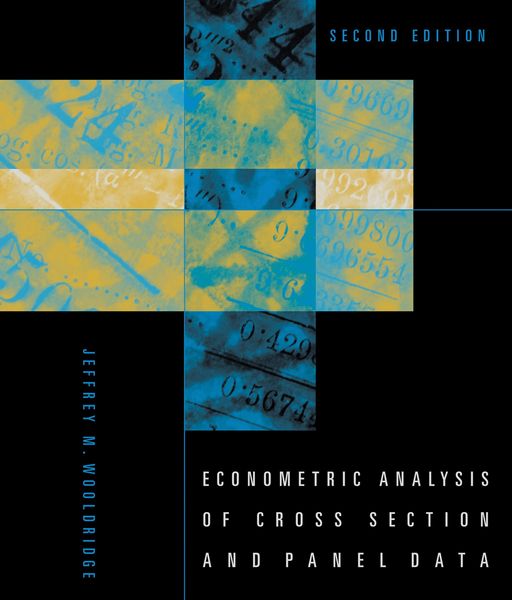
Econometric Analysis of Cross Section and Panel Data, second edition
151,99 €
inkl. gesetzl. MwSt.Beschreibung
Produktdetails
Format
ePUB 3
Kopierschutz
Ja
Family Sharing
Ja
Text-to-Speech
Ja
Erscheinungsdatum
01.10.2010
Verlag
MIT PressSeitenzahl
1096 (Printausgabe)
Dateigröße
16015 KB
Sprache
Englisch
EAN
9780262296793
The second edition of this acclaimed graduate text provides a unified treatment of two methods used in contemporary econometric research, cross section and data panel methods. By focusing on assumptions that can be given behavioral content, the book maintains an appropriate level of rigor while emphasizing intuitive thinking. The analysis covers both linear and nonlinear models, including models with dynamics and/or individual heterogeneity. In addition to general estimation frameworks (particular methods of moments and maximum likelihood), specific linear and nonlinear methods are covered in detail, including probit and logit models and their multivariate, Tobit models, models for count data, censored and missing data schemes, causal (or treatment) effects, and duration analysis.
Econometric Analysis of Cross Section and Panel Data was the first graduate econometrics text to focus on microeconomic data structures, allowing assumptions to be separated into population and sampling assumptions. This second edition has been substantially updated and revised. Improvements include a broader class of models for missing data problems; more detailed treatment of cluster problems, an important topic for empirical researchers; expanded discussion of "generalized instrumental variables" (GIV) estimation; new coverage (based on the author's own recent research) of inverse probability weighting; a more complete framework for estimating treatment effects with panel data, and a firmly established link between econometric approaches to nonlinear panel data and the "generalized estimating equation" literature popular in statistics and other fields. New attention is given to explaining when particular econometric methods can be applied; the goal is not only to tell readers what does work, but why certain "obvious" procedures do not. The numerous included exercises, both theoretical and computer-based, allow the reader to extend methods covered in the text and discover new insights.
Noch keine Bewertungen vorhanden
Verfassen Sie die erste Bewertung zu diesem Artikel
Helfen Sie anderen Kundinnen und Kunden durch Ihre Meinung.
Kurze Frage zu unserer Seite
Vielen Dank für dein Feedback
Wir nutzen dein Feedback, um unsere Produktseiten zu verbessern. Bitte habe Verständnis, dass wir dir keine Rückmeldung geben können. Falls du Kontakt mit uns aufnehmen möchtest, kannst du dich aber gerne an unseren Kund*innenservice wenden.
zum Kundenservice