KI-Beratung Beta

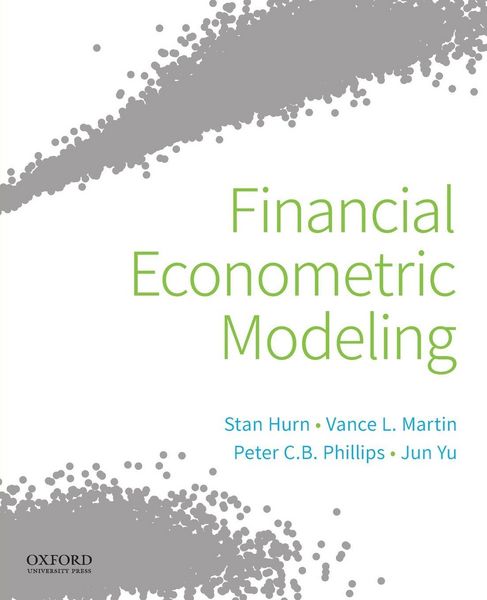
Produktbild: Financial Econometric Modeling

Financial Econometric Modeling

128,99 €

inkl. gesetzl. MwSt., Versandkostenfrei


Beschreibung

Produktdetails

Einband

Taschenbuch

Erscheinungsdatum

15.05.2020

Verlag

Oxford Academic

Seitenzahl

634

Maße (L/B/H)

23,5/19,1/3,4 cm

Gewicht

1165 g

Sprache

Englisch

ISBN

978-0-19-085706-6

Beschreibung

Produktdetails

Einband

Taschenbuch

Erscheinungsdatum

15.05.2020

Verlag

Oxford Academic

Seitenzahl

634

Maße (L/B/H)

23,5/19,1/3,4 cm

Gewicht

1165 g

Sprache

Englisch

ISBN

978-0-19-085706-6

Herstelleradresse

Libri GmbH
Europaallee 1
36244 Bad Hersfeld
DE

Email: gpsr@libri.de

Noch keine Bewertungen vorhanden

Verfassen Sie die erste Bewertung zu diesem Artikel

Helfen Sie anderen Kundinnen und Kunden durch Ihre Meinung.

Kundinnen und Kunden meinen

Bewertungen (0)

  • Produktbild: Financial Econometric Modeling
    • I: Fundamentals
    • 1. Prices and Returns
    • 1.1 What is Financial Econometrics?
    • 1.2 Financial Assets
    • 1.3 Equity Prices and Returns
    • 1.4 Stock Market Indices
    • 1.5 Bond Yields
    • 1.6 Exercises
    • 2. Financial Data
    • 2.1irst Look at the Data
    • 2.2 Summary Statistics
    • 2.3 Percentiles and Value at Risk
    • 2.4 The Efficient Market Hypothesis
    • 2.5 Exercises
    • 3. Linear Regression
    • 3.1 The Capital Asset Pricing Model
    • 3.2 Multi-factor CAPM
    • 3.3 Properties of Ordinary Least Squares
    • 3.4 Diagnostics
    • 3.5 Measuring Portfolio Performance
    • 3.6 Minimum Variance Portfolios
    • 3.7 Event Analysis
    • 3.8 Exercises
    • 4. Stationary Dynamics
    • 4.1 Stationarity
    • 4.2 Univariate Time Series Models
    • 4.3 Autocorrelation and Partial Autocorrelations
    • 4.4 Mean Aversion and Reversion in Returns
    • 4.5 Vector Autoregressive Models
    • 4.6 Analysing VARs
    • 4.7 Diebold-Yilmaz Spillover Index
    • 4.8 Exercises
    • 5. Nonstationarity
    • 5.1 The RandomWalk with Drift
    • 5.2 Characteristics of Financial Data
    • 5.3 Dickey-Fuller Methods and Unit Root Testing
    • 5.4 Beyond the Simple Unit Root Framework
    • 5.5 Asset Price Bubbles
    • 5.6 Exercises
    • 6. Cointegration
    • 6.1 The Present Value Model and Cointegration
    • 6.2 Vector Error Correction Models
    • 6.3 Estimation
    • 6.4 Cointegration Testing
    • 6.5 Parameter Testing
    • 6.6 Cointegration and the Gordon Model
    • 6.7 Cointegration and the Yield Curve
    • 6.8 Exercises
    • 7. Forecasting
    • 7.1 Types of Forecasts
    • 7.2 Forecasting Univariate Time Series Models
    • 7.3 Forecasting Multivariate Time Series Models
    • 7.4 Combining Forecasts.
    • 7.5 Forecast Evaluation Statistics
    • 7.6 Evaluating the Density of Forecast Errors
    • 7.7 Regression Model Forecasts
    • 7.8 Predicting the Equity Premium
    • 7.9 Stochastic Simulation of Value at Risk
    • 7.10 Exercises
    • II. Methods
    • 8. Instrumental Variables
    • 8.1 The Exogeneity Assumption
    • 8.2 Estimating the Risk-Return Tradeoff
    • 8.3 The General Instrumental Variables Estimator
    • 8.4 Testing for Endogeneity
    • 8.5 Weak Instruments
    • 8.6 Consumption CAPM
    • 8.7 Endogeneity and Corporate Finance
    • 8.8 Exercises
    • 9. Generalised Method of Moments
    • 9.1 Single Parameter Models
    • 9.2 Multiple Parameter Models
    • 9.3 Over-Identified Models
    • 9.4 Estimation
    • 9.5 Properties of the GMM Estimator
    • 9.6 Testing
    • 9.7 Consumption CAPM Revisited
    • 9.8 The CKLS Model of Interest Rates
    • 9.9 Exercises
    • 10. Maximum Likelihood
    • 10.1 Distributions in Finance
    • 10.2 Estimation by Maximum Likelihood
    • 10.3 Applications
    • 10.4 Numerical Methods
    • 10.5 Properties
    • 10.6 Quasi Maximum Likelihood Estimation
    • 10.7 Testing
    • 10.8 Exercises
    • 11. Panel Data Models
    • 11.1 Types of Panel Data
    • 11.2 Reasons for Using Panel Data
    • 11.3 Two Introductory Panel Models
    • 11.4 Fixed and Random Effects Panel Models
    • 11.5 Dynamic Panel Models
    • 11.6 Nonstationary Panel Models
    • 11.7 Exercises
    • 12. Latent Factor Models
    • 12.1 Motivation
    • 12.2 Principal Components
    • 12.3atent Factor CAPM
    • 12.4 Dynamic Factor Models: the Kalman Filter
    • 12.5arametric Approach to Factors
    • 12.6 Stochastic Volatility
    • 12.7 Exercises
    • III: Topics
    • 13. Univariate GARCH Models
    • 13.1 Volatility Clustering.
    • 13.2 The GARCH Model
    • 13.3 Asymmetric Volatility Effects
    • 13.4 Forecasting
    • 13.5 The Risk-Return Tradeoff.
    • 13.6 Heatwaves and Meteor Showers
    • 13.7 Exercises
    • 14. Multivariate GARCH Models
    • 14.1 Motivation
    • 14.2 Early Covariance Estimators
    • 14.3 The BEKK Model
    • 14.4 The DCC Model
    • 14.5 Optimal Hedge Ratios
    • 14.6 Capital Ratios and Financial Crises
    • 14.7 Exercises
    • 15. Realised Variance and Covariance
    • 15.1 High Frequency Data
    • 15.2 Realised Variance
    • 15.3 Integrated Variance
    • 15.4 Microstructure Noise
    • 15.5 Bipower Variation and Jumps
    • 15.6 Forecasting
    • 15.7 The Realised GARCH Model
    • 15.8 Realised Covariance
    • 15.9 Exercises
    • 16. Microstructure Models
    • 16.1 Characteristics of High Frequency Data
    • 16.2 Limit Order Book
    • 16.3 Bid Ask Bounce
    • 16.4 Information Content of Trades
    • 16.5 Modelling Price Movements in Trades
    • 16.6 Modelling Durations
    • 16.7 Modelling Volatility in Transactions Time
    • 16.8 Exercises
    • 17. Options
    • 17.1 Option Pricing Basics.
    • 17.2 The Black-Scholes Option Price Model
    • 17.3irst Look at Options Data
    • 17.4 Estimating the Black-Scholes Model
    • 17.5 Testing the Black-Scholes Model
    • 17.6 Option Pricing and GARCH Volatility
    • 17.7 The Melick-Thomas Option Price Model
    • 17.8 Nonlinear Option Pricing.
    • 17.9 Using Options to Estimate GARCH Models
    • 17.10 Exercises
    • 18. Extreme Values and Copulas
    • 18.1 Motivation.
    • 18.2 Evidence of Heavy Tails
    • 18.3 Extreme Value Theory
    • 18.4 Modelling Dependence using Copulas
    • 18.5 Properties of Copulas
    • 18.6 Estimating Copula Models
    • 18.7 MGARCH Model Using Copulas
    • 18.8 Exercises
    • 19. Concluding Remarks
    • A. Mathematical Preliminaries
    • A.1 Summation Notation
    • A.2 Expectations Operator
    • A.3 Differentiation
    • A.4 Taylor Series Expansions
    • A.5 Matrix Algebra
    • A.6 Transposition ofatrix
    • A.7 Symmetric Matrix
    • B. Properties of Estimators
    • B.1 Finite Sample Properties
    • B.2 Asymptotic Properties
    • C. Linear Regression Model in Matrix Notation
    • D. Numerical Optimisation
    • E. Simulating Copulas
    • Author index
    • Subject index