KI-Beratung Beta

Gutscheinbedingungen

**Gültig vom 23.11. bis 30.11.2026 | Gültig für nicht preisgebundene fremdsprachige Bücher | Einzelne Artikel können ausgeschlossen sein | Online auf www.bücher.de einlösbar | Click & Collect nur mit Online-Zahlung (Paypal/Kreditkarte) vorab | Nicht kombinierbar mit anderen Gutscheinen oder Preisaktionen | Nur einmal pro Einkauf einlösbar | Gutschein wird auf max. 500€ Bestellwert angerechnet | Keine Barauszahlung | Nicht gültig für Versandkosten und Services

  • Produktbild: Patterns in the Machine
  • Produktbild: Patterns in the Machine

Patterns in the Machine A Software Engineering Guide to Embedded Development

45,99 €

inkl. gesetzl. MwSt., Versandkostenfrei


Beschreibung

Discover how to apply software engineering patterns to develop more robust firmware faster than traditional embedded development approaches. In the authors’ experience, traditional embedded software projects tend towards monolithic applications that are optimized for their target hardware platforms....

Beschreibung

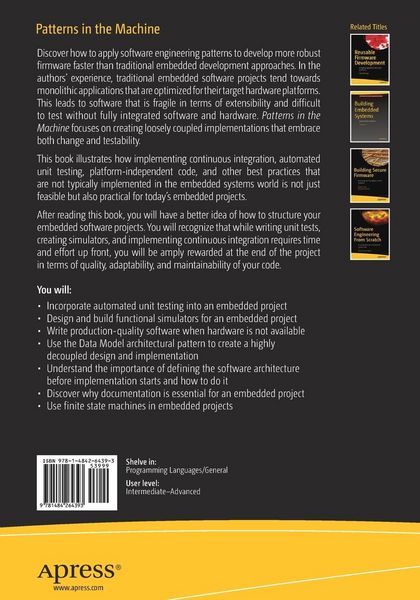
Discover how to apply software engineering patterns to develop more robust firmware faster than traditional embedded development approaches. In the authors’ experience, traditional embedded software projects tend towards monolithic applications that are optimized for their target hardware platforms. This leads to software that is fragile in terms of extensibility and difficult to test without fully integrated software and hardware.  Patterns in the Machine focuses on creating loosely coupled implementations that embrace both change and testability.

This book illustrates how implementing continuous integration, automated unit testing, platform-independent code, and other best practices that are not typically implemented in the embedded systems world is not just feasible but also practical for today’s embedded projects.

After reading this book, you will have a better idea of how to structure your embedded software projects. You will recognize that while writing unit tests, creating simulators, and implementing continuous integration requires time and effort up front, you will be amply rewarded at the end of the project in terms of quality, adaptability, and maintainability of your code. 

What You Will Learn

  • Incorporate automated unit testing into an embedded project
  • Design and build functional simulators for an embedded project
  • Write production-quality software when hardware is not available
  • Use the Data Model architectural pattern to create a highly decoupled design and implementation
  • Understand the importance of defining the software architecture before implementation starts and how to do it
  • Discover why documentation is essential for an embedded project
  • Use finite state machines in embedded projects

Who This Book Is For

Mid-level or higher embedded systems (firmware) developers, technical leads, software architects, and development managers.

Produktdetails

Einband

Taschenbuch

Erscheinungsdatum

20.01.2021

Abbildungen

XIX, 293 p. 59 illus.

Verlag Apress

Produktdetails

Einband

Taschenbuch

Erscheinungsdatum

20.01.2021

Abbildungen

XIX, 293 p. 59 illus.

Verlag Apress
Seitenzahl

293

Maße (L/B/H)

25,4/17,8/1,8 cm

Gewicht

598 g

Auflage

1st ed.

Sprache

Englisch

ISBN

978-1-4842-6439-3

Herstelleradresse

Springer-Verlag GmbH
Tiergartenstr. 17
69121 Heidelberg
DE

Email: ProductSafety@springernature.com

Noch keine Bewertungen vorhanden

Verfassen Sie die erste Bewertung zu diesem Artikel

Helfen Sie anderen Kundinnen und Kunden durch Ihre Meinung.

Kundinnen und Kunden meinen

Bewertungen (0)

  • Produktbild: Patterns in the Machine
  • Produktbild: Patterns in the Machine
  • 1: Introduction.- 2: Core Concepts.- 3: Design Theory For Embedded Programming.- 4: Persistent Storage Example.- 5: Software Architecture.- 6: Automated Unit Testing.- 7: Functional Simulator.- 8: Continuous Integration.- 9: Data Model.- 10: Finite State Machines.- 11: Documentation.- 12: File Organization and Naming.- 13: More About Late Bindings.- 14: Initialization and Main.- 15: More Best Practices.- 16: PIM Thermostat Example.- 17: The Tao of Development.- Appendix A: Terminology.- Appendix B: UML Notation for State Machines.- Appendix C: UML Cheat Sheet.- Appendix D: Why C++.- Appendix E: Package Management and Outcast.- Appendix F: Requirements vs. Design Statements.