KI-Beratung Beta

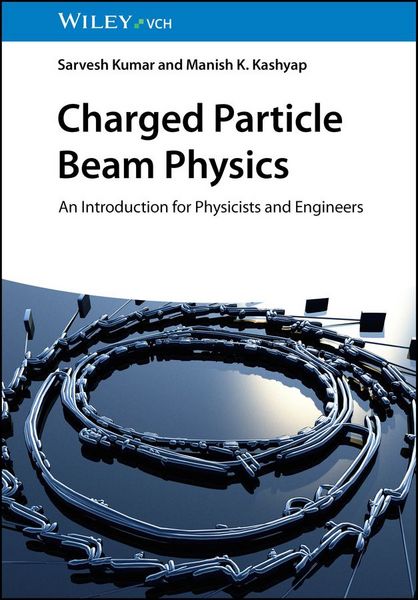
Produktbild: Charged Particle Beam Physics
- 12%

Charged Particle Beam Physics An Introduction for Physicists and Engineers

12% sparen

94,99 € UVP 109,00 €

inkl. gesetzl. MwSt., Versandkostenfrei


Beschreibung

Offers a clear and practical introduction to the essentials of charged particle beam physics, covers the design of accelerator machines and their basic components   A cornerstone of modern accelerator technology, charged particle beam physics encompasses theoretical principles, advanced simulations, and...

Beschreibung

Offers a clear and practical introduction to the essentials of charged particle beam physics, covers the design of accelerator machines and their basic components
 
A cornerstone of modern accelerator technology, charged particle beam physics encompasses theoretical principles, advanced simulations, and real-world applications. Charged Particle Beam Physics: An Introduction for Physicists and Engineers provides a comprehensive foundation for understanding, modeling, and implementing beam optics components in accelerator systems.
 
Combining essential concepts with cutting-edge techniques, such as the transfer-matrix method and numerical simulation tools, this detailed yet accessible textbook simplifies the core concepts and principles of the complex field. Reader-friendly chapters systematically address ion sources, beam optics design, advanced diagnostic and vacuum systems, and more. Authors Sarvesh Kumar and Manish K. Kashyap discuss key topics such as electrostatic, magnetostatic, and radiofrequency fields, as well as practical applications in materials science, plasma physics, and radiation biology.
 
Bridging theoretical knowledge with practical implementation, Charged Particle Beam Physics:
 
* Provides in-depth coverage of charged particle beam physics, relevant to both single-pass configurations and standard beam transport lines across accelerator systems
* Combines elements of electrodynamics, particle physics, optics, and engineering for a holistic understanding
* Explores state-of-the-art methods such as open-source beam optics codes
* Includes end-of-chapter problems and worked solutions, along with numerical examples using open-source tools such as TRANSPORT and TRACE3d
 
Charged Particle Beam Physics: An Introduction for Physicists and Engineers is ideal for graduate-level students in physics and engineering courses focused on accelerator physics and beam optics, as well as researchers and professionals working in accelerator design and operation. It serves as both a teaching resource and a reference for practitioners tackling fundamental calculations and developing accelerator components across various disciplines.

Produktdetails

Einband

Gebundene Ausgabe

Erscheinungsdatum

24.09.2025

Abbildungen

200 schwarz-weiße Abbildungen

Verlag Wiley-VCH

Produktdetails

Einband

Gebundene Ausgabe

Erscheinungsdatum

24.09.2025

Abbildungen

200 schwarz-weiße Abbildungen

Verlag Wiley-VCH
Seitenzahl

288

Maße (L/B/H)

24,7/17,5/1,9 cm

Gewicht

666 g

Auflage

1. Auflage

Sprache

Englisch

ISBN

978-3-527-41404-8

Herstelleradresse

Wiley-VCH GmbH
Boschstraße 12
69469 Weinheim
DE

Email: wiley-vch@kolibri360.de

Noch keine Bewertungen vorhanden

Verfassen Sie die erste Bewertung zu diesem Artikel

Helfen Sie anderen Kundinnen und Kunden durch Ihre Meinung.

Kundinnen und Kunden meinen

Bewertungen (0)

Die Leseprobe wird geladen.
  • Produktbild: Charged Particle Beam Physics
  • 1 BASIC PRINCIPLES OF PARTICLE ACCELERATORS

    1.1 History of Accelerators

    1.2 Units in Accelerator Physics

    1.3 Common Components of Accelerators

    1.4 Electrostatic Accelerators

    1.5 Motion of a Charged Particle in a Magnetic Field

    1.6 Cyclotron

    1.7 Synchroton

    1.8 Betatron

    1.9 Colliders

    1.10 Synchrocyclotrons

    1.11 Storage Rings

    1.12 FFAG Accelerators

    1.13 Wakefield Accelerators


    2 BEAM OPTICS

    2.1 Phase Space

    2.2 Liouville's Theorem

    2.3 Emittance and Brightness

    2.4 Transfer Matrix

    2.5 Transverse Beam Dynamics

    2.6 Longitudinal Beam Dynamics


    3 ION SOURCES

    3.1 Plasma Physics

    3.2 Negative Ion Source

    3.3 ECR Ion Source

    3.3 Microwave Ion Source

    3.5 Laser Ion Source

    3.6 Vacuum Arc Ion Source

    3.7 High Current Gaseous Ion Source


    4 MAGNETOSTATIC DEVICES

    4.2 Solenoid Magnets

    4.4 Dipole Magnets

    4.4 Quadrupole Magnet

    4.5 Sextupole Magnets

    4.6 Scanner Magnets

    4.7 Steerer Magnets

    4.8 Wien Filter

    4.9 Achromatic magnets

    4.10 Undulators and Wigglers


    5 ELECTROSTATIC DEVICES

    5.1 Motion of a Charged Particle in an Electric Field

    5.2 Electrostatic Gap Lens

    5.3 Einzel Lens

    5.4 Electrostatic Dipole

    5.5 Electrostatic Quadrupole

    5.6 Electrostatic Accelerating Tubes


    6 RADIO FREQUENCY DEVICES

    6.1 Motion of a Charged Particle in a Radio frequency field

    6.2 RF Gap

    6.3 RF Buncher

    6.4 RF Chopper

    6.4 Multiharmonic Buncher

    6.5 RF Accelerating Cavities

    6.6 Radiofrequency Quadrupoles

    6.7 Drift Tube Linacs


    7 BEAM DIAGNOSTIC DEVICES

    7.1 Faraday Cups

    7.2 Beam Profile Monitors

    7.3 Transverse Emittance Scanner

    7.4 Longitudinal Emittance Scanner


    8 APPLICATIONS OF ACCELERATORS

    8.1 Nuclear Physics

    8.2 Materials Sciences

    8.3 Atomic Physics

    8.4 Plasma Physics

    8.5 Radiation Biology

    8.6 Accelerator Mass Spectroscopy

    8.7 High Energy Elementary Particle Physics Appendices


    Solutions to Chapter Problems