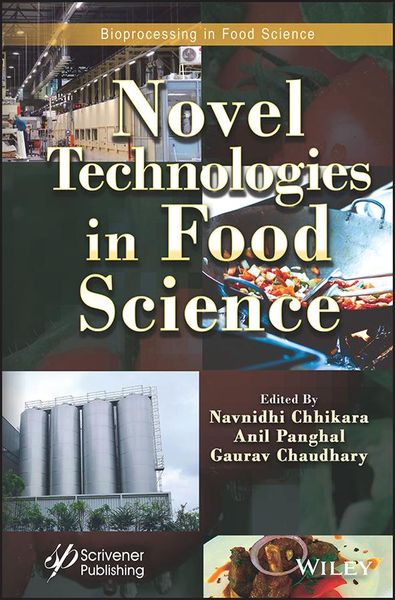
Novel Technologies in Food Science
276,99 €
inkl. gesetzl. MwSt.,
Beschreibung
Produktdetails
Einband
Gebundene Ausgabe
Erscheinungsdatum
07.02.2023
Herausgeber
Navnidhi Chhikara + weitereVerlag
John Wiley & SonsSeitenzahl
656
Maße (L/B/H)
23,3/15,7/4 cm
Gewicht
1036 g
Auflage
1. Auflage
Sprache
Englisch
ISBN
978-1-119-77557-7
Presenting cutting-edge information on new and emerging food engineering processes, Novel Technologies in Food Science, the newest volume in the ground-breaking new series, "Bioprocessing in Food Science," is an essential reference on the modelling, quality, safety, and technologies associated with food processing operations today.
Novel Technologies in Food Science, the latest volume in the series, "Bioprocessing in Food Science," is based on the novel technologies in usage and requirements for handling, processing, storage, and packaging of food. Novel bioprocessing technologies are gaining more interest among researchers and industries due to the minimal impact on product quality in comparison to conventional methods. These techniques are also superior in terms of energy, time-saving and extended shelf life, and thus can replace the conventional technologies partially or completely. Practical application of these technologies by the food industry, however, is limited due to higher costs, lack of knowledge in food manufacturers for the implementation of technologies, and validation systems. An in-depth discussion on consumer needs and rights, industry responsibilities, and future prospectus of novel technologies in food science are covered in this volume.
The main objective of this book is to disseminate knowledge about the recent technologies developed in the field of food science to students, researchers, and industry people. This will enable them to make crucial decisions regarding the adoption, implementation, economics, and constraints of the different technologies.
Different technologies like ultrasonication, pulse electric field, high-pressure processing, magnetization, ohmic heating, and irradiation are discussed with their application in food product manufacturing, packaging, food safety, and quality assurance. Whether for the veteran engineer or scientist, the student, or a manager or other technician working in the field, this volume is a must-have for any library.
Noch keine Bewertungen vorhanden
Verfassen Sie die erste Bewertung zu diesem Artikel
Helfen Sie anderen Kundinnen und Kunden durch Ihre Meinung.
Kurze Frage zu unserer Seite
Vielen Dank für dein Feedback
Wir nutzen dein Feedback, um unsere Produktseiten zu verbessern. Bitte habe Verständnis, dass wir dir keine Rückmeldung geben können. Falls du Kontakt mit uns aufnehmen möchtest, kannst du dich aber gerne an unseren Kund*innenservice wenden.
zum Kundenservice