• Produktbild: Decarbonising the Built Environment
  • Produktbild: Decarbonising the Built Environment

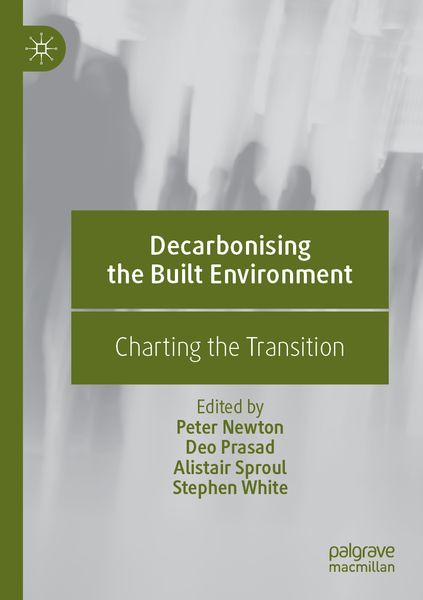
Decarbonising the Built Environment Charting the Transition

53,99 €

inkl. gesetzl. MwSt., Versandkostenfrei

Lieferung nach Hause

Beschreibung

Produktdetails

Einband

Taschenbuch

Erscheinungsdatum

14.08.2020

Herausgeber

Peter Newton + weitere

Verlag

Springer Singapore

Seitenzahl

555

Maße (L/B/H)

21/14,8/3,2 cm

Gewicht

750 g

Auflage

1st ed. 2019

Sprache

Englisch

ISBN

978-981-13-7942-0

Beschreibung

Portrait

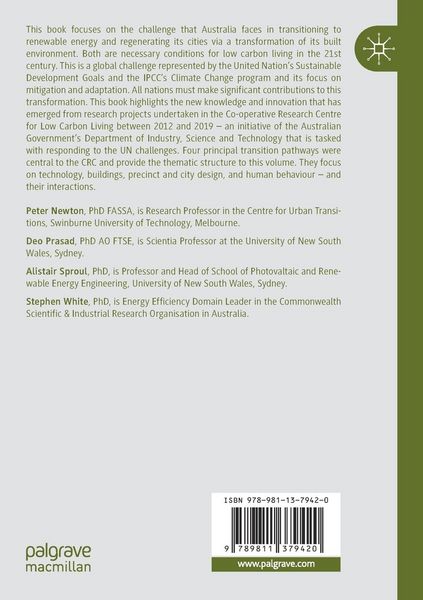
Peter Newton, PhD FASSA, is Research Professor in the Centre for Urban Transitions, Swinburne University of Technology, Melbourne.

Deo Prasad, PhD AO FTSE, is Scientia Professor at the University of New South Wales, Sydney.

Alistair Sproul, PhD, is Professor and Head of School of Photovaltaic and Renewable Energy Engineering, University of New South Wales, Sydney.

Stephen White, PhD, is Energy Efficiency Domain Leader in the Commonwealth Scientific & Industrial Research Organisation in Australia.

Produktdetails

Einband

Taschenbuch

Erscheinungsdatum

14.08.2020

Herausgeber

Verlag

Springer Singapore

Seitenzahl

555

Maße (L/B/H)

21/14,8/3,2 cm

Gewicht

750 g

Auflage

1st ed. 2019

Sprache

Englisch

ISBN

978-981-13-7942-0

Herstelleradresse

Springer-Verlag GmbH
Tiergartenstr. 17
69121 Heidelberg
DE

Email: ProductSafety@springernature.com

Kundinnen und Kunden meinen

0 Bewertungen

Informationen zu Bewertungen

Zur Abgabe einer Bewertung ist eine Anmeldung im Konto notwendig. Die Authentizität der Bewertungen wird von uns nicht überprüft. Wir behalten uns vor, Bewertungstexte, die unseren Richtlinien widersprechen, entsprechend zu kürzen oder zu löschen.

Die Bewertungen sind nach Format, Anzahl Sterne und Datum sortiert.

Verfassen Sie die erste Bewertung zu diesem Artikel

Helfen Sie anderen Kund*innen durch Ihre Meinung

Kundinnen und Kunden meinen

0 Bewertungen filtern

  • Produktbild: Decarbonising the Built Environment
  • Produktbild: Decarbonising the Built Environment
  • 1. Pathways to Low Carbon Living.- Part 1: Energy Transition2. Energy futures for Australia.- 3. Rooftop photovoltaics: distributed renewable energy and storage (or low cost PV changes everything).- 4. Community owned renewable energy: enabling the transition towards renewable energy?.- 5. Unlocking the benefits of vehicle electrification.- 6. Decarbonising household energy use: the smart meter revolution and beyond.- Part 2: Transition to Zero Carbon Buildings.- 7. Assessing embodied greenhouse gas emissions in the built environment.- 8. Transitioning to net zero energy homes: learnings from the CRC's high performance housing Living Laboratories.- 9. Decarbonising commercial buildings.- 10. The trajectory to a net zero emission built environment: the role of policy and regulation.- Part 3: Regenerating Urban Precincts and Cities.- 11. Sustainable precincts: transforming Australian cities one neighbourhood at a time.- 12. Development of low carbon urban forms: concepts, tools andscenarios.- 13. Health and the compact city.- 14. Low carbon urban mobility.- 15. Integrated urban water systems.- 16. Energy benchmarking for efficient, lower carbon wastewater treatment operations in Australia.- 17. Toward low carbon urban metabolism: the impact of eliminating food waste.- 18. Urban heat island mitigation for overheating and local climate change.- 19. Performance of urban precincts: towards integrated assessment.- Part 4: Human Factors in Low Carbon Living.- 20. Consumer responses to rating tools and residential energy efficiency disclosure.- 21. The Low Carbon Readiness Index.- 22. A social psychological guide for transformation into low carbon living.- 23. Shifting domestic energy consumption through a holistic understanding of the home system of practice.- 24. Engaging home renovators: opportunities and challenges for low carbon living.- 25. Sharing advice online: lessons for fostering sustainable homes from online discussion.- 26. Engaging local communities.- Part 5: A Future Perspective.- 27. Visions scenarios and pathways for rapid decarbonisation of Australian cities by 2040.