Gutscheinbedingungen

**Gültig vom 15.06.2026 bis 17.06.2026 | Gültig für nicht preisgebundene fremdsprachige Bücher | Einzelne Artikel können ausgeschlossen sein | Maximaler rabattfähiger Warenkorbwert 500 € | Nicht kombinierbar mit weiteren Aktionen | Nur einmal pro Person einlösbar | Nur solange der Vorrat reicht

  • Produktbild: Depopulation, Deindustrialisation and Disasters
  • Produktbild: Depopulation, Deindustrialisation and Disasters

Depopulation, Deindustrialisation and Disasters Building Sustainable Communities in Japan

116,99 €

inkl. gesetzl. MwSt., Versandkostenfrei

Lieferung nach Hause

Beschreibung

Produktdetails

Einband

Taschenbuch

Erscheinungsdatum

14.08.2020

Herausgeber

Katsutaka Shiraishi + weitere

Verlag

Springer

Seitenzahl

364

Maße (L/B/H)

21/14,8/2,2 cm

Gewicht

516 g

Auflage

1st ed. 2019

Sprache

Englisch

ISBN

978-3-030-14477-7

Beschreibung

Portrait

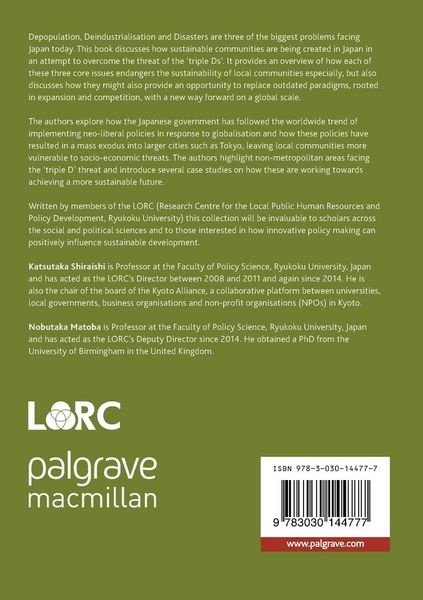
Katsutaka Shiraishi is Professor at the Faculty of Policy Science, Ryukoku University, Japan and has acted as the LORC’s Director between 2008 and 2011 and again since 2014.  He is also the chair of the board of the Kyoto Alliance, a collaborative platform between universities, local governments, business organisations and non-profit organisations (NPOs) in Kyoto.

Nobutaka Matoba is Professor at the Faculty of Policy Science, Ryukoku University, Japan and has acted as the LORC’s Deputy Director since 2014.  He obtained a PhD from the University of Birmingham in the United Kingdom.

Produktdetails

Einband

Taschenbuch

Erscheinungsdatum

14.08.2020

Herausgeber

Verlag

Springer

Seitenzahl

364

Maße (L/B/H)

21/14,8/2,2 cm

Gewicht

516 g

Auflage

1st ed. 2019

Sprache

Englisch

ISBN

978-3-030-14477-7

Herstelleradresse

Springer-Verlag GmbH
Tiergartenstr. 17
69121 Heidelberg
DE

Email: ProductSafety@springernature.com

Kundinnen und Kunden meinen

0 Bewertungen

Informationen zu Bewertungen

Zur Abgabe einer Bewertung ist eine Anmeldung im Konto notwendig. Die Authentizität der Bewertungen wird von uns nicht überprüft. Wir behalten uns vor, Bewertungstexte, die unseren Richtlinien widersprechen, entsprechend zu kürzen oder zu löschen.

Die Bewertungen sind nach Format, Anzahl Sterne und Datum sortiert.

Verfassen Sie die erste Bewertung zu diesem Artikel

Helfen Sie anderen Kund*innen durch Ihre Meinung

Kundinnen und Kunden meinen

0 Bewertungen filtern

  • Produktbild: Depopulation, Deindustrialisation and Disasters
  • Produktbild: Depopulation, Deindustrialisation and Disasters
  • PART I  Japan as the epitome of the triple Ds in the world.- Chapter 1 Global Trends in Facing the Triple Ds: Dynamics, Challenges, and Opportunities; Thorsten Wiechmann.- Chapter 2 Japanese Democracy in the Era of the Triple Ds; Kazuaki Nagatomi.- Chapter 3 Decentralisation and the Triple Ds in Japanese Municipalities; Kimie Tsuchiyama.- Chapter 4 Japanese Governance and Meta-governance; Tatsuro Niikawa.- Chapter 5 Kyoto Alliance for Local Public Human Resource Development; Tomomi Kubo & Kazuyo Murata.- PART II  Depopulation.- Chapter 6 A New, Sustainable Form for Farming Villages and the Role of Migrants from the City; Naoko Oishi.- Chapter 7 Prospects and Challenges of the Social Security System and in Realising “Regional Cohesive Societies”; Kanako Imasato.- Chapter 8 Sustainable Medical Care Systems in Areas with a Declining and Aging Population: A Consideration of the Northern Part of Kyoto Prefecture as a Case Study; Nao Toyoda & Hiroshi Yahagi.- Chapter 9 The Emerging Food Desert in Kyoto: A New Challenge for Planners for a Sustainable and Health Living in the Built Environment; Daisuke Abe.- PART III  Deindustrialisation.- Chapter 10 Impact of Industrialisation on Cities in Japan: The Past and Future of Osaka; Mayuko Shimizu.- Chapter 11 Issues with Japan’s Agricultural Subsidies, which are Resistant to New Situations: Focusing on the Case Study of Morimoto District, Kyotango City, in the Northern Area of Kyoto Prefecture; Hong Shi Jin.- Chapter 12 Energy Governance: Mainstreaming Energy Policy for Local Sustainability; Nobutaka Matoba.- PART IV  Disasters.- Chapter 13 Formation and Development of “Disaster Resilience Theory” in Japan; Ryoga Ishihara.- Chapter 14 Tohoku Food Communication as a Case Study of the New Economy in Post Disaster-Affected Tohoku, Japan; Fumihiko Saito.- Chapter 15 The Development of Disaster Management Laws and Systems after the Great East Japan Earthquake, and Local Resilience; Naofumi Ota.- Chapter 16 Impacts of the Fukushima Nuclear Power Plant Accident on Nuclear Policies; Kenichi Oshima.- Chapter 17 Community Foundations and Social Investments in Japan; Masataka Fukao.- 18. Conclusion; Katsutaka Shiraishi.