KI-Beratung Beta

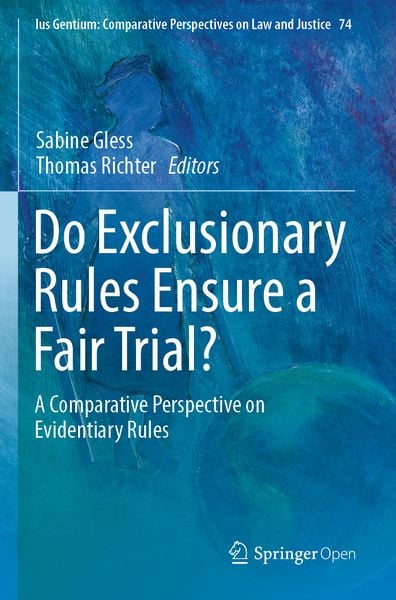
  • Produktbild: Do Exclusionary Rules Ensure a Fair Trial?
  • Produktbild: Do Exclusionary Rules Ensure a Fair Trial?
Band 74

Do Exclusionary Rules Ensure a Fair Trial? A Comparative Perspective on Evidentiary Rules

51,99 €

inkl. gesetzl. MwSt., Versandkostenfrei


Beschreibung

This open access publication discusses exclusionary rules in different criminal justice systems. It is based on the findings of a research project in comparative law with a focus on the question of whether or not a fair trial can be secured through evidence exclusion. 

Part I explains the legal framework...

Beschreibung

This open access publication discusses exclusionary rules in different criminal justice systems. It is based on the findings of a research project in comparative law with a focus on the question of whether or not a fair trial can be secured through evidence exclusion. 

Part I explains the legal framework in which exclusionary rules function in six legal systems: Germany, Switzerland, People’s Republic of China, Taiwan, Singapore, and the United States. Part II is dedicated to selected issues identified as crucial for the assessment of exclusionary rules. These chapters highlight the delicate balance of interests required in the exclusion of potentially relevant information from a criminal trial and discusses possible approaches to alleviate the legal hurdles involved.

Portrait


Dr. Sabine Gless
teaches criminal law, criminal procedure and international criminal law at the University of Basel, Switzerland. She has conducted extensive comparative research in the area of criminal procedure, with a focus on evidence law and international cooperation. In both areas, human rights and issues concerning the exclusion of evidence have been at the centre of her research interests. More recently she covers topics related to the use of robots in criminal justice systems. 
 
Dr. Thomas Richter
served as the head of the East Asian Department of the Max Planck Institute for Foreign and International Law in Freiburg, Germany. In this capacity, he analysed the criminal law and criminal procedure law of the PRC and co-directed a comparative study on non-prosecution policies in Germany and the PRC. Most recently, he assessed the Rule of Law Programme for Asia, initiated by the German Konrad Adenauer Foundation (2013). Hisresearch interests include criminal law, human rights law and environmental law in East and South-East Asia, especially in China.

Produktdetails

Einband

Taschenbuch

Erscheinungsdatum

14.08.2020

Abbildungen

XV, 380 p. 4 illus., 1 illus. in color.

Herausgeber Sabine Gless + weitere

Produktdetails

Einband

Taschenbuch

Erscheinungsdatum

14.08.2020

Abbildungen

XV, 380 p. 4 illus., 1 illus. in color.

Herausgeber
Verlag Springer
Seitenzahl

380

Maße (L/B/H)

23,5/15,5/2,2 cm

Gewicht

598 g

Auflage

1st ed. 2019

Sprache

Englisch

ISBN

978-3-030-12522-6

Herstelleradresse

Springer-Verlag KG
Sachsenplatz 4-6
1201 Wien
AT

Email: ProductSafety@springernature.com

Noch keine Bewertungen vorhanden

Verfassen Sie die erste Bewertung zu diesem Artikel

Helfen Sie anderen Kundinnen und Kunden durch Ihre Meinung.

Kundinnen und Kunden meinen

Bewertungen (0)

  • Produktbild: Do Exclusionary Rules Ensure a Fair Trial?
  • Produktbild: Do Exclusionary Rules Ensure a Fair Trial?

  • Part I: Comparative Perspectives.- Chapter 1. The Potential to Secure a Fair Trial Through Evidence Exclusion: A Swiss Perspective.- Chapter 2. The Potential to Secure a Fair Trial Through Evidence Exclusion: A German Perspective.-  Chapter 3. Regulating Interrogations and Excluding Confessions in the United States: Balancing Individual Rights and the Search for the Truth.- Chapter 4. The Potential to Secure a Fair Trial Through Evidence Exclusion: A Taiwanese Perspective.- Chapter 5. The Potential to Secure a Fair Trial Through Evidence Exclusion: A Chinese Perspective.- Chapter 6. Criminal Justice and the Exclusion of Incriminating Statements in Singapore.- Part II: Exclusionary Rules – quo vadis.- Chapter 7. The Purposes and Functions of Exclusionary Rules: A Comparative Overview.- Chapter 8. The Fair Trial Rationale for Excluding Wrongfully Obtained Evidence.- Chapter 9.  Exclusionary Rule of Illegal Evidence in China: Observation from Historical and Empirical Perspectives.- Chapter 10. Securing a Fair Trial Through Exclusionary Rules: Do Theory and Practice form a Well-balanced Whole?.- Chapter 11. Exclusionary Rules – Is It Time for Change?